This is the real enigma about Hungary's public finances


We learned already two weeks ago that the central budget was again in deficit in April. The ministry's statement now explains the causes.
When comparing the deficit figures with those from April last year, it is important to highlight one factor: this year, the way in which the vehicle tax is paid has changed. Instead of two instalments (by 15 March and 15 September) it had to be paid in one lump sum in April this year, so this item alone has added HUF 60 billion to the revenue side.
Let's stick to the revenue side of public finances, as this is where we see the most interesting developments. Payments by business organisations in the fourth month of the year were lower than at this time last year. More worryingly, however, VAT receipts grew by only 3.7% year-on-year in April, to over HUF 794 billion, up from HUF 766 billion last year.
We also looked at the factors behind the evolution of "net VAT receipts". It can be seen that gross VAT receipts have undershot last year's print in almost every month, and the normalisation (i.e. reduction) of reimbursements is shoring up the VAT receipts balance.
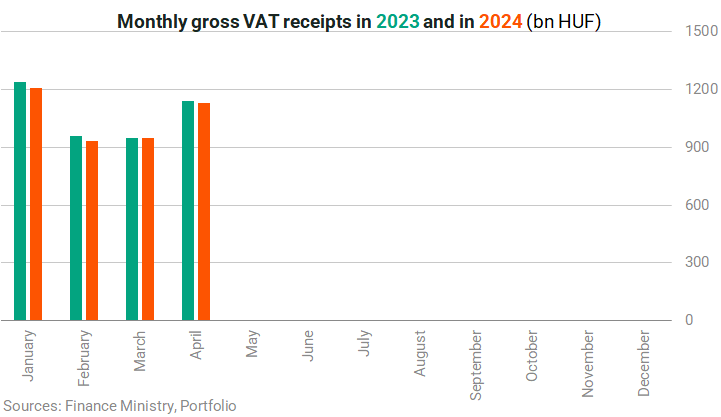
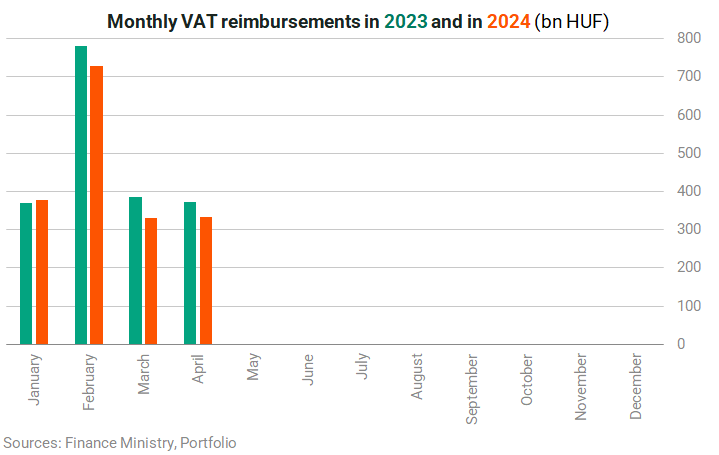
As a result, this year's total net VAT balance is just above the total for the first four months of 2023. This suggests that the fundamentals of the Hungarian economy are not yet in a position to support a balanced budget on all fronts, and that consumption is not yet in its best possible shape.

The situation, however, is different with personal income tax receipts and revenues from contributions. PIT receipts amounted to HUF 354 billion in April this year, up from HUF 308 billion last year, which corresponds to an annual increase of 14.8%. Meanwhile, contributions (calculated from the revenue side of the two social security funds) showed an increase of 18.1% in April.
In other words, while last year the real mystery was the evolution of VAT receipts, now it is perhaps why the gradual improvement in the income situation of the population (wage growth and the resulting increase in PIT receipts) has not yet been reflected in spending, i.e. in consumption and related VAT receipts. It seems that the population's sore wounds from last year's massive inflation are only slowly healing.
Taming spending also fails to beef up the budget
It is a rare sight in the budget that the expenditure side shrinks on a year/year basis, and this is what happened in April. In the central budget, there was a notable decline: the expenditure side of the budget was down from HUF 2,790 billion last year to HUF 2,444 billion. This is linked to several specific factors:
- the state spent HUF 90 billion less on public transport reimbursements;
- housing subsidies fell by HUF 41 billion compared to last year;
- and spending on EU programmes fell by HUF 220 billion;
- subsidies for public utilities (better known as the funding for the reduction of overheads) were down by HUF 90 billion this year.
Interest expenditure, at HUF 266 billion, was higher than in April last year, but only by 12%. This means that the decline in interest expenditure compared to last year has slowed down, but the balance for the first four months is still scary: the state budget spent HUF 875 billion on interest in January-April last year, while in the same period this year it spent almost twice as much, HUF 1500 billion.
However, the shrinkage on the expenditure side of the central budget was almost fully compensated by social security funds. The expenditure side of the Pension Insurance Fund increased by 21.2%, while the Health Insurance Fund grew by HUF 111 billion yr/yr in April. This is linked to the debt settlement of over HUF 60 billion paid to hospitals in April.
It also acts against the rebalancing of the budget that the government spends much more on public assets in 2024. In April alone, HUF 102 billion was spent on this, up from HUF 52 billion last year. In the first four months of the year, the government has spent HUF 663 billion on this, compared to HUF 475 billion last year. The Jan-Apr spending also exceeds the full-year target by 24%. This is certainly linked to recapitalisation deals related to the purchase of Budapest Airport.

Cover photo: Getty Images





