Hungary toll collection grows into a HUF 450 billion business


The revenue of the National Toll Payment Service Company (NÚSZ) increased significantly, by more than 15%, to HUF 445.1 billion in 2023 from HUF 386.6 billion in 2022.
The largest item in this is e-toll revenue (HUF 306.6 billion), i.e. the toll for lorries in proportion to the distance travelled, which increased by 8.7% compared to the previous year. Also significant is the e-vignette revenue of more than HUF 100 billion, 31.4% higher than in 2022.
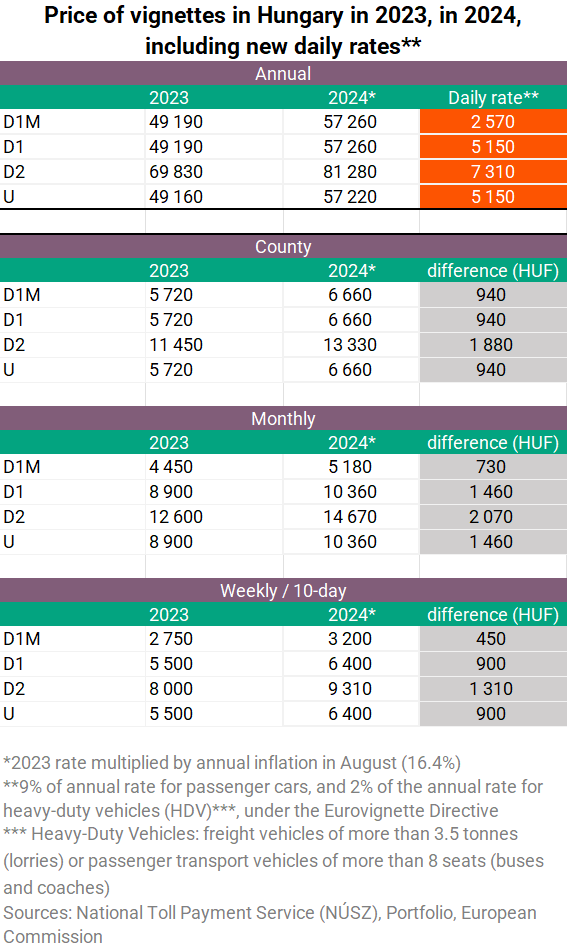
The reason behind the sharp increase - typically 40 to 70% - in the price of e-vignettes is that last year the state raised the price of vignettes, which are typically bought by foreigners. In contrast, annual and county sticker prices have risen by only 5% each. (The rule of thumb is that August inflation is the basis for next year's sticker increase, which was 15.6% in 2022).

These two huge items just 'pass through' the NÚSZ, the e-toll revenues are a source of revenue for the state budget, while the e-toll is used to cover the availability fee of MKIF Hungarian Concession Infrastructure Development Ltd.
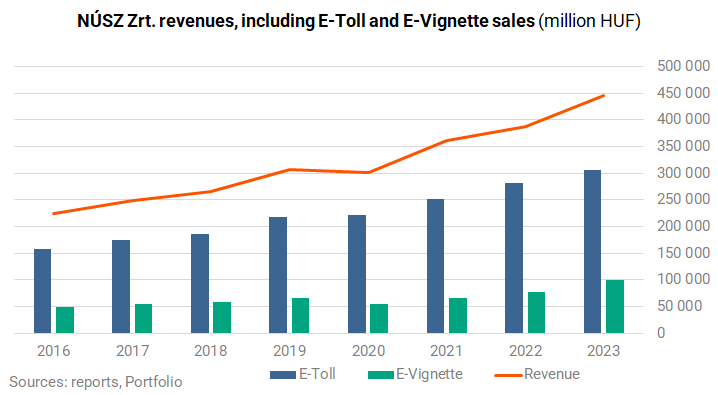
The revenue from e-toll sales itself was HUF 20.3 billion, and the turnover from e-vignette sales was HUF 14.7 billion, representing increases of 33% and 50%, respectively. The company also had revenues from axle weight measurement stations.
More and higher fines
Also flowing through the company is the revenue from fines, which last year amounted to HUF 10.5 billion, an increase of 22.7%, which the company explains both by the growing number of cases and the increase in the amount of penalties.
Wages
The number of employees in the company practically did not change (up at 641 from 639 in 2022), while the wage bill increased by 13.5%, which corresponded to the average wage increase for employees. This is lower than both 2022 and 2023 annual average inflation. Employees also received a SZÉP card allowance of HUF 546,000 and another HUF 104,000 based on a special decision.
The company's operating profit was close to HUF 1.5 billion, while its after-tax profit was HUF 216,000, which is practically break-even.
Many changes on Hungarian motorways in 2024
Compared to the 2023 management described by the above figures, much is changing this year:
- The one-day sticker, mainly for foreigners and transit passengers, has been available from 1 April at a price of HUF 5,150. This is a very poor price/value ratio compared to other stickers, but it is cheaper than the 10-day sticker, so it may reduce the revenue of the NÚSZ.
- As of 1 February, buses were exempted from the e-vignette system and got transferred to the e-toll system proportional to the distance travelled, as were lorries weighing more than 3.5 tonnes. This will generate extra revenue for the budget, as this calculation method is much more costly, but technically this move will actually reduce e-vignette revenue.
- In addition to the existing infrastructure (road) charge, an external cost charge has been introduced to compensate for the environmental burden, which could increase cash-flow revenue very significantly - according to NÚSZ estimates - by HUF 186 billion.
The total net premium revenue expectation for the 2024 budget is HUF 549 billion, a significant increase compared to 2023. The company expects net cash toll revenues of HUF 608 billion, which exceeds the base year by HUF 59 billion.
External cost charge
The calculation of the external-cost charge has been made more complicated. There are now two main components: air and noise pollution and carbon emissions, explained the Communications Director of NÚSZ at the end of last year. The air and noise pollution item will be further broken down into two components: the suburban toll and the element of the toll road linking municipalities (interurban). The classification depends on the proximity of the given road section to the settlement. To calculate the interurban factor, for example, if the suburban section is 0.251, then 1-0.251=0.749 for the interurban section. Unfortunately, the units of measurement have not made the calculation any easier, because the length of the toll road section is given in metres, but it has to be calculated in kilometres, so this has to be converted.
The calculation of the carbon dioxide emissions charge requires the number of axles and environmental classification of the vehicle. The draft regulation establishes 2,584 toll road sections. For example, in the J3 toll category, i.e. for three-axle vehicles subject to tolls, the infrastructure charge was set at 97.66 cents/km gross on motorways and 55.25 cents/km gross on trunk roads from 1 January.
Cover photo: Getty Images





