Depressing data published on Hungarian teenagers


Ágnes Németh, Senior Research Fellow at the Faculty of Pedagogy and Psychology of Eötvös Loránd University (ELTE), said that the HBSC survey has been conducted in accordance with international standards since 1986, with data collection taking place every four years, but due to methodological innovations, the data can only be compared from 2002.
The representative survey of students in 5th, 7th, 9th and 11th grade was conducted in a school setting, using a self-report method, and was last conducted between April and June 2022, with 197 schools, 331 classes and approximately 6,200 students.
Unhealthy eating habits on the rise
An analysis of eating habits shows that the proportion of adolescents eating breakfast regularly has been falling for years. 40% of girls and 60% of boys never eat breakfast on school days, and two-thirds of students eat breakfast both days at weekends in Hungary. There is a positive trend in the daily consumption of fruit and vegetables, but less than a third of young people do so.
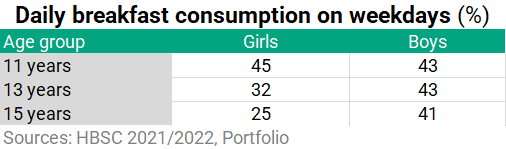
Overall, 51% of adolescents ate breakfast daily on weekdays. Gender differences were observed, with a higher proportion of boys (56%) than girls (46%) eating breakfast every day. Daily breakfast consumption ranged from 8% among 15-year-old girls in North Macedonia to 86% among 11-year-old boys in the Netherlands.
Daily breakfast consumption on weekdays decreased in more than half the countries and regions between 2018 and 2022. Girls, especially those in older age groups, were less likely to eat breakfast daily on weekdays.
Overall, fewer than two in five adolescents (38%) eat fruit or vegetables daily, with these figures declining with age (from 45% of 11-year-olds to 33% of 15-year-olds for fruit, and from 40% to 36% for vegetables). Worryingly, more than half of adolescents report eating neither fruit nor vegetables every day (56% of boys and 51% of girls aged 15).
The following tables show data for Hungary:
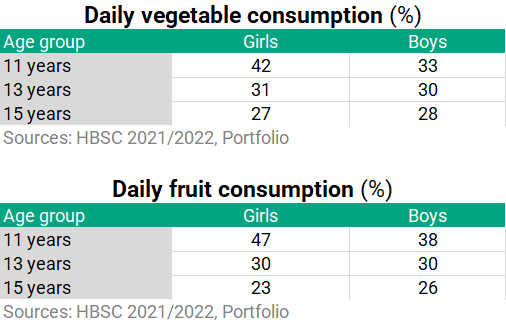
Eating a healthy, balanced diet during childhood and adolescence also promotes healthy growth and development. Numerous factors influence adolescents’ food choices, including individual, familial, school, environmental and commercial. Regular breakfast consumption is an indicator of healthy eating habits. It is associated with a healthier body mass index (BMI), better mental health, higher intakes of micronutrients, improved cognitive/school performance and overall better diet quality. WHO recommends eating at least five portions of fruit and vegetables per day and reducing the consumption of free sugars to less than 10% of daily energy uptake. (Source: HBSC report from the 2021/2022 survey)
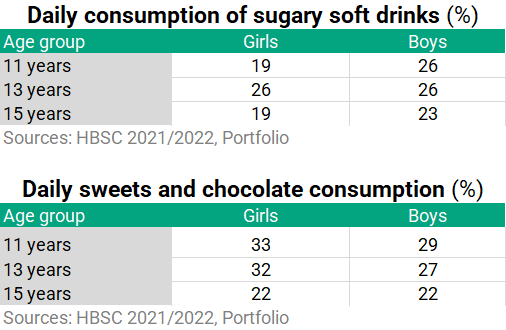
Fewer Hungarian children in the above age groups consume foods and drinks with high sugar content, and the proportion of young people who are physically active has started to increase slowly, but the number of overweight people is still rising, Ágnes Németh said.
Body image versus reality
Overall, girls tend to think they are fat in much greater proportion than boys. However, the body image generally does not match reality - unsurprisingly. By and large, girls have low self-esteem in this respect, while boys are more forgiving with how much extra weight they carry.
In Hungary, 37% of 11-year-old girls think they are fat, while only 22% are actually overweight. While 25% of 11-year-old boys think they are overweight, 34% of them actually are. Among 13-year-olds, 45% of girls think they are fat, but in reality only 21% of them are overweight or obese. 33% of boys think the same and 37% are actually overweight or obese so this is almost a match. While 46% of 15-year-old girls see themselves overweight, only 20% of them actually are. In this age group, 27% of boys think they are fat, and 30% are overweight or obese.

Overall, the consumption of sweets and sugary drinks remains high, with one in four adolescents (25%) reporting daily consumption of sweets or chocolate. This rate is higher among girls (28%) than boys (23%) and has seen an increase since 2018, particularly among girls (from 23% to 27% for 11-year-old girls and from 26% to 28% for 15-year-old girls). While daily soft drink consumption has seen a minor overall decline since the last survey in 2018, it still stands at 15% of adolescents, with higher rates among boys (16% vs 14% for girls) and those from less affluent families.
When asked about how often they brush their teeth, 95% of Hungarian respondents said they brush every day, but the proportion who brush more than once a day has been between 60 and 65% for decades.
Physical inactivity: a cause for concern
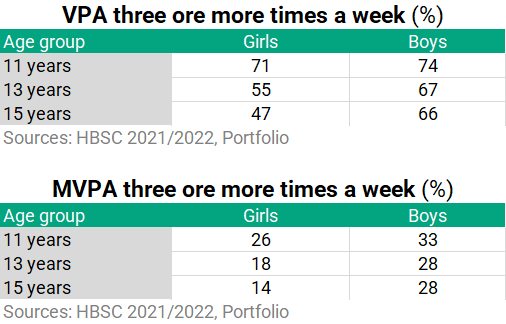
The World Health Organisation (WHO) recommends that young people get at least an average of 60 minutes of moderate to vigorous physical activity (MVPA) per day. The report shows that overall, only 25% of boys and 15% of girls achieve 60 minutes of MVPA daily, with participation declining with age, particularly among girls (24% of 11-year-old girls vs. 13% of 15-year-old girls).
While 60% of adolescents meet the WHO recommendation for vigorous physical activity (VPA) at least three times a week, this rate is lower among girls (51%) compared to boys (69%). This gender gap widens with age, with 65% of 11-year-old girls meeting the recommendation compared to just 46% of 15-year-old girls.
Key findings show that (i) overall, nearly three fifths of adolescents met the WHO recommendation for vigorous physical activity (VPA) of at least three times a week; (ii) both MVPA and VPA decreased with age, with the decline being more pronounced in girls than in boys; (iii) on average, around one in four adolescents were found to be highly inactive, and rates of 0–2 days of MVPA increased with age; (iv) adolescents from low-affluence families were less likely to participate in MVPA and VPA.
In Hungary, around a third of students spend almost all of their free time being sedentary (mainly using screens), but they sleep little on weekdays, averaging 7.5 hours. The results also show that average sleep time has fallen significantly over the last eight years, said the head of research.
The survey found that adolescents in Hungary were positive about their relationships with family and friends, and rated communication with their parents as good. According to Dóra Várnai, psychologist and member of the research team, the survey showed that two thirds of students in the age groups surveyed live with both parents, while one fifth of students live in a single-parent family. The two-child family model is the most common, at 40%.
The survey also shows that the educational attainment of parents and the wealth of the family is improving, but nearly 30% of pupils' families fall into the low-affluence category. Dóra Várnai added that the question was not about the parents' earnings, but about the existence of assets (such as unshared bedroom, family car(s), computer(s), holiday(s) abroad), according to an international protocol, i.e. the Family Affluence Scale (FAS).
The survey found that while the majority of children enjoy high levels of family support and three quarters of pupils like their school, the proportion of pupils who find school work very overwhelming has increased significantly, to 11.6% in 2022 from 6.1% in 2002 .
According to research, rates of substance use have been stagnating. The most common is marijuana use, with around 17% of secondary school students saying they had tried the drug.
Among the health risk behaviours, smoking and alcohol consumption rates have again shown an increase over the last four years, in contrast to previous trends. Around one in six students smoke at least weekly and four in ten have been drunk. The number of people who have tried electronic cigarettes is more than a third, the survey found.
The survey also asked how children perceive their own health. The proportion of pupils rating their health as excellent fell by more than 10% between 2002 and 2022, and has never been lower than in 2022 (19%).
More than half of schoolchildren experience two or more psychosomatic symptoms on at least a weekly basis, the research found. One in ten pupils suffer bullying at school from their peers and 20% of pupils have been bullied online at least once.
In international comparisons, Hungarian young people are below average in eating habits and obesity, smoking and alcohol consumption, online bullying, self-assessed health and the prevalence of certain psychosomatic symptoms, but around average in physical activity and marijuana use, for example. However, they were more positive than the international average in their assessment of their social relationships, the research found.
Cover photo: Getty Images





