Will Hungary's Orbán cabinet actually come up with an adjustment package?


Something in the air
Hungary dodged the bullet in early summer when none of the three major credit rating downgraded either the country’s ratings or rating outlook.
The wait-and-see attitude owes to the fact that they mostly
expect the cabinet to table a new fiscal consolidation package before the end of the year.
This was essentially what S&P said in April and what Fitch noted in mid-June.
2024 slippage
Analysts agree that it will be extremely difficult to meet even the upwardly revised 4.5% of GDP deficit target this year, even with HUF 675 billion worth of public investment projects temporarily shelved.
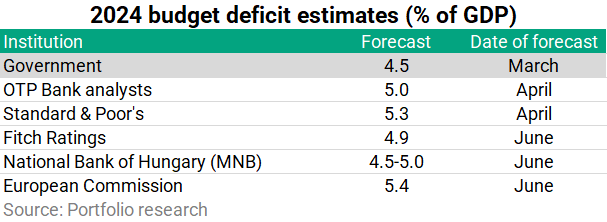
As regards this year's budget, it is important to note that its in-year performance is extremely difficult to evaluate, as the government has only formally revised the headline cash deficit figure, but not the amounts of the main expenditure and revenue estimates (when it last revised downwardly its GDP growth expectations to 2.5% from 4.0%in the already adopted budget, and raised the deficit target to 4.5% from the 2.9% it had nodded on). Therefore, we are unable to compare the monthly detailed expenditure and revenue data with the government's updated expectations, as these are not publicly available. It is no coincidence that the quality of Hungarian fiscal policy is disappointing by international standards and is getting worse.
It is difficult to judge exactly how the 2024 budget actually compares to the government's expectations after the first six months, but the above suggests that the slippage this year could be somewhere around HUF 700-800 billion.
There are positive risks (if GDP grows by more than 2.5% and if household consumption picks up and generates greater VAT receipts), and negative risks (ad hoc events such as the consolidation of hospital debts or health expenditures overshooting the budgeted amount).
Possible measures, including tax hikes
Fundamentally, the cabinet can tackle this problem three ways:
- It deals with the fiscal slippage already this year, with an announcement to be made as soon as possible in order to achieve the adjustment impact in the shortest time possible. The odds of this happening is slim to none.
- It will not be concerned at all about the slippage because it is confident that a) it will be insignificant (in the eyes of market participants, financing investors and credit rating agencies) and it can still show a declining deficit trajectory after the 6.7% shortfall posted in 2023, with deficit possibly above 5% b) it is playing the long(ish) game, hoping that the economic environment will improve and facilitate a faster fiscal recovery this year c) a combination of the two. This is the second most likely scenario.
- In our view, the most likely scenario is that the government keeps its promise to the credit rating agencies, i.e. it puts a fiscal consolidation package on the table this year, but it will not cover the year 2024, but mostly the 2025 budget, the drafting of which has been officially postponed to November.
2025 outlook
The fiscal situation next year will be simultaneously better and worse than in 2024. On the plus side, economic growth will be larger and a greater nominal GDP will prop up every indicator where GDP is the denominator. Interest expenditures will drop by about 1% of GDP.
On the negative side, the cabinet pledged to lower special taxes next year, and the elections coming up in the spring of 2026 could already urge the cabinet to start opening the purse strings. There’s the EU’s latest financial penalty of some HUF 80 billion, the financing need of investments put off from this year and a lower deficit target (3.7% after this year’s 4.5%).
Overall, it looks likely that the government will need some tidying up to do in the budget next year too.
Accepting the assumption that fiscal adjustment is just a matter of time, the key question is
whether the cabinet will reduce expenditures or raise revenues this autumn.
The government's track record suggests that the adjustment package will be centred around two kinds of measures.
Sectoral taxes
Firstly, the cabinet will heavily rely on special sectoral taxes. In practice, this could mean that - and this is the lesser evil - some extra money could be collected this year from the sectors that have been hit by the windfall profit tax over the past two years. The real kick in the gut could come only next year, though, if the cabinet once again goes back on its word and the 'extra profit taxes' will not be phased out completely even in 2025.
This was effectively suggested by Economy Minister Márton Nagy a couple of weeks ago when he said that "although we have said that the extra profit tax could be phased out by 2025, I can still see extra profit in certain sectors personally."
Asked in which sectors it might be justified to maintain an windfall profit tax, he said, "it's very simple that in the banking sector you always see this issue, but I don't want to make an example."
In several of our articles, we have looked at how the sectors singled out by the government for a special tax performed in the last financial year, including the record profits of the banking sector and the background to them, and the booming retail sector.
We wouldn't be surprised if the government looked to these sectors first when looking for extra budgetary resources.
If only because there is speculation after Viktor Orbán's radio interview a week ago that the government will use the EU fine as an excuse to collect extra taxes from certain sectors that the government considers "winners of [the Russia-Ukraine] war and migration".
Orbán said that after Fidesz won the EP elections on 9 June, "Hungary was punished with a migration fine". He said that he sees solutions to
make those who benefit from migration and war pay this fine, and that the legal framework for this is already in place.
It will be interesting to see how the government will justify the extra taxes, what technical solution it will use, whether the package will come in the form of government decrees or tax laws, and how it will affect the population (price increases, inflationary impact).
Putting off investment
Another possible tool for the government is to postpone investments, i.e. to keep putting off state development projects, as it has been doing since 2022. The government has made previous years soft in this respect, which means that if these deferred investments were to fall back on the books, it would push up the budget's investment spending to a particularly high level.
It is more likely that there will be investment projects "revived" from their temporary stupor while others will be put off to offset the impact. This way the volume of public development may remain at a lower level. This is also politically convenient, as the further ahead in time we go, the fewer concrete investment plans there are, and therefore less spectacular their postponement.
Not a 100 meter dash
It also follows from this line of thinking that it is very likely that the government will try to sell a medium-term budget plan (up to 2-3 years) to investors, credit rating agencies and even the Fiscal Council in the autumn.
In this respect, the 2024 budget should not be seen in isolation, because it is very much linked to the 2025 and 2026 budgets.
There are processes in the economy (lower interest expenditure, lower energy support spending, uncertainty over EU funds, inflation-linked expenditure, delayed payments for postponed investments) that can affect the budgetary position positively or negatively over several years.
Therefore, the government may even communicate this by consolidating the new deficit trajectory with new measures aimed at getting close to the 3% deficit target at some point.
A lot depends on the credibility of the medium-term plan, including the measures to stabilise the balance, i.e. the government simultaneously has to
- maintain the confidence of sovereign bond investors and financiers who are sensitive to both the high refinancing rate and the rising foreign currency debt ratio,
- reassure international credit rating agencies concerned about rising public debt getting stuck at high levels, as well as
- allay the Fiscal Council's doubts about stalled deficit reduction and manage expectations stemming from the excessive deficit procedure.
But it is also rational for the government to look ahead three years. Firstly, it can make the above actors believe that it takes fiscal stability seriously. Secondly, it would build up a reserve for the second half of 2025.
As the 2026 parliamentary elections approach, the government's instinct to start spending heavily may kick in, leading to a looser fiscal policy (see, for example, the personal income tax refund announced in June 2021, ahead of the 2022 elections).
The first calls for a more supportive and stimulating role for the state have already emerged from the business community. And its seems the cabinet has listened, although the dire state of the budget makes it questionable that the stimulus measures announced today could be of meaningful size.
The effective limit to government policies that support growth, stimulate the economy and directly help families may not even be the deficit. Indeed, in recent years the state has been able to finance itself easily, even at a high cost (interest expenditure as a share of GDP reached 4.7% last year).
This snowball effect is reflected in the public debt. In the first quarter of this year, Hungary's debt-to-GDP ratio rose to a two-year high. Clearly, the country is unable to overcome the debt accumulation of the Covid crisis and the war crisis. The European Commission, for example, projected in its country report that Hungary's debt-to-GDP ratio would rise to 74.3% this year from 73.5% at the end of last year, and the outlook for the future is not rosy, either.

So overall, the government will be giving with one hand and taking away with the other in the coming years, and the public debt ratio will play a key role in this.
Cover photo: Getty Images





