Banks in Hungary get daunting message, may start reassessment of special taxes


In several of our articles, we have argued that the government is not in an easy position because of the budget. In our latest article, we showed that some analysts, experts and rating agencies expect the government to present a consolidation package. The size of this package is not small, it could amount to several hundred billion forints, especially in the year 2025.
The size of the package, i.e. the adjustment, is further increased by the fact that there will be parliamentary elections in 2026, for which the government can prepare with stimulus measures that directly support consumption (family allowances, targeted programmes, tax credits and exemptions).
And based on past experience, the rational behaviour of market participants is to immediately think that the government will balance the budget by raising taxes, and to base its adjustment and increase its room for manoeuvre on raising special taxes.
On the other side, i.e. among the representatives of the sectors affected by special levies and windfall profit taxes, we believe that this requires a recalculation, as a new scenario is added to the two existing ones.
In our view, so far there has been
- a positive (lower probability) scenario, in which the sectors concerned could expect the government to keep its promise made last year and fully phase out the extra profit tax originally reserved for two years (2022-23) and then for an extra year (2024) by 2025; and
- a more realistic baseline scenario, in which companies bearing the extra burden could expect the windfall tax burden not to decrease.
At the Portfolio Lending 2024 conference we have surveyed the attendees what they believed would happen to the windfall tax and the result speaks volumes:
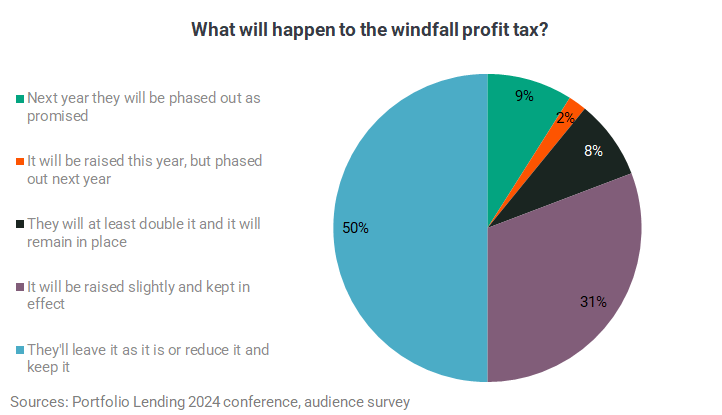
The need for fiscal adjustment, the government's predicament, is creating a new situation, which is also exacerbated by the consequences of the EU's excessive deficit procedure. We would not be surprised if in the near future, in addition to the two scenarios described above, a third scenario (relatively likely) were to emerge, involving a substantial increase in the special tax burden on the sectors concerned (mainly the banking and retail sectors).
The chances of this scenario were reinforced by an article today from Máté Lóga, a State Secretary at the Ministry of National Economy, in which he wrote that banks have only partially met the government's expectations, and that "there are risks associated with the fulfilment" of the cabinet's requirement.
He said that the banking system was able to make extra profits between June 2023, i.e. the date when the halving of the extra profit tax was announced, and June 2024 by defying a clear government mandate to increase their government security holdings and instead largely just restructuring their portfolios of government securities in a bid to meet the condition for the halving of the bank tax.
However, he also noted that there are several smaller institutions that have fully met the government's expectations. Having said all this, the Secretary of State anticipates:
However, he also noted that there are several smaller institutions that have fully met the government's expectations. Having said all this, the state secretary noted that
it is unfair to expect the government to allow a sector in an outstandingly high profitability position to earn extra income without saying anything, partly in disregard of government intent.
After all this, and based on the adjustment track record of previous years, the easiest and simplest way for the government to find hundreds of billions of forints somewhere is to raise the special tax burden.
On the other hand, this may have negative implications for external observers of the Hungarian economy and budget, such as credit rating agencies or the European Commission.
It is also worth recalling how this special tax burden is distributed among the representatives of the banking sector.
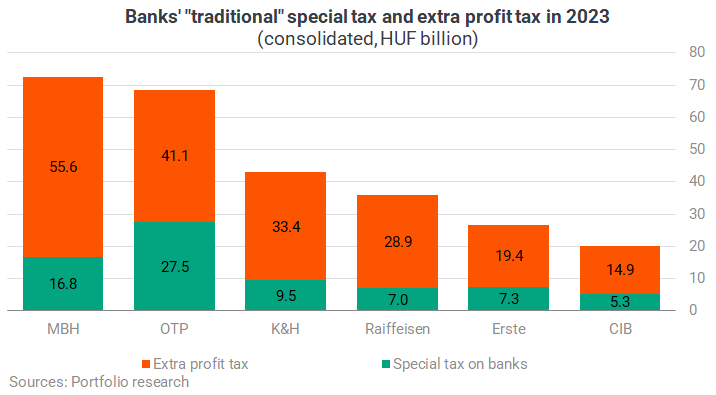
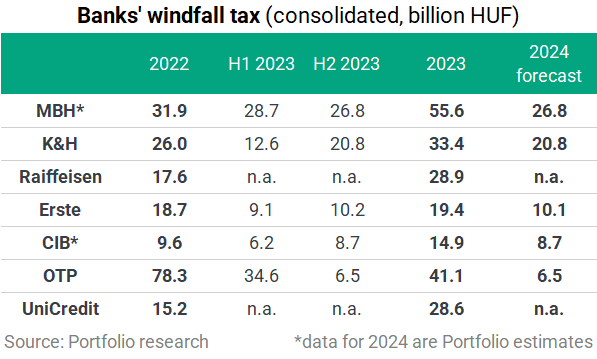
This issue will be decided by November at the latest, when the public part of the autumn planning process for the 2025 budget will start. It will therefore be worth monitoring the coming months to see what further messages the government, including the relevant Ministry of National Economy, will send to the sectors concerned.
Cover photo: MTI Photo/Prime Minister's Press Office/Vivien Cher Benko





