Hungarian gov't looks into flight delays, cancellations


Investigations afoot
Bence Tuzson has ordered another eight investigations into the extreme delays and cancellations experienced in recent days, bringing the total number of investigations to eleven. The procedures currently under way concern flights operated by Ryanair and Wizz Air.
Airlines are "stretching" their own schedules so much that a morning flight delay can result in a delay of several hours by the end of the day. This is a particular challenge for airport operators, who are also the victims of "overstretched, ill-considered" schedules.
According to the statement, the consumer protection authority will investigate whether, in the circumstances and under the conditions set out in the so-called EC Regulation on air passenger rights, air carriers provided written information to passengers at the airport, and if necessary, offered rebooking or refunds.
Wizz Air blames weather, traffic control authorities
On 28 June, low-cost carrier Wizz Air issued a statement saying that the
European airspace has been severely impacted due to airport slot management issues caused by multiple, simultaneous weather events occurring throughout Europe.
"These events have impaired the capabilities of air traffic control authorities and Eurocontrol to manage industry-wide traffic volumes, leading to major delays and cancellations across the European airline industry. These events have affected Wizz Air’s operations, as well as other airlines’ operations, across Europe," it added.
Wizz Air apologised for the inconvenience, stressing that
this issue is out of our control.
The airline "strongly advised" passengers to book directly on its website or app to ensure timely schedule updates and direct customer assistance. "In case passengers have bookings with online travel agencies (OTAs) and other third parties, they should check the status of their flight and request changes as necessary through the respective OTAs."
In the meantime, Wizz Air continues to battle brutal delays. Wizz passengers missed their flight in Cyprus after a 6-hour delay due to lack of information, and other passengers were stranded in Catania for no less than two days.
Wizz Air is currently dealing with problems of the Pratt & Whitney engines because of which lots of their planes are grounded, and they must wet-lease aircraft.
Trade union chief pleads for better working conditions
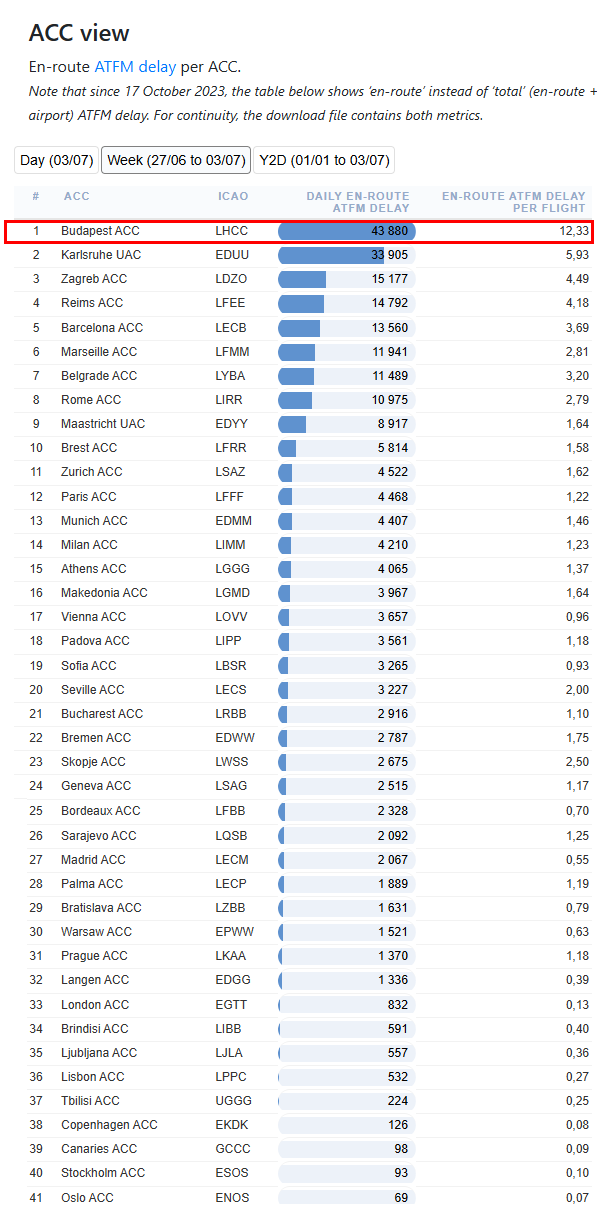
Daniel Liebhart, head of the aviation department of Austrian trade union vida and employed as a traffic controller, has appealed to the Hungarian government to finally pave the way for better working conditions for the Hungarian air traffic controllers of HungaroControl.
Due to the Hungarian government's negative attitude towards social dialogue with trade unions and employees, as well as various legislative measures, the conditions for colleagues in our neighbouring country have continued to deteriorate in recent years,
he wrote on vida's site.
He added that
the staff of the Hungarian service provider suffer in a toxic corporate environment, leave HungaroControl to work in another country, or give up the profession altogether.
"The state air traffic control is unable to meet the minimum expectations of the workforce in terms of social standards and pay," he said.
Liebhart also claims HungaroControl is largely to blame for the flight delays in Europe, but he also mentioned Wizz Air as a culprit.
Especially in the context of its EU presidency, the Hungarian state is faced with the important task of establishing a functioning social dialogue not only at its air traffic control company HungaroControl, but also at the Hungarian airline Wizz Air in order to improve the working conditions of its employees, vida said in a statement.
"In the past, Wizz Air has repeatedly boycotted and publicly discredited the establishment of such a dialogue as well as company co-determination and union organization. Such practices only promote wage and social dumping in the European aviation industry and thus also have a negative impact on the Austrian sector," criticizes Daniel Liebhart.
It is urgently necessary for the Hungarian government to take measures to ensure fair and just working conditions in the aviation industry.
"This is not only a question of justice for employees, but also one of responsibility towards European partners and an essential aspect of air traffic safety," Liebhart pointed out.
"The Hungarian government has a duty to take action against such abuses and improve working conditions," he concluded.
Right to care
Passengers shall be offered free of charge:
- (a) meals and refreshments in a reasonable relation to the waiting time;
- (b) hotel accommodation in cases
- where a stay of one or more nights becomes necessary, or
- where a stay additional to that intended by the passenger becomes necessary;
- (c) transport between the airport and place of accommodation (hotel or other).
- In addition, passengers shall be offered free of charge two telephone calls, telex or fax messages, or e-mails.
Right compensation
In addition to the above, passengers are also entitled to a flat-rate compensation of €250, €400 or €600 depending on the distance.
The Ministry of Justice has published on its website a short information sheet on the rights of air passengers in the event of delays or cancellations.

The compensation referred in the above table shall be paid in cash, by electronic bank transfer, bank orders or bank cheques or, with the signed agreement of the passenger, in travel vouchers and/or other services.
When passengers are offered re-routing to their final destination on an alternative flight, the arrival time of which does not exceed the scheduled arrival time of the flight originally booked
- (a) by two hours, in respect of all flights of 1500 kilometres or less; or
- (b) by three hours, in respect of all intra-Community flights of more than 1500 kilometres and for all other flights between 1500 and 3500 kilometres; or
- (c) by four hours, in respect of all flights not falling under (a) or (b),
the operating air carrier may reduce the compensation by 50%.
Upgrading and downgrading
- If an operating air carrier places a passenger in a class higher than that for which the ticket was purchased, it may not request any supplementary payment.
- If an operating air carrier places a passenger in a class lower than that for which the ticket was purchased, it shall within seven days, by the means listed above, reimburse
- (a) 30% of the price of the ticket for all flights of 1500 kilometres or less, or
- (b) 50% of the price of the ticket for all intra-Community flights of more than 1500 kilometres, except flights between the European territory of the Member States and the French overseas departments, and for all other flights between 1500 and 3500 kilometres, or
- (c) 75% of the price of the ticket for all flights not falling under (a) or (b), including flights between the European territory of the Member States and the French overseas departments.
You can read about EU air passenger rights here and find the relevant legislation here.
Cover photo: Portfolio





