Hungary's external trade balance on a slippery slope despite the still high figures


The increase of €1,146 million was the result of imports shrinking by 9.8% and imports by 8.8% (in EUR terms) compared to a year earlier. Accordingly, the balance is very similar to a year earlier (€1,219 million). What is new in this latest figure is that this is the first time in 17 months that the surplus is below that of a year earlier. As a result, the sharply improving trend in the trade balance has stalled.
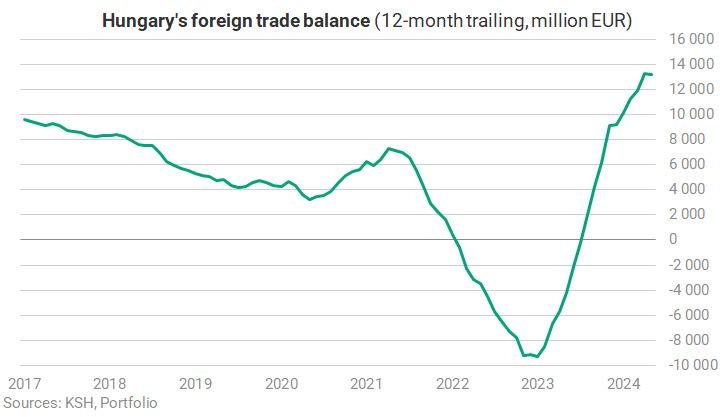
A slowdown in the growth of the surplus was to be expected, as last year May-June was a strong period for external trade, with very large monthly surpluses. Therefore, the annual surplus is unlikely to increase further in June.
The reason for the high surplus is no longer the fall in energy prices. Of course, this was part of the reason why the external trade balance turned into a large surplus, but it did not contribute to the recent improvement to historical highs.
The primary reason for the increase in the surplus is the contraction in imports, but this is not the result of cheaper gas imports, but of falling imports for consumption and investment. This is painful because it suggests that the Hungarian economy is still not showing any spectacular dynamism.
Experts at the National Bank of Hungary (MNB) believe that, in addition to slow growth in consumption, investment may be primarily responsible for the economy's low import demand. (By the way, retail sales data also released today suggest that the recovery in household consumption is not particularly dynamic either.)

The import effect is so strong that the trade balance can improve even as exports suffer. This is the other sad part of today's external trade statistics: export performance is very modest due to the sluggishness of the external conjuncture (Industrial production data also released today showed a similar overall picture.)
So, overall, the nice figures for the trade balance are being achieved with a month-on-month decline in external trade, which is a sign of weak economic activity. It is therefore necessary to assess a very contrasting outlook for the future.
If external demand finds its way ahead of internal demand, the trade surplus could even increase further through a pick-up in exports (and with them re-export imports). If, on the other hand, household consumption starts to pick up more spectacularly, imports could surge and this could start to deflate the balance from where it is - there is room for that now.
Cover photo: Getty Images





