Hungarian gov't fires its special tax weapon- Who will be really paying the heavy price?


The invisible cash cow
Technically, banks have been paying the transaction tax for more than 10 years, but the burden is passed on mainly corporate and, to a lesser extent, retail banking customers. In 2019, it was revealed that less than a quarter of total transaction tax revenue, around 22%, comes from retail customers, with the rest coming from corporate transactions.
Since then, it has been suggested from time to time that the levy should be reduced or amended, but the government is reluctant to touch the almost invisible cash cow that is grazing almost invisibly, but still giving 'milk' worth hundreds of billions of forints annually.
Specifics of the raise
For those transactions that have already been subject to transaction tax, the tax will change from 1 August:
- in general cases (including securities transactions), the levy will be raised to 0.45% from 0.3%, with a maximum of HUF 20,000 per payment transaction (up from HUF 10,000);
- the financial transaction tax on cash withdrawals will go up to 0.9% from 0.6%.
In other words, the burden of the normal transaction tax will increase by one and a half times, and it will double for larger transactions, as the upper limit will rise to HUF 20,000 from HUF 10,000.
From 1 October, there will also be an additional levy on transactions involving a conversion, on top of the current transaction tax:
- if a transaction involves a conversion between different currencies (including currency swaps), the transaction is subject to a 0.45% higher transaction tax, with a HUF 20,000 cap. In other words, the levy will increase to 0.9% from 0.3% for transactions involving a currency conversion.
It is worth noting that physical currency exchange was already subject to the transaction tax, which will increase to the general level of 0.45%.
As a result of the above, the upper (double) limits will be adjusted as follows: the limit to reach the 10,000 duty cap was previously HUF 3.333, but now it will be HUF 4.444 million for strictly forint transactions and HUF 2.222 million for those including currency conversions.
How much it will milk then?
The government expects HUF 85 billion from the hike to the general FTT and HUF 7 billion from the additional conversion levy in 2024. The latter is estimate to reach HUF 30 billion in 2025. For 2024, the government expected revenue of HUF 348 billion previously, and HUF 440 billion after the tax increases.
In 2025, including the additional conversion levy, the higher general FTT and the higher caps, and assuming that the previous year's cash flow growth continues,
we estimate that a little over HUF 600 billion could flow into state coffers from transaction taxes in 2025.
The government and the banking sector have different interpretations of how good a year the financial institutions had last year, but the fact is that cash revenues are growing nicely, and even after deducting the transaction tax, the banks still have some left.
In 2023, banks' full-year cash income (transfer fees, card fees, account management fees, etc.) exceeded HUF 840 billion, of which HUF 333 billion was paid in transaction fees, leaving them with roughly HUF 507 billion in revenue net of the levy.
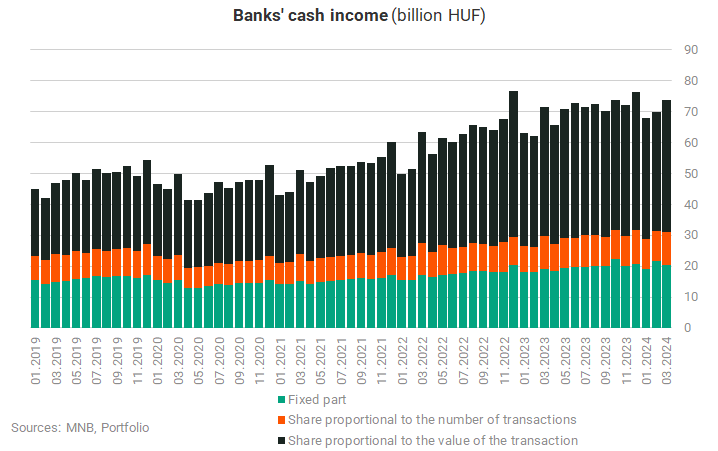
There are also plenty of development and operational costs for banks, just think of the Instant Payment System. But it's also worth bearing in mind that industry experts cash flow is increasingly a core service for banks, rather than a profit centre.
How's going to foot the bill and for how long?
The issue of passing on the increased burden is a tough one. The government insists that banks, as a response to the FTT-related measures, are forbidden to raise fees or abolish discounts for retail customers until the end of this year.
This, according to a source familiar with cash flows, effectively prevents banks from passing on fees in the segment for the time being. Although the bank may increase the price of other services, competition will limit this.
All that can be said about 2024 is that the retail share (about 20%) of this year's HUF 92 billion levy payment is likely to be borne by the banks, while the corporate share is likely to be passed on.
It is also clear as day that
banks will pass on the fee to retail customers after the end of the moratorium, and they have every right to do so: the reasons for the fee increases include the change in legislation.
But it is not so certain that the ban will only remain in place until the end of the year. As we have seen before, the government may well not let go of retail customers' hands for years, or at least until the general election in 2026.
The government has increased the exemption from transaction fees for retail transfers to HUF 50,000 from HUF 20,000, as the central bank (MNB) has already proposed. Regulators will also have to make sure that banks pass on not just the burden but also the gains to the public. Since they can change the charges to the benefit of the customer, they will not have to wait until the end of the year to do so.
How much more will currency exchange cost?
Contrary to the general rules, the conversion surcharge also applies to currency exchanges between own accounts. So, for example, the exchange of multicurrency accounts with Revolut, Wise or domestic banks competing with them in the field will also be subject to a 0.45% fee, up to a maximum of HUF 20,000.
However, Minister of National Economy Márton Nagy said yesterday that if Revolut and Wise carry out the conversion to retail customers at the middle rate, they would not have to pay the increased fee.
If there is such a rule, it will obviously also apply to banks. Until these details are finalised, we do not know how these services might become more expensive, but remarks made yesterday suggest that this will mainly be a tax on corporate foreign exchange transactions. This will almost certainly become clear by the end of the year, before the expire of the pass-on ban.
Possible impacts
There is no way of knowing what would have happened if the transaction tax had never been introduced, but industry experts believe that its mere existence has not significantly set back the digital transition in payments. Everyone is used to the banks (in fact the state) getting their share of the money transferred by the public, and the hike announced now will not drive bank customers back to using cash to any appreciable extent.
However, it is almost certain that sooner or later the impact of the tax increase will be felt on the retail side, and that businesses will face extra costs already this year.
Cover photo (illustration): Getty Images





