Hungary plans to deploy soldiers to help alleviate burden on air traffic control


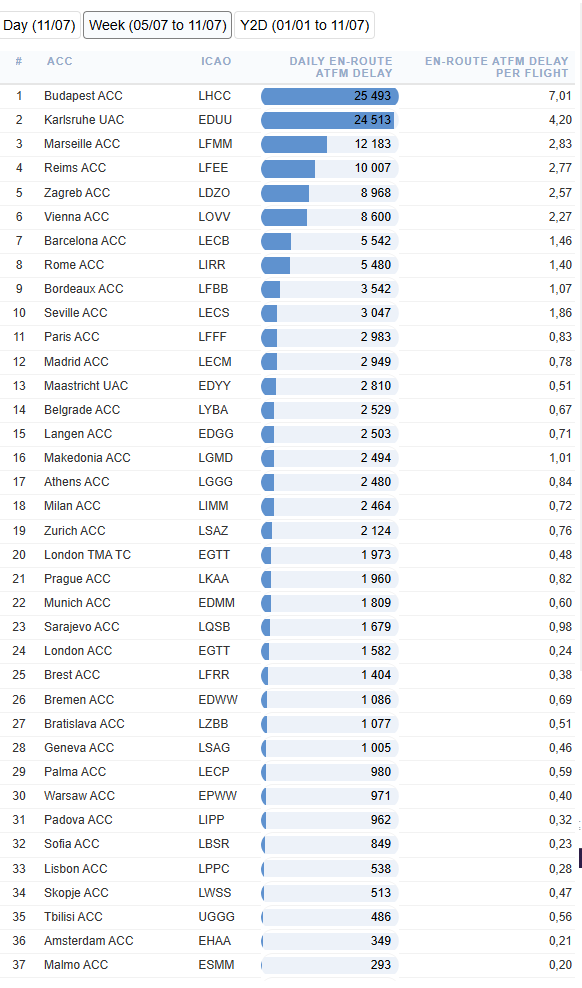
In the summer of 2024, significant delays in European airspace became extremely frequent, and Budapest airport was also heavily affected. Gergely Gulyás, Prime Minister Viktor Orbán's chief of staff, blamed both airlines and air traffic control for the possible causes.
HungaroControl, which coordinates Hungarian airspace, has also been implicated, as it is alleged that the conditions at the service are inadequate and that there is a serious staff shortage. Gulyás said that they had already increased the number of staff in the past, but this had not sufficiently solved the problems.
HVG reached an anonymous source with knowledge of the industry who backed up the reasons given for the problematic situation by actual figures.
He said that up to 4,000 aircraft a day could pass over Hungary in July. To put this into context, HungaroControl says on its website that Hungarian air traffic controllers control an average of 600,000 flights a year, with a plane entering Hungarian airspace every 30-40 seconds during busy periods, averaging 1,700 flights a day. The record was 3,527 aircraft in one day.
The domestic airspace is divided into a total of eight sectors, which means that 12 to 16 planes can pass through a sector at any one time, and 40 to 60 per hour.
However, due to congestion, HungaroControl may only be able to keep six sectors open instead of eight.
HungaroControl says that in addition to the significant capacity expansions by airlines, the airspace closure due to the Russian-Ukrainian war has played a major role in this extreme increase.
The exceptional situation that has developed across Europe in recent months poses complex challenges for all players in the aviation industry. Increasingly extreme and frequent storm chains due to climate change have caused significant delays and flight cancellations across Europe,
said HungaroControl in a statement earlier this month.
Flight delays are not a Hungarian phenomenon; they are also common in Europe for the reasons mentioned above, it stressed.
The problematic situation is well illustrated by the fact that the current volume is 25-30% higher than before the coronavirus pandemic, while the number of staff has increased from 179 to 185 (+3.4%) in the same period.
The article adds that, despite the high wages in Hungary, many people choose to emigrate because they can earn even higher wages as air traffic controllers abroad.
The problem has not escaped the attention of the Hungarian government, so they have been working on a possible solution. The Ministry of Defence suggested that staff shortage could be solved with voluntary reserve soldiers.
A draft ministerial decree on the idea was adopted in May, according to which, following the amendment, volunteer reserve air traffic controllers would be considered as professional staff, including volunteer reserve tower controllers, approach controllers, and area controllers, as well as volunteer reserve trainee air traffic controllers.
ApproachController isa person that provides air traffic control for departing and arriving flights. They are the link between the tower controllers and the area controllers.
Area Controller (sometimes called en-route controller) is a person that normally serves the flights during the cruise phase.
The Tower Controller (also referred to as "aerodrome controller") is responsible for the provision of air traffic services to aerodrome traffic. Their area of responsibility includes (i) the manoeuvring area, i.e. runway(s) and taxiway(s); and (ii) the airspace in the vicinity of the aerodrome.
They also describe the exact criteria that must be met to become a volunteer air traffic controller: 18 years of age, a high school diploma and an intermediate level of English. In addition, there is a requirement to pass a radio-telephony (RTF) test in English and to obtain a civil air traffic controller licence or a civil trainee air traffic controller licence.
The impact assessment estimates that a total of 10 people could be deployed to help air traffic controllers, at a cost of HUF 131 million until 2028.

Cover photo (illustration): Portfolio





