Manufacturing firms' lack of demand resembles Covid outbreak - research institute


Nothing like this since the pandemic
Hungarian industry has had a weak start to the year, with most sectors in decline and it is becoming increasingly certain that it will not recover in the coming period. "The production volume of the Hungarian manufacturing industry has declined so far in 2024, investment is lagging behind and the economic outlook is pessimistic," Kopint-Tárki Economic Research Institute said in a recent analysis. "Demand shortages persist both domestically and abroad, but a recovery in the economy would require an increase in investment and a pick-up in demand," the quarterly business survey says.
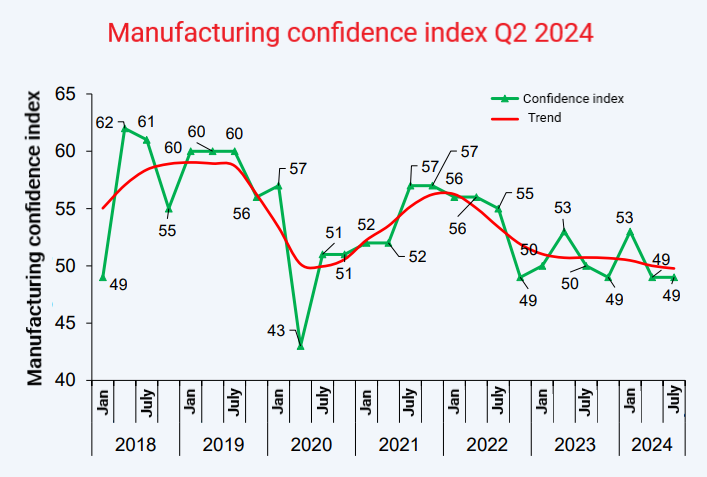
Micro and small enterprises have the worst perception of the current state of the economy, while large enterprises see the situation as significantly better,
the research firm notes. They point out that the lack of investment is worrying, with half of firms not planning to invest significantly, partly because they do not see a return on their investment.
The proportion of firms experiencing demand shortages is the highest since the outbreak of the pandemic,
the report points out. This can be explained by a decline in global demand in the automotive industry, insufficient domestic demand, and uncertainty in the external and internal economic environment.
Overall, Kopint-Tárki says that the Hungarian manufacturing sector is in a difficult situation and that serious changes would be needed to recover. A lack of investment could cause serious problems not only now, but also in the future, which will result in competitiveness problems. At present, there is no active and meaningful economic policy measure to stimulate investment and consumption on a broad scale, and the lack of such a measure will almost certainly leave the manufacturing sector "stuck" this year.
Let's check out the details!
Almost half (46%) of the manufacturing companies surveyed are already experiencing a shortage of demand, both domestically and abroad. In the last 5 years, the only quarter in which demand shortages have been reported at such a high level was when the pandemic broke out. There are of course global and local reasons for this.
"On the one hand, the demand for the automotive industry, Hungary's main export, has declined significantly this year, while at the same time there has been a general slowdown in the dynamics of demand from companies and households in Hungary, which can be explained by the uncertainty of the economic environment," Kopint-Tárki said in its analysis.
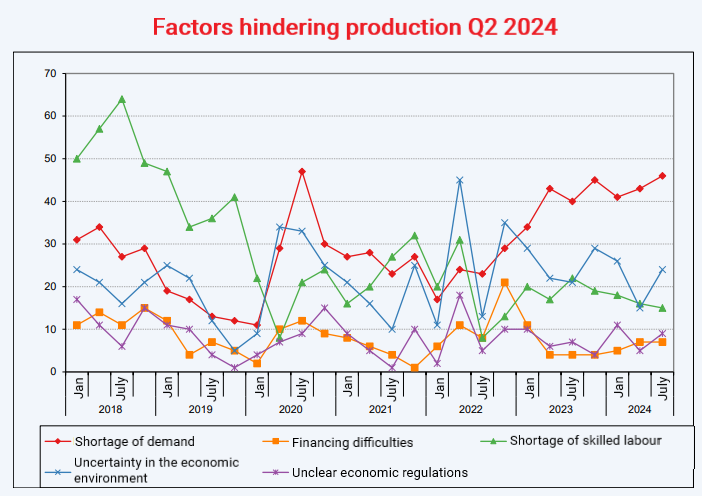
The majority of the problems are probably due to the fact that companies have the capacity to handle much more orders than they currently have, and so there is already some spare capacity, although not yet to a significant extent. Unfortunately, this also applies to labour, with only 15% complaining of labour shortages, compared with around 60% before the pandemic and 30% two years ago.
Remarkably, the mention of financing difficulties is well below the other barriers, remaining below 10%. Thus, poor business performance is not primarily caused by financial factors.
Perception of the economic situation at a low point
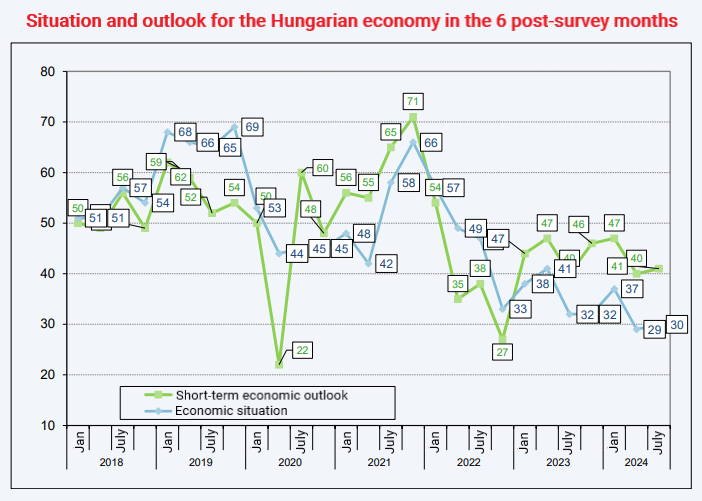
The perception of the current situation and prospects of the Hungarian economy in the manufacturing sector remains at a low point, according to Kopint-Tárki. In this quarter, it is still true that respondents consider the situation of their own companies to be better than that of the Hungarian economy, i.e. they suspect external reasons to be behind the decline in production.
The perception of the outlook for the domestic economic environment has been persistently negative for the 10th consecutive quarter, with only two such long negative series in the history of the business cycle test.
Between Q1 2011 and Q2 2013 (also 10 quarters) and between Q1 1992 and Q2 1995 (14 quarters). Sentiment is unlikely to improve by the end of the summer, making it almost certain that this second-longest period of pessimism since the second quarter of 2022 will be the second-longest of all time, the analysts say.
Micro and small enterprises are the most likely to feel that the current state of the economy is bad, while large enterprises feel that the situation is significantly better. However, there is no significant difference in outlook by size of enterprise. The larger the firm, the more resilient it can be to the current situation, but it is not a good omen for the domestic economy that even large firms are pessimistic about the future, as the question arises how long firms can withstand the economic downturn.
Cover photo is an illustration. Source: Getty Images





