Hungary's second-hand car market revs up in July, new car registrations not so much


According to the latest Datahouse figures, 9,685 imported used cars were registered in Hungary in July 2024, up 14% both in monthly and annual terms. In the first seven months of the year, second-hand car imports (including registration) totalled 63,458 units, up by 2.4% from the same period a year ago.

The registration of new passenger cars dropped sharply by 27.3% m/m and edged up 2.3% year on year in July to 8,528, according to Datahouse figures. Apart from a 3.2% yr/yr drop in January, new car registrations grew every month this year, although the humble July increase follows a nearly 24% yr/yr jump in June.

Second-hand car registrations outnumbered new car registrations more than in July (1,157) only once in the past 19 months, in January this year (1,197). New car registrations beat used car registrations the most in March this year, by 4,322.
A total of 71,860 new passenger cars were registered in January-July, up 10.7% yr/yr.

According to a statement Datahouse sent to state newswire MTI, the number of imported second-hand passenger cars would likely be higher than in the first six months, and we should expect the annual growth to remain around 5%.
Numerically this implies the import of around 11,000 used cars this year. To reach that goal, some 39,000 more second-hand cars should be imported in the remaining five months of the year, which translates into a monthly average of over 7,800. In August-December last year, nearly 44,000 used passenger cars were imported, an average of 8,740 per month, which suggests that the aforementioned full-year estimate is indeed attainable.
The light orange columns in the graph below show how many used cars need to be imported by the end of the year to reach a 5% yr/yr growth. For a more realistic estimate, we have applied the the share of total Aug-Dec registrations from last year instead of using the above average for each month.

According to Bertalan Halász, CEO of JóAutók.hu, the increase in real earnings will sooner or later have an impact on used car imports. The July figure could signal the start of a gradual increase, but a stable recovery is hampered by several factors.
The price advantage of imports is still lower than in the pre-Covid years due to price increases abroad, and the current exchange rate of the euro, which is close to 400 forints, is also reducing the chances of buyers looking abroad, the expert said.
The most popular brand among imported used cars is still Germany's Volkswagen with a 12.5%, followed by Opel and Ford with 8.8%. Audi came fourth and BMW fifth with 6.7 and 5.8%, respectively.
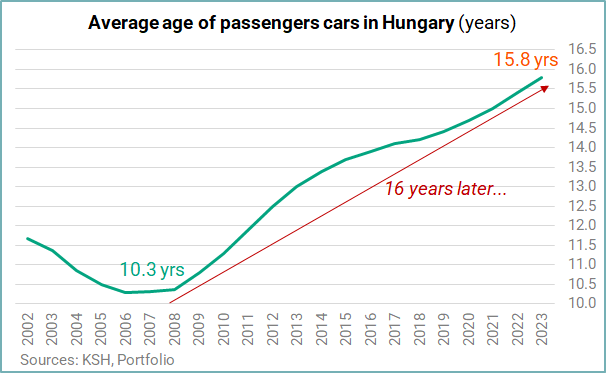
The average age of the Hungarian passenger car fleet is close to 16 years.
Cover photo (for illustration purposes only): Getty Images





