Several important Hungarian data in the pipeline for the week ahead


What happened last week?
We have had a very exciting few days that could determine trading for a long time. The most important event of the past week was clearly the US labour market data last Friday, which showed a worrying rise in the unemployment rate. This also triggered the so-called Sahm's rule, which states that the US economy is already in recession. The news immediately put a lid on the Fed's interest rate decision on Wednesday, when the central bank left its policy rate unchanged, as investors immediately after the event started pricing in a bigger rate cut than before for the next few meetings.
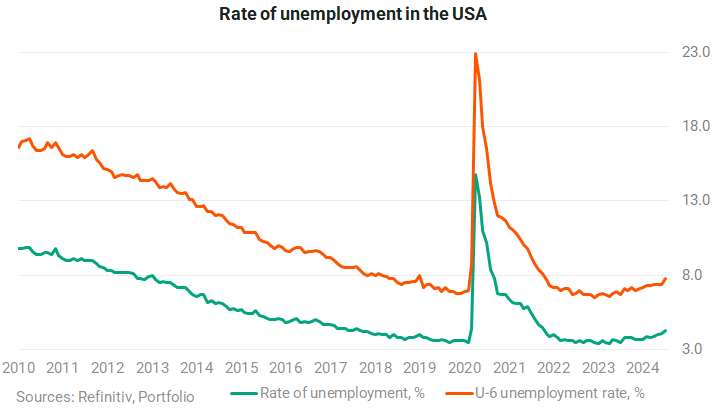
The United States is setting the pace, but there have been important developments in other major economies. In the eurozone, inflation came in above expectations, the Bank of Japan unexpectedly cut interest rates, giving a big boost to the already strengthening yen, while the Bank of England cut rates in response to falling inflation.

The markets were clearly driven by Friday's data, with the US labour market report giving a big blow to markets alongside the negative numbers in the corporate flash report. On Friday, the leading US indices closed around 2% down and the dollar weakened. The latter did not favour the forint this time, with the Hungarian currency also close to 400 against the euro.

What can we expect this week?
Some very important data are coming this week, but mainly from Hungary. Here too, the most important economic indicators are coming in, with the main market-moving data being inflation. There is no data coming in that could radically change international sentiment. What will need to be watched is how the narrative built up after Friday's data reprices market assets. Also, there will most certainly be strong comments on the Fed (as was the case on Friday), which could have some impact on markets. But these are not pre-planned events, it is difficult to prepare for them, so one has to be constantly alert. As far as pre-planned events are concerned, it looks like this:

On Monday, the Hungarian Central Statistical Office (KSH) will release its first estimate of foreign trade for June, and the Bank of Japan will publish the minutes of its latest interest rate decision meeting, which included a surprise hike. China's PMI is of particular interest given the slowdown in the Chinese economy. More important is the ISM PMI from the US, which, if poor, could amplify the market fall (equally, if better than expected, could dampen the bearish sentiment, but this is quite uncertain).
On Tuesday, the KSH will present retail sales data for June. This is a very important data, but it is also important to add that we already know the second quarter GDP, so the consumption statistics are now more of a detailed insight. Abroad, the focus should be on the weakening German industrial order books and the consumption data from the recovering eurozone.
On Wednesday, the Hungarian industry data for June will be released. These are also very important, but it should be pointed out that the second quarter GDP already includes this. On this day, we also have Chinese foreign trade and German industry, which are not so important from a stock market perspective, but are more important for the development of the global economy.
Thursday will also be an important day, with the Hungarian inflation data and the preliminary public finances data for July. As the Hungarian fiscal situation is not very encouraging, the July balance will be very important. Abroad, the US weekly jobless claims are worth mentioning.
Only Chinese inflation remains for Friday, which is also an important release as the country is struggling with low inflation. If it stays low, it means that Chinese consumption cannot bounce back.
Cover photo (for illustration purposes only): Portfolio





