Inflation suddenly on an upward path in Hungary


July inflation data published by the Hungarian Central Statistical Office (KSH) this morning point to a renewed acceleration:

The quarterly annualised, seasonally adjusted core inflation indicator, which is more closely tracking underlying processes, is already at 6.9%, while the normal core inflation indicator is at 4.7% on an annual basis. The quarterly annualised indicator was already at 6.9% in May, the highest since May 2023 when the inflation shock was still winding down:

At the level of the main product groups, the following price changes were measured by the KSH in July. These show that the monthly jump of 0.6% for food is noteworthy and is linked to the end of the compulsory retail discounts in July, which meant that the prices of some products, previously in the price cap scheme, simply shot up. This was the case for flour, which jumped 38.1% in a month, sugar, which rose 13.9%, and edible oil, milk and eggs, which went up 9%, 6.8% and 4.3% respectively. The price of poultry meat was 3.0% and pork 2.5% higher than in June.
With no change to the overheads reduction scheme, it seems that more households were able to qualify for the reduced tariffs in the summer, which may have been the reason why household energy prices fell 0.8% in one month (including a 1.6% drop in the average price of piped gas) and 4.5% compared to July 2023. Vehicle fuel prices rose by 3.8% m/m, which pulled the other articles and fuels category well upwards (1.4% monthly increase).
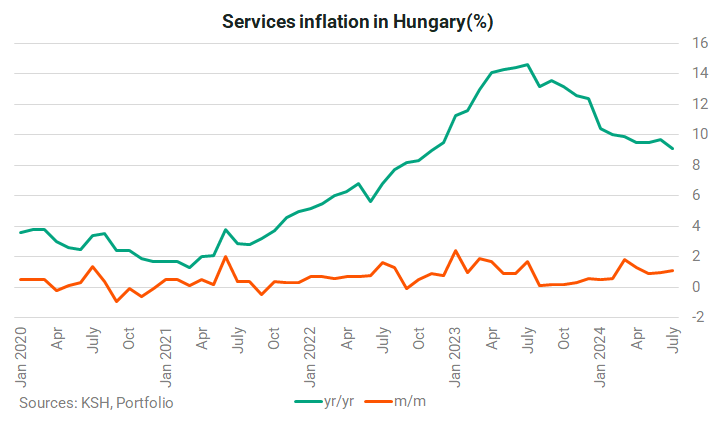
Also important is that services jumped by 1.1% in a month, which was caused, for example, by the price of holiday services going up 12.3% and postal services by 5.0%.
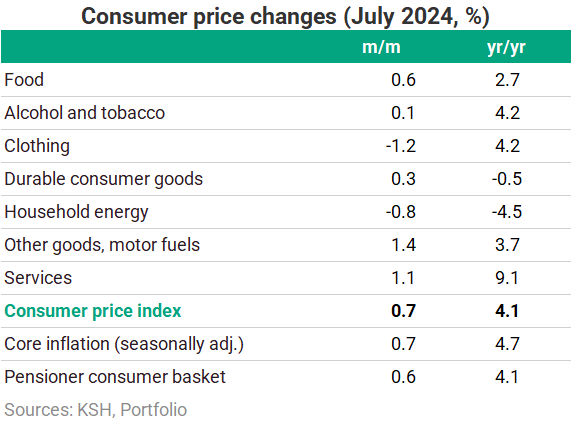
On an annual basis in July, according to KSH data:
- Food prices rose by 2.7%, including sugar by 46.3%, flour by 12.4%, pork by 10.7%, chocolate and cocoa by 10.0%, restaurant meals by 8.0%, fruit and vegetable juice by 7.1%, edible oils by 6.5%, non-alcoholic beverages by 5.5%, milk by 4.8% Egg prices fell by 14.7%, dairy products by 8.0%, dry pasta by 7.6% and bread by 4.6%.
- Services increased by 9.1%, including rent 11.7%, personal care services 10.3%, tolls, vehicle rental, parking by 10.1%, repair and maintenance of vehicles by 10.0%, repair and maintenance of dwellings by 9.0%, sports and museum admissions by 8.3%, and recreation services by 5.6%.
- The prices of clothing, alcoholic beverages and tobacco rose by 4.2% to 4.2%, with tobacco up by 4.3%.
- Household energy became 4.5% cheaper, including 9.3% cheaper gas and 2.1% cheaper electricity, while the main rules of the overheads reduction scheme remained unchanged.
- Prices of durable consumer goods fell by 0.5%, with used cars down by 7.4%, new cars down by 6.3%, household furniture up by 1.9%, kitchen and other furniture up by 1.7%, heating and cooking equipment up by 1.3%. Pharmaceuticals and medical goods rose by 6.5% and motor fuels by 6.0%.
The July data show an acceleration in inflation overall, above expectations, driven by the end of compulsory retail sales discounts, higher fuel prices and a significant rise in holiday services prices. The big question is whether, with nominal wage growth well above 10% and real wage growth around 10%, and core inflation running at around 5-7%, the National Bank of Hungary (MNB) can continue on the path of interest rate cuts for the time being, given the gloomy external sentiment and the EUR/HUF exchange rate near 400. After all, if the public's cautionary motive were to ease and people were to start spending a bit more lavishly, this could even ''pile on'' to inflation, which is already picking up again, accelerating it further.
Portfolio's analysts' consensus is that inflation could accelerate to 4.8% by the end of the year (the MNB's latest forecast was for 4.3%), but today's data and the above suggest that this could be revised higher. In turn, the MNB's room for manoeuvre for further interest rate cuts could narrow considerably if it wishes to maintain a forward-looking real interest rate of at least 1-2% points at the current base rate of 6.75% to protect the exchange rate.
Meanwhile, it should also be noted that with US recessionary concerns, the Fed will most likely cut by at least 25 basis points in September, and further cuts (including from the ECB) could follow, so external developments could increase the MNB's room for manoeuvre in lowering rates.
Even so, what the market has already priced in from the Hungarian central bank in recent days seems exaggerated at the moment. Based on forward rate agreements (FRAs), the base rate could have fallen to 5.75% by year-end, which would imply four 25-basis-point cuts. In comparison, today's inflation data are likely to make the MNB more cautious, as it has stressed in its communications in recent months that it would be very cautious about further easing. Thus, it is in the cards for the MNB to wait between cautious cuts to gain more confidence on underlying inflation developments.
Cover photo (for illustration purposes): Getty Images





