Huge wage hikes possible in Hungary, with HUF 400,000 minimum wage in sight!


Although the minimum wage has increased steadily over the past ten years, the minimum wage has not come close to the average: it has hovered around 40% of the average wage over the period. In fact, during periods of increasing labour shortages, we have seen a downward trend, and there were temporary jumps of one or two percentage points only in years when the minimum wage was raised sharply by over 10%.
However, sustained growth would have required a rapid increase in the minimum wage over many years. But this has not happened, partly because of economic problems and partly because minimum wage hikes were adjusted to election cycles.
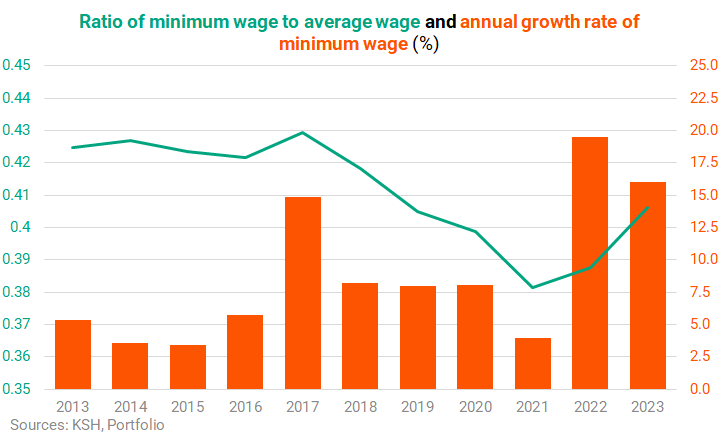
However, the government now seems determined to ensure that we see not just temporary increases in the minimum wage, but a sustained upward trend. Gergely Gulyás, the minister in charge of the Prime Minister's Office, said that a three-year deal between workers and employers could be reached, allowing for a rapid and radical increase in the minimum wage.
Economy Minister Márton Nagy said that the minimum wage should reach 50% of the average wage by 2027 at the latest. This would imply a change of almost 10 percentage points in a few years.
If the government wants to achieve this, it has no choice but to increase the minimum wage very substantially every year.
If we assume that average wages will increase in the coming years by the same amount as in the last ten years, then by 2027 we will be talking about an average gross wage of over HUF 860,000.
This would mean a minimum wage of HUF 430,000, with the government's 50% pledge, an extreme increase compared to the current HUF 266,800.
This would require an increase of 17-18% in the minimum wage every year for the next three years, while the average should not increase by more than 10%.

But raising the minimum wage by almost 20% over the years is no guarantee either.
When the minimum wage increases significantly, substantial adjustments in the other wage categories will also have to be made. This is simply to help employers avoid wage congestion. Thus, although the government may well raise the minimum wage substantially in order to reduce the gap between the minimum wage and the average wage, the gap may not melt away as expected.
Precisely because substantial increases should be made at least up to the median wage (half of workers earn more and half earn less than this) when the minimum wage rises sharply, but even those on the average wage (roughly two-thirds of workers earn less than the average) do not necessarily settle for a small raise.
Moreover, labour shortages are likely to increase in the coming years, and in a tight labour market, workers' bargaining power is improving, so almost everyone is demanding higher wages.
It is also worth considering the extent to which real wages (the purchasing power of earnings) would have to increase in order for the minimum wage to reach 50% of the average wage. Assuming equilibrium real wage growth of around 3% at the national level, the purchasing power of the minimum wage would have to rise by more than 10% annually for three years. However, it is almost impossible to achieve such a large growth differential between minimum wage increases and average wage increases, precisely because minimum wage hikes push the wage scale higher.
So how can the 50% target be achieved? Of course, it is not impossible to achieve the leap that the cabinet wants in a year or two. To do this, we need to draw on the examples of the last 30 years.
The last time the minimum wage came close to the average was when it increased by more than 55% from one year to the next, jumping from 30% of the average to 40%. This happened in 2001. The jump in the above ratio was helped by the fact that in 2002 the minimum wage was also raised sharply by 25%.

However, more than a third of the convergence in the minimum wage was immediately eroded by the fact that the minimum wage was left on hold in 2003. With the average wage raised by over 10% that year, the logical consequence of a flat minimum wage was a fall in the share of the lowest wage relative to the average, to close to 36%.
Almost nothing changed in this respect for almost a decade (between 2003 and 2011), before the minimum wage rate jumped back up to around 40% of the average wage in 2012. But this was not a happy time for minimum wage earners, as the net rate remained the same, only the gross rate increased sharply due to new tax rules.
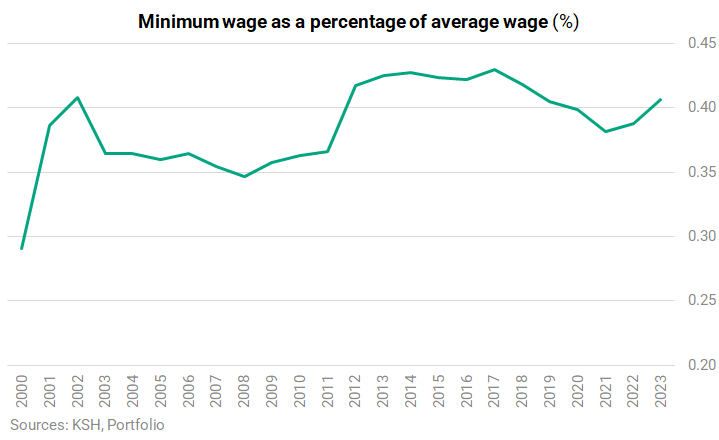
In sum, the only way to bring the minimum wage significantly closer to the average in just a few years is to increase the minimum wage by an extreme amount (20-50%). In other words, an increase of around 6-10% - which could be achieved without serious economic risks and which is being talked about by the interest groups - is certainly not enough to catch up.
Moreover, for the result to be more than temporary, the minimum wage will have to rise at least as fast as the national average wage in the coming years.
Moreover, a rapid central increase in the lowest wages could have serious risks.
On the one hand, many small firms may not be able to absorb the sudden surge in wage costs, so some businesses could go belly-up. However, many argue that this is not a problem in times of labour shortages, as workers can easily find new jobs and the disappearance of less efficient firms could even lead to improved productivity in the economy.
The other, more serious risk is a resurgence of inflation. Companies can either immediately raise prices to offset the rapid wage increases, ultimately stripping their employees from making progress, or cut costs and investment.
A surge in prices could lead to new wage demands, and in this situation, a tight labour market would only amplify the inflationary trend, while a slowdown in investment is worsening the economic outlook.
The problem could be exacerbated if they keep raising the minimum wage at such a massive rate - as planned - for several years, as this could trigger the price-wage spiral that has dragged Hungary down in recent years, partly due to the minimum wage hikes carried out with no link to productivity.
High inflation will lead not only to a rapid increase in the minimum wage but also in the average wage, and ultimately neither the average wage earner nor the minimum wage earner will get ahead.
It is also possible that the increase in the minimum wage and the guaranteed wage minimum will follow different paths in the coming years. Remember, last December the minimum wage was increased by 15%, while the wage minimum for skilled workers was raised by only 10%.
The rates of increase in the minimum wage for unskilled and skilled workers do not generally differ, but it cannot be ruled out that the the Permanent Consultation Forum of the Business Sector and the Government (VKF) will continue along the path it started on last year, as several trade unions have hinted at such a plan. And according to Gergely Gulyás, the government is also inclined to do so, as he believes that the minimum wage and the wage minimum can be brought to the same level in a few years.
According to Portfolio's calculations, if the cabinet wants the minimum wage to reach 50% of the average wage, while the gap between the minimum wage and the minimum wage would disappear, the guaranteed wage minimum would go up by around 30%, while the minimum wage would increase by 60% in 3 years.
This would curb the pressure on average wage growth (since the wage minimum would increase less than the minimum wage), but it would not stop it. The consequence of the plan is that by 2027 there would be no difference in law between the minimum wage for unskilled and skilled workers.
Cover photo (for illustration purposes only): Getty Images





