This is how much the minimum wage could be raised in Hungary


10-15% hikes on the horizon?
Although the series of negotiations on the 2025 minimum wage and guaranteed wage minimum have already started in the Permanent Consultation Forum of the Business Sector and the Government (VKF), so far we have seen only tentative probes by both the employers' and the employees' representative bodies.
It seems that they do not even need to think long and hard about how much wage growth they would consider realistic in the coming years, as the government can set the direction. Portfolio understands that the cabinet would be happy with a minimum wage increase of between 10-15% over the next three to four years.
This will certainly be welcomed by the workers' side, as their overall aim is to increase wages substantially above inflation, and annual average inflation is expected to be around 3-4%. Some workers' representatives are seeking wage increases of over 10% each year, and it looks very much as if the rate set by the government may be appropriate for them.

The bigger question is the attitude of employers to rapid wage increases. Business representatives would certainly like to see single-digit wage hikes in the coming years, as inflation and productivity trends do not explicitly imply rapid minimum wage increases.
They may be reassured by the fact that "only" the minimum wage would rise very quickly, while the guaranteed wage minimum would go up at a much more subdued rate. Indeed, the cabinet seems to want to merge the minimum wage and the wage minimum for skilled workers.
However, it is possible that the smallest companies (where many people work for minimum wage) will still face difficulties in managing their wages, as they employ the largest number of minimum wage earners.
How do we get to the 50% mark?
Companies may be pleased that the rate of wage growth is still somewhat slower than what government official remarks earlier suggested. Indications from Márton Nagy, Minister of National Economy, and Gergely Gulyás, the Prime Minister's chief of staff, were that the cabinet would remove the gap between the minimum wage and the wage minimum for skilled workers by 2027, while raising the minimum wage to 50% of the average wage. The implication was that the minimum wage should be increased by 17-18% per year.
Portfolio has learned on Tuesday that the current plan is rather to eliminate the gap between the minimum wage and the guaranteed wage minimum by the beginning of 2028, by which time the mandatory minimum wage will be half the average wage.
In addition, there is another twist to the story: the government would calculate that the minimum wage should always be 50% of the average wage of the previous year.
While it is difficult to see the economic logic of this - since it means that the minimum wage will not actually be half the average wage in a given year - it is undoubtedly much easier to achieve the target this way.
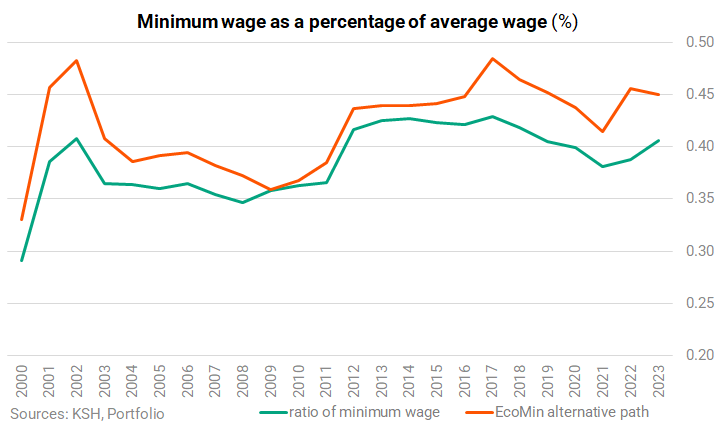
So overall, the minimum wage has been around 40% of the average wage in recent years, and to reach 50% would require a very significant wage increase of 17-18% over three years.
However, according to alternative calculations by the Ministry of Economy, the minimum wage currently corresponds to more than 45% of the (previous year's) average wage, so it does not need to be raised that much to reach half the average.
Portfolio calculates that a minimum wage increase of around 12-13% per year would be needed to close in on the government's target.
This is a much lower rate of increase than what was first suggested by government officials, which means that the gross minimum wage could rise above HUF 400,000 not by 2027, but by 2028.
However, the fact that there will be no increase of around 20% in the coming years is particularly good news for the national economy, as
- it would have been unaffordable for many companies and
- could have triggered a price-wage spiral, as companies would have wanted to quickly pass on the significant wage increases in consumer prices.
These risks persist even with a 12-13% minimum wage increase, but are more limited than with a faster wage hike. In addition, the raise to the minimum wage will not have such a drastic impact on the rate of wage growth in the whole economy, as the government would close the gap between the minimum wage and the wage minimum, resulting in a much smaller increase in the wage minimum for skilled workers.
As the guaranteed wage minimum is already HUF 326,000, an increase of only 20-30% from the current level is needed, compared to 50-60% for the minimum wage. Since the guaranteed wage minimum would then increase at about half the rate of the minimum wage, the overall increase for skilled workers would be very modest. This in turn reduces the pressure to increase the median and average wages.
Cover photo: Shutterstock





