Péter Ákos Bod: What kind of autumn awaits Hungary after the hot summer?


Call it social climate change, call it a manifestation of the polycrisis, but the fact is that the once quiet cucumber season in the world economy is a thing of the past. At the beginning of August, global capital markets underwent a rapid correction, scaring currency holders. The extremely hot summer in the northern hemisphere and increasingly extreme weather forecast a severe volatility in crop prices. And the change in demand for electric cars has developed into an industry crisis by mid-year.
World politics has not taken a summer holiday either. The Ukrainian-Russian war literally opened a new front. The US election contest between the two senior politicians, which had looked all but settled after the assassination attempt on Trump, took a very different direction by the end of August. Less visible but significant movements are taking place in European affairs, complicated by the domestic political instability of the two largest member states.
The political calendar also obliges, with personnel and content changes in the EU institutions.
The European Commission, currently being reconstituted, will have to present decisions on industrial and trade policy, competition and security policy, including in response to protectionist measures taken by the United States and Canada in the face of Chinese economic expansion. Even if Europe wanted to, it could not survive without market protection against the influx of state-subsidised products. The third year of war between Russia and Ukraine also calls for new strategic initiatives at EU level. The changes now taking shape will have a severe impact on the functioning of the Union as a whole and on all member states.
The market reversals of the past few hot weeks will be seen in hindsight whether they are just cases of business cyclical ups and downs or harbingers of larger movements.
It gives one pause for thought that the not entirely unexpected and small increase in interest rates by the Bank of Japan (from zero to 0.25%) caused such a large, even if temporary, fall in equity markets.
- Overcorrection in a volatile market, or a taste of how a big spike can happen at any time in uncertain financial market conditions?
- Is the fall in market demand for electric vehicles (EVs) merely a temporary phenomenon, due to a change in the previously favourable regulatory environment and a slowdown in customer demand?
- Or is the previously exponential growth process now being broken, with serious industry, employment and regional consequences?
In the world of macro-financial affairs, the end of the year has not brought any respite. European disinflation is progressing, but at a sluggish pace. They may be due to temporary factors, so the European Central Bank can look beyond them as it calibrates its long-running toolbox. At the same time, the assessment of the economic cycle in Europe is far from clear, and there are large differences between regions and major economies.
The Hungarian situation must be interpreted in such a turbulent context. But what is it like again?
A realistic assessment of our current situation is a test for analysts and for economic operators under pressure to make decisions. The consumer and business confidence index has remained in negative territory over the summer, even though the inflation crest has now been passed, and with more favourable lending rates, spending and investment could have in principle increased from the beginning of the year. But it did not.
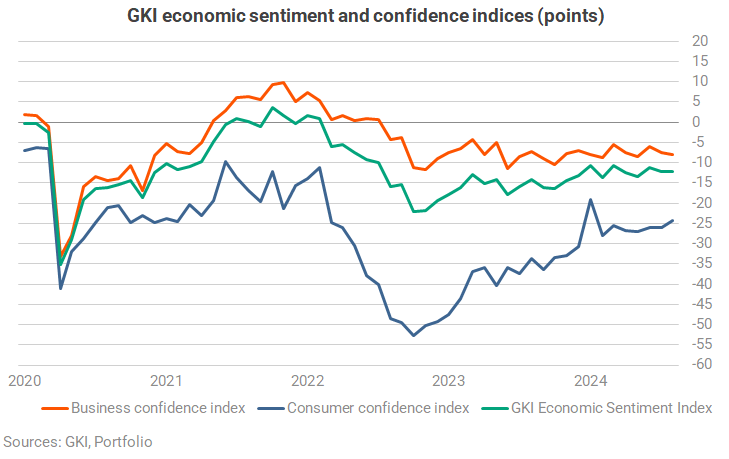
Indeed, expectations were shattered by summer news of a fall in investment, sluggish household consumption and surprisingly weak industrial performance. The declining birth rate points to worrying, persistent demographic factors, while the desire of the educated and young, productive age groups to leave the country is growing. Even the apparently positive employment, earnings and savings statistics, which do not match the perceptions of many, are a source of concern for analysts, as rising nominal averages are likely to be underpinned by rising income and wealth inequality.
The forint exchange rate, as an indicator of Hungary's fragile relations, causes many headaches for business and society alike with its frequent fluctuations. The Hungarian currency is weak by regional standards, but at least it has not recently produced the scary swings and weaknesses of two years ago. At the same time, the central bank, very much aware of the country risk and financial vulnerability aspects, stopped the process of interest rate moderation in the latest interest rate decision, rightly and with good reason, deviating from the regional trend.

What was, and what is to come
This is where we are now, at the start of the autumn season. Based on the facts of the first half of the year, the only thing that is clear is what not to expect this year.
2024 will not go down in the annals as the year when the economy bounced back from the recession of the previous year.
Hopefully, there will be some less disappointing data on domestic consumption, and perhaps some recovery in the country's main external markets, but this is more a hopeful forecast than a one backed by order books and ongoing projects. The year is unlikely to take on a new character in the months ahead.
It is indicative that "a fresh start" has appeared in the parlance of the Minister for Economic Development - once again. But that is what 2024 was supposed to be all about.
It should be noted that, although the first half of the year was a surprise in terms of scale, the character and sign of the trends had been indicated much earlier by objective professional analyses. However, at the beginning of the year, the government's narrative in interpreting the situation and trends diverged spectacularly from the assessment of the domestic and external research community. The policy rhetoric - and more seriously, the government documents - was all about a strong recovery phase after the recession of 2023. The government budget was premised on an economic growth rate of 4%, and even higher figures were bandied around in government circles, citing rising real incomes, the resulting consumption growth, EV-related output growth and investment - all against a backdrop of rapid disinflation. Research outlets projected a lower growth rate: most of the economic forecasts based on data from the beginning of the year and on global developments expected economic growth of between 2% and 3% in 2024, with downside risks. There was also considerable doubt about the government's optimism on inflation and the fiscal position.
Then, over the summer, the government narrative changed in the wake of the realities, at least as regards this year's expectations.
Based on the second quarter statistics, even the officials have now halved the growth rate that was confidently announced in the spring, and the promise of strong GDP growth (around 4%) has been postponed to next year. War, the impact of sanctions and general uncertainty were cited as reasons.
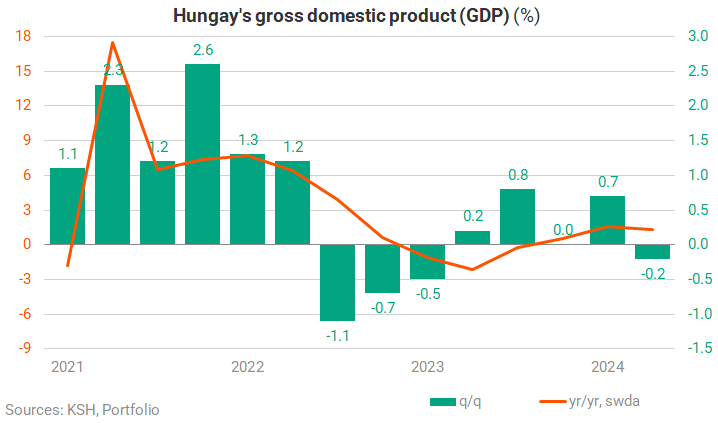
The government's acceptance of these realities is a positive turnaround, as prior to this the declarations did not provide any support to economic actors, who - depending on their sector and their capabilities - perceived a weaker domestic economy than hoped for. Business could only guess what the authorities would do to public finances. Now at least the gap between the factual developments and the official interpretation of the situation seems to be closing.
It is also good news that the 2025 budget will be drawn up at the end of the year, which is in line with the practice of previous decades and the logic of budget planning based on base year projections. A side specificity in this respect is that the timing of the budget law is reportedly motivated by a foreign policy event (the outcome of the US presidential election).
There is a certain factual basis for the government's interpretation of reality, which is that the state of our economy is the way it is because of war conditions, because of external factors. For a country so exposed to foreign trade and financial flows, it is a commonplace truth that major reversals in the external world can have serious consequences (in economic policy jargon: shocks). However, in a small, open economy, it is precisely because of this external exposure that it is necessary to be prepared to avoid or at least cushion potential shocks. With a high degree of openness, it is obvious that economic operators, public authorities and decision-makers at all levels keep abreast of changes in the world situation, reacting to and even anticipating them.
The fact that all countries in the region are open to the outside world is true for all countries of Hungary's size, but it does not excuse delayed, inadequate or incorrect adaptation. At a time of partly unexpected but largely predictable change, it should not be pretended that external circumstances and objective conditions are responsible for the situation.
When considering the contours of the economic outlook and the public policy space, it is important to look back to the previous, turbulent times and their consequences. Indeed, the trajectory of the country's economy beyond 2020, including the very special year 2022, last year's recession, was heavily influenced by external factors.
But the path to today's conditions cannot be explained away by the fact that it was shaped as it was by the pandemic, the war and the sanctions.
With the alarming data behind us, the question of how the economy and economic governance have adapted to the multidimensional changes (polycrisis) of recent years and in what state we face the new trends that are now unfolding is unavoidable.
When reality refuses to behave properly
These have undoubtedly been extraordinary years. Broad-based, diversified large economies have also suffered severe shocks in 2020-21, not always dampened and often amplified by economic policy actions. The global economy, and a number of critically important actors in it, are entering the current post-inflation period in a fragile and ambivalent state.
It is instructive that leading central bankers at their annual Jackson Hole conference acknowledged that they have often been wrong in their previous expectations.
In the resumption after the Covid shutdown, the surge in demand for raw materials and manufactured goods has encountered supply constraints and triggered an inflationary surge to which central banks have no foolproof monetary policy response. It is best to wait for market actors to adjust to the shock: buyers restrain or restructure their demand as much as possible in the new price environment, supply increases to stimulate higher prices, and governments smooth the shock with temporary job-preserving and income-supporting measures. If economic agents understand and accept the temporary nature of the price increase, and thus inflation does not feed through into expectations, then the central bank does not need to add monetary tightening to the temporary supply-side shock.
That is the theory. However, people's inflation expectations have been different, and many governments have unintentionally amplified the inflationary process by creating an excessice ex post money abundance.
However, stubborn inflation is currently keeping interest rates higher than they should be, and despite disinflation, monetary easing is slow. As a result, debt burdens are much higher than they were two or three years ago when yields were low, to the particular detriment of economic agents who have to refinance large debts.
Hungary is one of these. The country has the highest public debt ratio in the region, with a heavy interest burden, which is one of the reasons why Hungary's sovereign risk rating is lower among the major credit rating agencies compared to the norm for the new EU members. This well-known, but unfortunately persistent, risk exposure is compounded by structural rigidities, the specificities of our government operations and, increasingly, political risks.
Suffice it to briefly refer to our famous and much-discussed exposure to the automotive industry. A high degree of specialisation is notoriously risky: it pulls the economy up when conditions are good, and pulls it down when key sectors are in a slump. Industrial data for 2024 so far point to the latter situation, and there does not seem to be a meaningful policy response.
Structural conditions of concern include Hungary's energy demand and dependence on energy imports.
The economic landscape across Europe in 2021-22 was memorably dominated by the energy price and availability mess, with the particular twin challenges of the need to break away from Russian supply dependence and the need to respond rapidly to climate change. The majority of member countries have made a heavy sacrifice to meet the first challenge, with a determination and effectiveness that I find surprising. Clearly, much more needs to be done on the green transition.
But as far as our situation is concerned, Hungary is lagging behind in terms of energy efficiency, as well as in terms of breaking away from dependence on Russia. Our housing stock, our vehicle fleet, our infrastructure systems, our industrial energy balance are all poor. In the energy and climate transition, society has lost valuable time, partly due to the sacred cow of government policy, the "overheads reduction".
The industrial policy campaigns of recent years have even increased energy demand - and thus the country's exposure to any potential energy shocks.
Each of these are well-known aspects of the Hungarian situation, much discussed in the profession. But they must be taken together to assess the specific Hungarian characteristics, features and exposures when exploring possible developments in the months following the summer of surprises, as taking account of these and other important explanatory factors can help to make sense of last year's recession and this year's lack of momentum so far.
A few words about the "economic mechanism" in this country. With continuous and profound changes, the redistributive activity of public bodies has continued to grow, and the scope of market competition has narrowed proportionately. Regulatory practice - and, no less importantly, the official language - has tended to differentiate according to sector and ownership ("special tax on multinationals"). This, apart from being in conflict with EU law and a source of constant external conflict, whether the parties concerned take their grievances to the EU authorities, their national governments or remain silent, is already undermining the efficiency of market functioning in the short term. And in particular it discourages business investment, partly because of the weakening resource situation, but mainly because of the deterioration in the conditions for foresight.
Discriminatory treatment between operators is also common in the Hungarian private sector, similarly increasing business uncertainty. Such additional risk cannot be offset by a loosening of monetary conditions.
There are many factors behind the decline in investment volumes since the beginning of 2021, but extensive government intervention with difficult-to-follow motives is certainly one of the main reasons for the slowdown in business development.
The decline in the competitive sector's share was compensated for a while by the public sector's investment activity, especially in the pre-election period, but in the midst of the known serious budget problems, it is precisely this activity that the government has now been forced to curb. Even in the face of accumulated backlogs with serious consequences in a number of sectors, most spectacularly in infrastructure and the long problematic health sector.
Finally, there is no way to ignore the accumulation of political risks. The long-running debate with the EU institutions on the rule of law, the corruption threat, has now entered a new phase with the patience of our partners running out and now an EU court ruling with tangible financial consequences. However, the visceral government response to the ruling has only sharpened the conflict, which cannot, however, with the continuing withdrawal of funds, disappear or become secondary as many previous clashes at the level of the European Parliament and the Commission - at political level, with little impact on the economic agenda - have done. The "refugees will be deported to Brussels" type of tone, perhaps aimed at the domestic electorate, is particularly shocking when a decision is taken to facilitate the employment of Belarusian and Russian citizens, which is not justified by the current situation on the domestic labour market: the market participation of these two nations is secondary to, for example, the business presence of South Korea or the United States.
And this is not the only point of conflict to which the analyst is unable to attribute a sensible economic rationale, a national economic rationale or a social interest.
This year's rotating EU presidency would have provided a chance for the government to do some professional, somewhat boring intergovernmental work in Budapest as a good host in a few months of a content-shortened summer shutdown after the EU parliamentary elections. However, on the very first day of the Hungarian presidency, the chance of this happening has passed. It is now clearly a source of conflict and, as such, an additional economic and business risk that Hungary has assumed the rotating EU presidency this year.
All conflicts can be somewhat dampened, but they can also be sharpened. Economic analysts, including rating agencies, big investors, strategic analysts, are trying to interpret developments. It is not an easy task. Even the raw economic data itself does not give a clear indication of where Hungary is heading - all we have seen so far is what has not happened in terms of what government policy has been building on for a year.
Meanwhile, our internal world has also changed, in no small part as a result of this summer's EP and municipal elections. The government apparatus and the state media may be trumpeting positive messages based on promising data in selected areas, but public opinion is different. Moreover, people are confronted daily with the elementary dysfunctions of the state. Thus, while a "moderate level of political risk" used to be a regular feature of external risk analysis, it cannot be taken for granted at the end of 2024 for internal and external reasons.
The hot summer is coming to an end. It's anybody's guess what autumn, the end of the year, will bring.
THIS IS ON THE OTHER HAND, THE OPINION COLUMN OF PORTFOLIO. The articles reflect the views of the authors, which do not necessarily reflect the views of the Portfolio editorial team.
Cover photo (for illustration purposes only): Portfolio





