The whole world gears up for the Fed's rate decision this week


What happened last week?
The main economic events of the previous week were the release of inflation data in Hungary and the US, and the European Central Bank (ECB) interest rate cut. US inflation was broadly in line with expectations, but core inflation accelerated more than expected on a monthly basis. This is mainly due to faster-than-expected increases in transport services and housing costs, so US inflation developments remain characterised by a duality. Services inflation is persistent, while product inflation is already more deflationary by several items. Investors, however, have not been too impressed by the slightly higher-than-expected core inflation, as they have been paying more attention to real economic data since the risk of recession has risen.
The ECB's rate-setting meeting went as expected, with the central bank cutting its deposit rate by 25 basis points and refusing to commit to any interest rate path, but continuing to take its decisions in the light of incoming data. The euro fell only temporarily after the decision. The forint finally ended the week at 394.5, even though it had been at 397.5 on Tuesday.

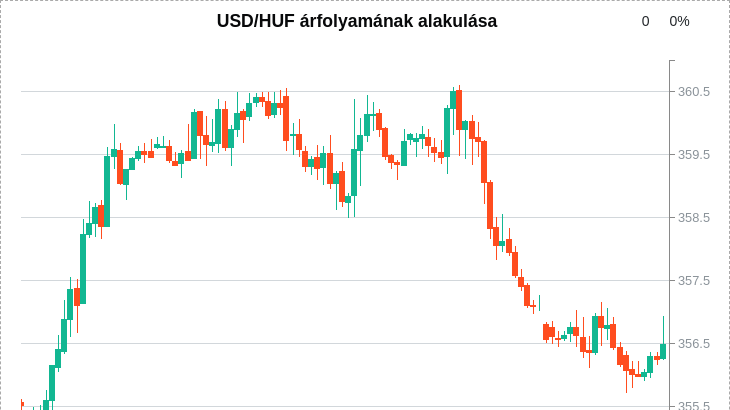
Although US producer inflation came in marginally above market consensus, it had a minor impact on the dollar, with the US jobless claims report coming in as expected, weakening the dollar. This was mainly because investors had already priced in an expected 25 basis point cut for next week's Fed decision. This deteriorating economic data has also caused US long-term government bond yields to fall. This also helped the Japanese yen and the forint over the weekend, which eventually strengthened.
It is also important to note the University of Michigan's Consumer Confidence Index, which came in above expectations at a time when incoming data tends to point towards a slowdown. It will therefore be interesting to see in the future whether this improvement is felt later in the incoming data or in the public's propensity to consume.
What can we expect this week?
On Monday morning, we have already started with important Hungarian macroeconomic data: the Bank of Hungary has published the July monthly balance of payments at 8:30 am (already out by the time of publication), which showed Hungary's international financial balance and gave an insight into the country's external financial situation. At the same time, the Q2 cash flow data will be released.
On the international front, the US economy is the focus of attention, with the New York Manufacturing Purchasing Managers' Index (PMI) due this afternoon, whose September performance could be an important predictor of the Federal Reserve's interest rate decision on Wednesday.
On Tuesday, 17 September, the Government Debt Management Agency (ÁKK) will hold its regular 3-month discount Treasury-bill auction at 11am. At the same time, the ZEW index on economic sentiment in Germany and the euro area will be released.

In the afternoon, the US will again take centre stage, with the release of August retail sales data at 14:30, which could have triggered some major market moves in recent months. The reason is that construction and manufacturing have been performing poorly for some time now and in essence the American consumer is the reason why the US is not yet in recession. If the retail sales data were to start deteriorating rapidly from there, a meaningful slowdown in the US economy, even into recession, could be essentially inevitable. The August US industrial production report, which will provide a picture of the performance of the manufacturing sector, is due shortly.
On Wednesday 18 September, the Japanese economy will be the first focus of attention, with the release of August's foreign trade data at 1:50 am (Hungarian time), as well as the industrial order books, an important indicator for the outlook for the manufacturing sector. In addition, the Bank of Japan wants to continue its cycle of interest rate cuts in the face of high inflation and strong economic performance. As the incoming data is quite important for the assessment of growth, we could see some major moves in the Japanese yen after the data is released.
But on Wednesday evening, the most important macroeconomic event of the week will be the Federal Reserve's interest rate decision.
Markets are anxiously awaiting this decision as they expect the first Fed rate cut of the current cycle. The key question is whether the Fed will start its rate cut cycle with a 25 or 50 basis point cut, and what interest rate path it is considering for next year. In addition, it will also be important to watch whether the Fed hints at quantitative tightening (QT), as liquidity conditions in the US could deteriorate a lot in the coming months.
On Thursday afternoon, weekly jobless claims data from the US will provide a quick snapshot of the current labour market situation. The Philadelphia Fed index, which provides information on the state of the manufacturing sector, will be released at the same time.
On Friday 20 September, the Japanese economy will again be in the spotlight. At 1:30am, the August inflation data will be released, which will play an important role in shaping monetary policy. Later, at 16:00, the European Union's September Consumer Confidence Index, which reflects European consumers' confidence in the economic outlook, will be published.
Cover photo (for illustration purposes): Portfolio





