This week brings further challenges for the forint


The most important event of last week was the escalation of the conflict in the Middle East, after Israel invaded the Lebanese wing of Hezbollah and Iran launched a missile attack against Israel. The events led to a more than 7% rise in oil prices, a stronger dollar and a weakening of emerging market currencies on global risk aversion.
Thus, in addition to the challenges facing the Hungarian economy - especially the suffering of industry and investment - and after the easing monetary policy of the past period, the forint has been weighed down by the deterioration in international sentiment, with the exchange rate falling to a one-and-a-half year low against the euro and stuck above 400.

The Hungarian currency fell to a two-month low against the US dollar, which managed to strengthen against the euro in recent weeks.
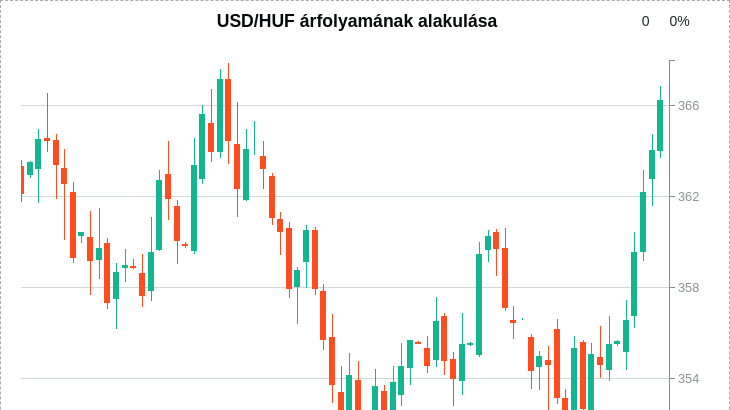
Meanwhile, data coming in during the week showed that the US economy continues to be in booming shape.
In September, employment improved strongly, unemployment fell and wage growth rose, while the services sector remained strong, according to the ISM survey. This in turn has priced in expectations of a US interest rate cut, causing the dollar to strengthen sharply against both developed and emerging market currencies.
What do we look out for this week?
The beginning of the week will be particularly rich in both Hungarian and international macroeconomic data releases. On Monday, the Hungarian Central Statistical Office (KSH) will publish two important data releases: retail sales in August and the external trade balance. The National Bank of Hungary (MNB) will publish statistics on the average auction rate and benchmarks for government bonds, as well as on foreign reserves.
At the international level, the German industrial order books data for August and the European Union retail sales data will also be key. These data will provide guidance on the performance of the European economy and the external constraints on the Hungarian economy.
In the US, the fiscal balance for September will be released, which will indicate the sustainability of public finances and could become a political focus in the finale of the presidential election campaign.
Tuesday sees the publication of the Ministry of Finance's September general government balance report in Hungary, reflecting the state of the country's fiscal policy and budgetary position.
The release of Germany's industrial production data will also be noteworthy. The EU's largest economy has suffered recently, which has also cast a shadow over Hungary's growth prospects. In the US, there will be trade balance data for August, where markets will be watching the development of the trade deficit with China.

Wednesday starts with the German trade balance and Japan's machinery orders. Then in the afternoon, the US mortgage applications number will be reported, while the Fed minutes will give an insight into the future of the central bank's monetary policy.
Two major data releases are due in Hungary on Thursday:
the September inflation release from the KSH and the MNB's data on residential mortgage lending.
US inflation is the key indicator most closely watched by the Federal Reserve, while mortgage demand reflects the state of the housing market, which may also determine the timing of further easing.
At the international level, US inflation and unemployment data will be released, which will provide a picture of the current state of the US economy and the Fed's future monetary policy.
Friday will see industrial production data from the UK and Germany, as well as the German inflation report. In addition, the US manufacturing inflation report and the Michigan index may also bring market movements, with inflationary pressures in the economy and consumer confidence also indicators monitored by the Federal Reserve.
Unusually, there will also be another important data release this weekend: the September inflation data from China will be released on Sunday at dawn Hungarian time. This indicator is of great importance in the world's second largest economy, where falling consumption has already fuelled fears of deflation.
Cover photo (for illustration purposes only): Portfolio





