Hungary to change system of local business tax - Finance Minister


The Minister began his speech with a summary. He recalled that in 2024, the Parliament adopted a "defence budget". Pensions, overheads, families, jobs, defence, he said, were the key words that the government had promised to protect.
According to the Minister,
- The Defence Fund has HUF 1,300 billion this year. Hungary will reach 2% of GDP for the defence this year.
- Family support: the state spends HUF 3,302 billion on family support. Wage increases have made a significant contribution to increasing family incomes.
- Employment is at a record high, with more people working in the Hungarian economy than ever before.
- Pensions have also achieved stability of value, thanks to the 6% increase at the beginning of the year and the payment of the 13th month pension.
- The Overheads Protection Fund currently has HUF 1,361 billion. After record prices in 2022 and '23, there has been consolidation in energy prices, but not to the extent seen in the pre-war period. The Overheads Protection Fund has fulfilled its function, reducing the burden on families through the utility bill subsidies.
- Wage increases have continued.
Inflation is expected to reach 3.5% this year,
Varga predicted.
These objectives have been met. In 2023 and 24, the Hungarian economy was already growing. The first half of the year as a whole saw an overall growth of 1.5%, a good result compared to the EU, which was accompanied by an increase in real wages, he said.
Budgetary balance
During the year, the government took measures: it postponed investments worth HUF 650 billion and decided to raise taxes by HUF 400 billion, he recalled.
The general government deficit stood at HUF 2,623 billion by the end of September, he said, summarising the latest cash flow data.
In the next three months, barring unexpected developments, the deficit path will be sustainable, Mihály Varga said.
Financing
"We expect interest expenditure to fall in the coming months. This will allow us to finance other objectives and reduce the deficit," he stressed.
He also talked about the structure of debt. While we have more legs to stand on in terms of borrowing, we are drawing in resources from more countries, and we are trying to reduce the scale of this in order to reduce the foreign currency exposure of public debt, he said.
He specifically mentioned the importance of retail financing (via government bonds) and that interest payments are not going to foreign hedge funds but to families.
There are HUF 11,226 billion of household savings in government securities, he said.
This was also recognised by the credit rating agencies. All three major credit rating agencies have Hungary in the recommended for investment category, Mihály Varga said, concluding his speech.
Initial question and answers
In reply to the first question, Mihály Varga said that,
from a technical point of view, it does not matter whether the budget is adopted in the spring or in the autumn.
For the Hungarian economy, it does matter, because the actors have more time to prepare for the coming year, and the environment in which they will make their business and private decisions.
In the case of the 2025 budget, it is different because there is more uncertainty around the economy. Another important aspect is that there could be a trend reversal event, in terms of war or peace, and that is the US presidential election. That is why the Hungarian government has decided to take this external development into account. The ministry will submit the budget by 15 November, Varga explained.
Renationalisation of Budapest Airport
The airport buyback is a closed transaction. There is much more potential in the airport than has been realised so far by the private investor, he explained in response to another question.
The government cannot allow such a strategic element, the international airport, not to participate in the regional competition,
otherwise Hungary will be left behind, he said.
Capital increase, asset sale and Exim loan - according to Mihály Varga, the financing came from a healthy mix of these.
On rail transport, he said that the railways have been provided with the necessary funds and the relevant ministry has not made any additional requests.
Growth, interest rates, 2025 budget
There is economic growth in Hungary. "We would like to see a higher rate, but the current rate is already an achievement," he said, adding that "we are planning for a deficit target of 3.7% next year and 2.9% in 2026, and we want to maintain this path."
Sometime by mid-December, the parliamentary debate on the 2025 budget could be concluded,
he predicted.
We would like to return to the path that characterised the Hungarian economy between 2013 and 2019:
a declining budget deficit, falling public debt and a growing economy, the Minister said.
He stressed that the postponement of investment is only temporary, and that 2,000 billion forints of public investment will be made this year.
No government politicians asked the minister questions during the first half of the event.
Business tax
The government is also preparing the 2025 budget and amendments to the tax laws that determine the revenue side. "You will be seeing this soon and all your questions will be answered from it," he said in response to a question on the local business tax (HIPA).
We are preparing a transformation of this system that will take money away from local governments, but will transform territorial development, he said. The government is thinking in terms of a fund, and the government will use it to coordinate district-level developments, Mihály Varga confirmed. Tibor Navracsics, Minister of Regional Development, has already mentioned the government's plan.
The increase in business tax could be HUF 115-120 billion next year. From this, funds can be reallocated to regional development aspects,
according to the Finance Minister.
Banks and banking fees
I completely agree with you,
unfortunately Hungarian bank rates are high. They are also high by European standards,
Mihály Varga admitted.
Competition must be strengthened, the government is working on this, said the minister, who said that there is already competition in this market.
Where we see abuses, it is up to the regulator, and the government can have regulatory tools to influence them, he added.
If the Finance Minister also finds Hungarian banking fees high, even by European standards, why is that they hiked the financial transaction tax and even introduced a new one that will definitely take these fees even higher? Oh yeah, the bloated budget deficit, that's right.
Budget planning
The government has not yet completed the process of drafting next year's budget. This work is still ongoing, he said in response to a question.
Economic policy
Responding to a question, Mihály Varga stressed that the country's financing is stable and does not need external, non-market sources. It does not need external financing.
No one is happy that the deficit and public debt increased after Covid, the minister said, pointing to the figures in neighbouring countries. He specifically mentioned the Slovak budget plans.
Why would Chinese money be worse?
This was the question posed by Mihály Varga as an answer to a question about a €1 billion loan Hungary took out from Chinese banks this spring.
Today China is a global economic power, and we must strive for a partnership with China that is good for the Hungarian people, he said.
He also asked opposition MP Zoltán Vajda if he thinks the Budapest-Belgrade railway line is bad.
The Orbán family's quarry has supplied construction materials for the renovation of the Budapest-Belgrade railroad, so in addition to the Hungarian Prime Minister's friend Lőrinc Mészáros, the richest person in Hungary with assets worth nearly HUF 1 trillion, Viktor Orbán's immediate family members may also be profiting from the huge railway construction project of the state, 444.hu reported in mid-September. This is according to internal documents they have seen, and the information has also been confirmed by two transportation companies involved in the project.
"I don't want to talk about private investments," Orbán replied, when asked at an international press conference on Tuesday (8 October) about his father's role in the renovation of the Budapest-Belgrade railway line.
Although the construction of the Budapest-Belgrade railway was ordered by the state, Orbán has always defended it by saying that it was commissioned to private companies, so it is none of his business who their subcontractors are. 444 noted that this is Viktor Orbán's long-standing defence to questions about his family's enrichment. According to Forbes.hu, the turnover of companies linked to the prime minister's family exceeded one billion euros in 2022, and their profits were close to HUF 54 billion.
With the conditions under which the Chinese loan was obtained, we would not be able to borrow foreign loans from the market now
said Varga. The terms of the loan remain secret.
The Hungarian state has enough liquidity to comfortably finance everything this year, he added.
EU funds
A total of HUF 1,000 billion in EU funds will be received this year,
and most of this has already been received so far, Mihály Varga said.
It is worth noting that it was revealed just yesterday that in the first nine months of the year, the budget received HUF 917.1 billion of EU funds related to EU projects.
He reiterated the government's earlier argument that the funds due to the country are being withheld for political reasons.
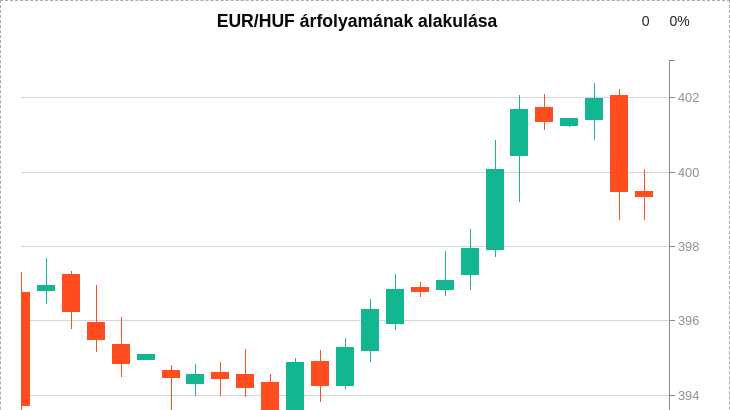
Gov't has no exchange rate target
The government has no exchange rate target,
stated Varga.
An exchange rate is used for the planning of the budget. The exchange rate is a matter for monetary policy, he said.
The minister was asked about this when asked about the euro exchange rate being around 400.
Will he remain Finance Minister or go to head the central bank?
The Finance Minister did not answer this question. Prime Minister Viktor Orbán said earlier that a new top ministerial post would be created with the merger of the Economy Ministry and the Finance Ministry. MNB Governor György Matolcsy's six-year mandate will expire next March and Varga was rumoured to be taking over, leaving current Economy Minister Márton Nagy the top ministerial position.
Varga's name has been circulating for months as the potential / likely successor of Matolcsy at the helm of the central bank. Orbán has recently announced plans to merge the Ministry of Economy and the Finance Ministry, adding that the minister leaving his government post could be the next MNB chief. The likelihood of Nagy staying and Varga leaving is greater than the other way around. Orbán had picked Matolcsy, whom he called his "right hand", to head the central bank when Matolcsy was Minister of the Economy, so in this sense the rumoured succession would not be a shocker. The question is what investors would think about the powers of Márton Nagy growing even further, as he would be responsible for fiscal policy too, including the financing of government debt (and the supervision of the Government Debt Management Agency, ÁKK), the planning of the budget, and tax policy.
Cover photo: MTI Photo/Zoltán Balogh





