Hungary inflation decelerates to central bank target


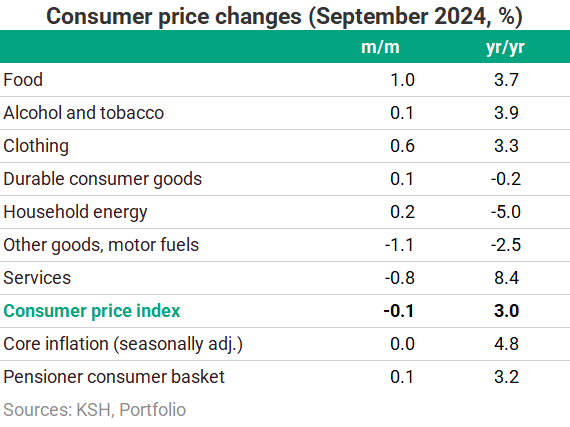
The deceleration in the inflation rate did not come as a surprise because it was largely due to foreseeable factors. The most prominent disinflationary effect was the continued decline in fuel prices. On a month-on-month basis, the price level fell by 0.1% in September, meaning that the early autumn price data do not point to any meaningful inflationary pressures.

Among the less predictable details, the most interesting is that food prices have increased by 1% on a monthly basis, meaning that many people may have experienced higher inflation in their daily shopping, based on prices in grocery stores.
At the same time, the rise in the prices of services, which has been responsible for high inflation in recent months, has eased noticeably. This can be seen not from the 0.8% drop in prices on a monthly basis (there are seasonal reasons for this), but from the fact that the annual price dynamics have finally moved slightly away from the double-digit range (8.4%), having fallen substantially.
The more favourable developments in services are very important for the longer-term inflation picture, as this is where the stickiness of expectations and the fact that actors raised prices based on past inflation data have been most apparent.
Last autumn, prices for services started to rise by 15-20% on the back of high inflation in the previous year (17.6% on annual average), and this year (and early next year) only much lower price hikes can be justified on the same basis.
Much less welcome is the fact that the sluggish Hungarian economy is also likely to play a role in the subdued rise in consumer prices.
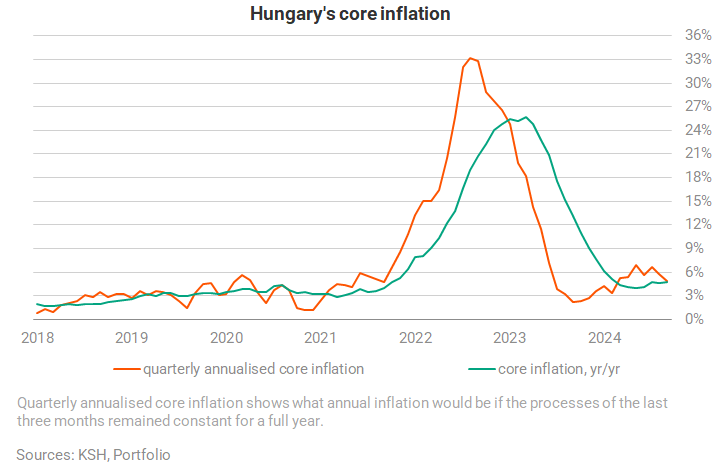
Apparently contradicting the easing inflationary pressures, the core inflation indicator (which is designed to capture more persistent price movements) rose to 4.8% yr/yr from 4.6%. However, a deeper look reveals that the picture here is also encouraging.
Indeed, if we look at the past three months of the indicator, we see a clear descending trend, i.e. the increase in annual core inflation is due to the base effect, not to recent price processes. According to our calculations, quarterly annualised core inflation has fallen to 4.8% in September from 5.7% in August.
This is the first time since the beginning of the year that this indicator does not exceed annual core inflation.
Despite today's favourable inflation data, the rest of the year is expected to bring a meaningful rise in the headline figure. This is because there are several base effects in the fourth quarter that cannot be offset by the increasingly favourable price dynamics this year. For December, experts forecast a CPI north of the 4% mark, outside the central bank's target range (3% +/-1ppt).
The favourable inflation data could even boost the central bank's tolerance for the weakening of the forint seen in recent weeks. This increases the chances that the MNB will cut interest rates in October, but monetary policy thinking on this issue is certainly more complex.
On the one hand, today's inflation figure does not change the overall picture, as it was in line with expectations. On the other hand, financial market movements and the increase in risk aversion abroad remain among the cautionary considerations. It is no coincidence that Deputy Governor Barnabás Virág has already indicated that this month's interest rate cut possibility has become more limited.
Virág said on Wednesday that the central bank's room for manoeuvre for a rate reduction in October has narrowed. Among the reasons, he cited rising geopolitical risks and the upcoming US election, Bloomberg reported.
Virág's remarks are consistent with the framework set up by the central bank, where, in addition to the domestic inflation outlook, regional performance and global risk sentiment also play an important role.
The situation has recently escalated in the Middle East, with China announcing a major stimulus package and stronger-than-expected real economic data from the US. Together, these may have increased inflation risks somewhat, while the strengthening of geopolitical risks also affected the forint, which remained above 400 against the euro for several days. In these circumstances, the more cautious approach in October is understandable given the central bank's decision framework.
Cover image (for illustration purposes only): Getty Images





