INSTANT VIEW - Hungary inflation bottomed out in September


The Central Statistical Office (KSH) reported this morning that Hungary's consumer prices rose 3.0% year on year in September, coming down to the central bank's target for the first time in 3.5 years. We have a selection of analyst reactions to the latest data.
Péter Virovácz, ING Bank
The latest data came as a minimal downside surprise compared to market consensus, while in line with our expectations. He also highlighted that the yr/yr index fell to 3.0% from 3.4%, reaching the central bank's target for the first time since January 2021, which marks a long 44-month journey.
[...] while this is a welcome development, there is no time to relax as there will be some bumps in the road ahead," he said.
The further moderation in inflation was partly due to a 0.1% month-on-month fall in the average price level, and partly due to last year's high base. "So, at face value, we are happy campers. But if we dig deeper into the details, we find some interesting developments," said Virovácz.
Fuel prices fell sharply in September, by 3.7% on a monthly basis, as a result of developments in the global oil market. "It is therefore hardly surprising that this item itself is clearly responsible for the improving inflation picture. However, this may be a short-lived positive story, given the recent movements," the analyst said. In his view, this item dampened the September CPI by 0.2 percentage points.
The surprise factor this time around is services inflation. Services prices fell by 0.8% m/m, mostly due to seasonal effects.
The price of recreational services fell sharply, as is usual in September, although the fall was larger than usual, perhaps due to generally sluggish domestic tourism.
"There was also a significant drop in the price of long-distance transport services, especially air transport," highlighted Virovácz.
Less surprising, but certainly a cause for concern, was the 1% month-on-month rise in food prices in September, the largest monthly increase since the start of the year. "This may reflect the impact of the summer drought and some continued price catching-up after the end of mandatory in-store discounts and price caps."
As for the annual indices, fuels and services dampened the headline figure, while this was partly offset by higher food prices. For the latter group of products, the annual increase was 3.7%, the highest since the end of 2023. For services, although there was a marked slowdown, the inflation rate was still 8.4%.
Services account for almost three-quarters of the 3.0% inflation rate. This item therefore continues to account for a significant share of inflation, as in developed and regional countries. This is important because this type of inflation is stickier than the price effect of items outside the core inflation basket.
Looking ahead, inflation rates are expected to rise sharply next month, making the visit to the inflation target a short one.
He cited not just the low base, but also the expectation that monthly repricing is likely to be more powerful again. "Fuel prices will push up inflation in the coming months as a result of oil price and exchange rate movements, and food prices may also continue to rise. Indeed, rising price pressures in these two items will also push up households' perceived inflation, so that despite the positive statistical picture,
households' caution and fear of inflation are unlikely to ease towards the end of the year.
According to ING's latest forecast, headline inflation could return to around 4.5-5.0% by December and core inflation to above 5%.
"Looking ahead to next year, inflationary risks are on the rise: (i) the expected pick-up in consumption, (ii) continued dynamic wage growth (especially after a possible further significant increase in the minimum wage) and (iii) the government's tax measures are likely to be passed on to consumers in the form of price increases over the course of 2025. ING expects inflation to average 3.8% this year, rising to 4.0% on average in 2025.
Although today's data is slightly below the National Bank of Hungary's latest forecast, it is unlikely to change the monetary policy stance in the short term, given the central bank's hawkish verbal intervention in recent days, said Virovácz.
As a result, we do not expect a rate cut in October,
although if the current positive momentum in services continues, this could theoretically pave the way for a further 25bp cut," said the analyst.
"The earliest would be in December if market sentiment improves and the forint strengthens again, although recent momentum paints a different picture. And we may even have to talk again about the possibility of a potential rate hike sooner than the timing of another rate cut," he concluded.
Gábor Regős, Gránit Fund Management
Food prices in September were on average 3.7% higher than a year earlier. We could be happy with these figures, but this is on top of the high price levels of the past.
A pleasant surprise, however, is the 0.8% fall in the price of services. Here, seasonal factors are reflected in the decrease in the price of holiday services (14.0%), but this year has been characterised by significant repricing of services, partly due to retrospective pricing, so it is good news that the rise in the price of other services has not taken away this fall.
However, together with the favourable data for September, the 8.4% year-on-year increase in services is still pulling inflation upwards.
Several factors have therefore contributed to the favourable inflation figure: low imported inflation (euro area inflation was 1.8%), low domestic demand (high prices have led to cautious consumption and more vibrant cross-border trade) and the normalisation of factor prices (e.g. energy).
Inflation is expected to rise in the coming months: base effects and rising oil prices due to the war in the Middle East will have an impact on inflation.
At the same time, while for a long time the question was whether we would exceed the 5% level by the end of the year due to base effects, and the monthly data always produced some kind of estimate of around 5% for December, the likelihood of this has now been significantly reduced.
For the year as a whole, inflation is expected to be in the range of 3.7-3.8%, while next year it could remain within the central bank's target range, slightly below its top.
However, the outlook for inflation next year remains subject to downside risks,
especially if economic growth remains low next year, either in Hungary or in the European Union, as the level of imported inflation is not irrelevant as a small, open economy. However, the recent significant weakness in the forint exchange rate is an upside risk.
While it would be appropriate to mention the impact of this inflation data on monetary policy
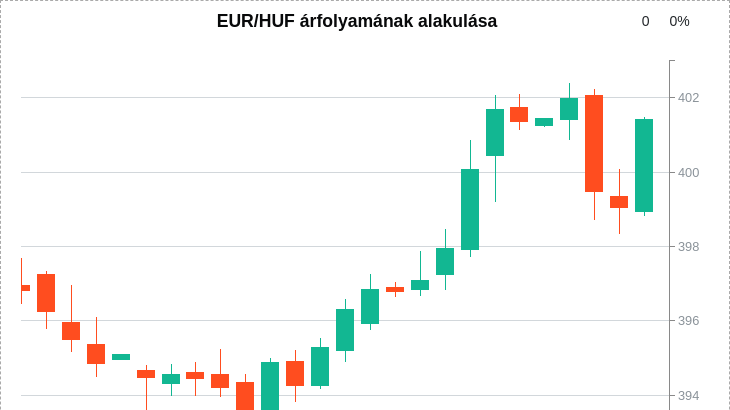
at the current forint exchange rate there is no way the central bank can ease, and as we have seen, even verbal intervention was needed this week to protect the forint.
János Nagy, Erste Bank
The figure was slightly better than both our expectations and the consensus of analysts. The domestic headline figure last hit the central bank's medium-term target nearly four years ago. Core inflation, on the other hand, rose to an annual rate of 4.8% in September.
Overall, we see inflation remaining in the target range as a temporary phenomenon for the time being.
The base effect is quite negative for the rest of the year. The biggest question in the months ahead is how much room for further price corrections the economy will have at the end of the year, as it rebounds from a year and a half of recession.
The combination of dynamic domestic wage growth and the increase in rail track access charges will put pressure on operators during the autumn. Moreover, the additional charges for banking [financial transaction tax hike and new FTT] announced in June may soon be reflected in the fees. Price pressures are also visible in producer prices.
Overall, we expect the index to rise again for the rest of the year, with a range of 4.0-4.5% expected for December. The base will be quite unfavourable, especially in the last quarter, so that the headline rate could then again move out of the central bank's tolerance band.
We expect the disinflation process to resume next year and inflation to return to the central bank's target range on a sustained basis only in the second half of 2025.
The favourable data could, as always, raise the possibility that the central bank could be looser than planned at the next meeting, but the core inflation rate, which was close to 5% in September, and the weakening of the forint should guide the MNB towards a no-change decision.
Márta Balog-Béki, MBH Bank
On a monthly basis, the price of services fell by 0.8%, which was the direction we had expected, but the data came in above our expectations. The last time we saw a price decline in this category was in September 2022. The year-on-year increase in services has moderated to 8.4% from 9.5%, but it is still very high and still not in line with the MNB's inflation target.
For this year, we continue to expect average annual inflation of 3.8%. Following the favourable data releases in August and September, annual inflation could rise again by the end of the year, mainly due to the very low base. By the end of the year, the headline index is still expected to be around 4.5%.
Some disinflation is forecast in early 2025, but the pace of return to the inflation target is a slower process,
and core inflation developments do not suggest that inflation could easily be brought down to 3% already next year.
Wage growth dynamics could remain relatively high until 2026, which could also put downward pressure on inflation. A stable and sustainable achievement of the central bank's inflation target of 3% is expected only in 2026, and more likely in the second half of that year.
The central bank will hold three more rate-setting meetings this year and, in an otherwise supportive international interest rate environment, there is little likelihood of unchanged rates.
The MNB's Deputy Governor recently suggested that geopolitical tensions and uncertainty ahead of the US elections could justify a cautious approach in October. By the end of the year, we expect the base rate to fall to 6.25%, and rate cuts could continue next year.
The results of our analyst survey conducted before the Sept inflation data came out are available here:
Cover photo: Shutterstock





