S&P warns Hungary's pre-election spending present downside risks to fiscal projections


On 25 October 2024, S&P Global Ratings affirmed its 'BBB-/A-3' long- and short-term foreign and local currency sovereign credit ratings on Hungary.
The outlook remains stable.
"The stable outlook reflects our expectation that Hungary's economic recovery, ongoing disinflation, and stabilizing cost of debt will support the government's fiscal consolidation efforts in the medium term, allowing the government's debt burden (as a share of GDP) to stabilize," S&P said.
- Downside scenario
S&P said it could lower the ratings should Hungary's fiscal performance prove much weaker than the rating agency's forecasts, or if external pressures re-emerge, for example from an energy supply shock, affecting the forint exchange rate and inflation.
- Upside scenario
S&P said it could raise the ratings if Hungary's fiscal position improved significantly, alongside a reduction in its external vulnerabilities.
Rationale
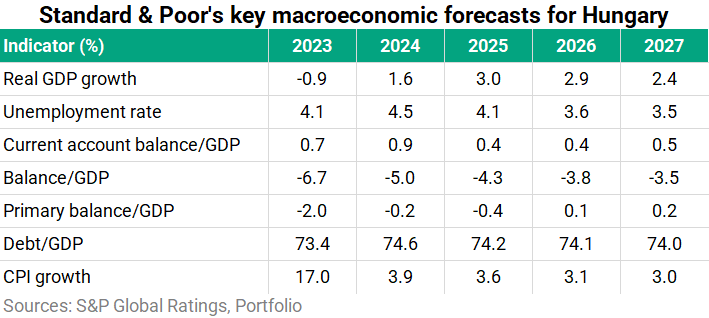
S&P expects Hungary's fiscal deficits will narrow from 2025, then average 3.7% through 2027, considering strengthening economic prospects and active consolidation measures this year–-totalling about 1.3% of GDP. Over the past years, Hungary's public finances have been characterized by overruns of discretionary and non-discretionary spending, including from large outlays on the government's utility cost subsidies and an outsized interest bill.
The table of forecasts in S&P's rating review shows that they expect Hungary's budget gap at 5.0% of GDP, against the government's 4.5% target, a 4.3% shortfall for 2025, against the cabinet's 3.7% goal, and a 3.8% deficit for 2026, against the government's 2.9% target. S&P does not believe the budget deficit will be pushed under 3.0% of GDP even in 2027, for which year they expect a 3.5% gap.
Discretionary spending hikes ahead of the 2026 elections still present a downside risk to our fiscal projections,
S&P warned.
We have recently written about this problem:
S&P highlighted that compared with other countries in the region, Hungary has one of the highest debt-to-GDP ratios, reaching 74.6% of GDP in 2024 according to S&P's forecasts, up from 73.4% in 2023. The rating agency projects only a moderate decline in the debt ratio to 74.2%, 74.1% and 74.0% for the next three years, respectively.
They project interest spending to represent 9% of government revenue on average over 2025-2027. "This is also elevated and will be sensitive to external developments, including energy costs, EU transfers, and the exchange rate."
S&P's baseline expectation is that inflation continues to subside and that the current account remains in modest surpluses, allowing the National Bank of Hungary (MNB) to cautiously normalize monetary policy.
Key risks to the monetary easing cycle include renewed upward pressure on wages, exchange rate volatility, and commodity import prices.
S&P forecasts Hungarian
real GDP growth of 1.6% in 2024,
accelerating to about 3.0% in 2025, as both investment growth and external demand recover, alongside enduring private consumption. For 2026 and 2027, however, they expect growth of only 2.9% and 2.4%, respectively.
"Strengthening consumer confidence and high pent-up savings across Hungarian households should also bolster growth momentum in 2025, alongside the ongoing monetary easing cycle. Only partially offsetting these factors will be the fiscal drag from the government's consolidation efforts," S&P said.
However, they acknowledge that
the outlook for growth remains somewhat uncertain
considering that Hungary's open and trade-intensive economy remains susceptible to external developments, including growth performance in Germany, Hungary's key trading partner, as well as any spill-over effects from geopolitical tensions on energy or other key import prices.
Hungary's constrained relations with the EU could also lead to delayed disbursement of associated funding. Disagreements with the EU continue to deter the unblocking of further EU funds; without compromise, we expect parts of the allocated Recovery and Resilience Program envelope will be lost.
While EU fund absorption appeared lacklustre through the first half of 2024, S&P forecasts EU fund inflows will help Hungary's capital account balance reach 1.5% of GDP on average per year for 2024-2026, from 0.9% in 2023, somewhat underpinning the rating agency's near-term growth assumption
Nevertheless, the post 2026 pace of EU capital inflows into Hungary is less assured.
They noted that the flow of foreign direct investment as a share of total investment has declined somewhat since 2022, but is set to rebound in light of sizable investments into its electric vehicle (EV) sector and associated battery production facilities, notably from Chinese companies.
"Nevertheless, we think prospects for further investments into these sectors remain unclear and vulnerable to lower demand for EVs across Europe. At the same time, the recent EU decision to impose tariffs on Chinese EV imports could accelerate direct investment into European auto manufacturing hubs including Hungary."
2026 elections and 'state of danger'
S&P recalled that the 2022 general elections gave way to a larger constitutional super majority for Prime Minister Viktor Orbán's Fidesz party (albeit at a cost to fiscal prudence), and the party has since pursued policy continuity despite current economic constraints.
"The government's frequent use of state-of-emergency measures, however--which have been extended on different grounds since 2020--reinforces our view that
checks and balances between different public institutions remain limited.
As the 2026 election approaches, S&P sees risks of difficult policy trade-offs. In their view,
not all economic policy objectives appear compatible
They note, for example, narrowing budgetary deficits and bringing down headline inflation while boosting annual GDP growth to the government's recently raised growth targets. In October 2024, the government announced the outlines of an economic action plan aimed at boosting annual growth to between 3% and 6%. While the details are unclear, the plan entails potentially costly (and inflationary) fiscal measures to make housing more affordable, to boost wages, and to raise support for small and medium-sized enterprises.
Although not our baseline, we see some risks of budget overshoots ensuing.
"Weaker fiscal outcomes would likely complicate the central bank's capacity to meet its inflation targets, worsening the coordination between fiscal and monetary policy." Although they anticipate that the appointment of a new central bank governor in March 2025 could yield a more growth-supportive MNB compared with the current regime, they do not foresee the bank taking an excessively dovish tilt.
S&P also assumes that
Hungary's near-term fiscal performance will also be affected by utilization of state-owned enterprises for offloading fiscal outlays.
"We think these quasi-fiscal channels (Eximbank and Development Bank, among others) will remain incorporated in the government's fiscal deficit management and funding strategy. For 2024, we include off-balance-sheet debt uptake of 1.25% of GDP, related predominantly to the government's acquisition of Budapest Airport in June 2024. The government acquired 80% stakes in the airport, which it financed via the budget allocation, a loan from Exim Hungary, and proceeds from assets sales."
About the banking sector
"In 2024, Hungarian banks achieved similarly high profits like in 2023, with a systemwide return on equity of 19.9% in June 2024 from 22.8% the year before, owing to strong net interest incomes and robust asset quality. Despite the economic slowdown, we do not observe a material worsening in credit quality as household creditworthiness remains resilient and the stabilization in asset quality was supported by the reclassification of transactions previously falling under the payment moratorium.
"Systemwide funding figures continue to be sound while Hungarian banks are occupied with issuing loss-absorbing instruments to meet final regulatory minimum requirements for own funds and eligible liabilities. Liquidity reserves are ample, supported by the rise in household savings and rising central bank reserves.
Nevertheless, repeated proposals or intentions to curtail the central bank's independence pose a material downside risk to our assessment of the domestic banking sector, if they were to pass the legislative process,
the S&P said, highlighting another interesting risk factor.
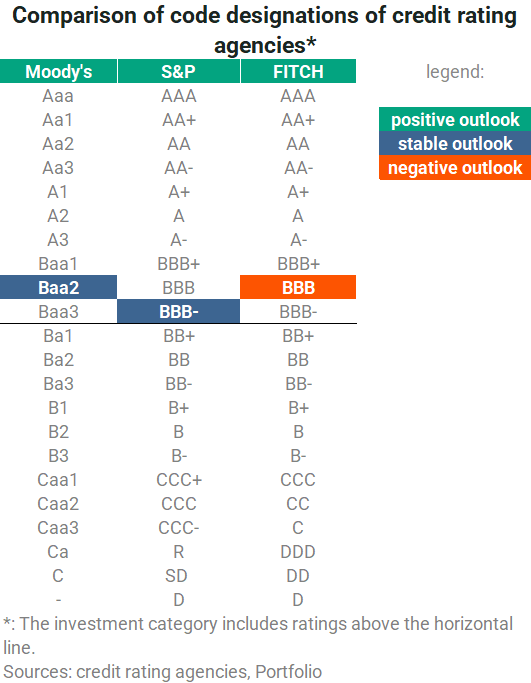
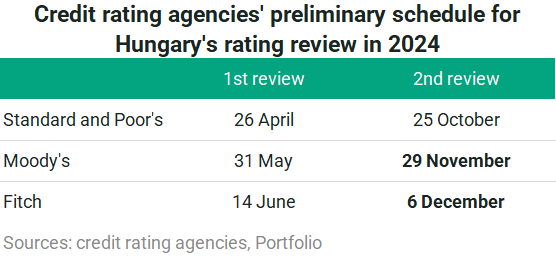
Two more rating reviews are due this year, one in late November and another one in early December (see table below). S&P has a BBB- rating, a single notch above junk grade, on Hungary since a downgrade in January 2023.
Economy Ministry reaction
The ministry reacted almost immediately to the rating agency's decision on Friday night, describing the outcome of S&P's review as a sign of unbroken confidence. The ministry wrote that "although we are going through a difficult period, there are more and more positive signs pointing in the direction of a turnaround in the Hungarian economy".
The ministry also mentioned the government's new growth target of 3-6% and that the recently announced 21-point action plan will make this target achievable.
Finance Ministry reaction
Finance Minister Mihály Varga made a short video statement from Washington on the S&P decision. In it, he underlined that Hungary remains in investment grade at every rating agency. The minister highlighted the assessment of S&P's that the Hungarian economy could be on a stronger path next year.
Reducing the budget deficit also serves to create more fiscal and financial space for economic growth, said Varga. The minister also recalled that since the outbreak of the Russian-Ukrainian war, nearly 20 credit rating reports had been prepared on Hungary, which, according to him, concluded that the Hungarian economy is crisis-proof, the conditions for growth are right and the country is a good place to invest.
Why rating agency moves matter?
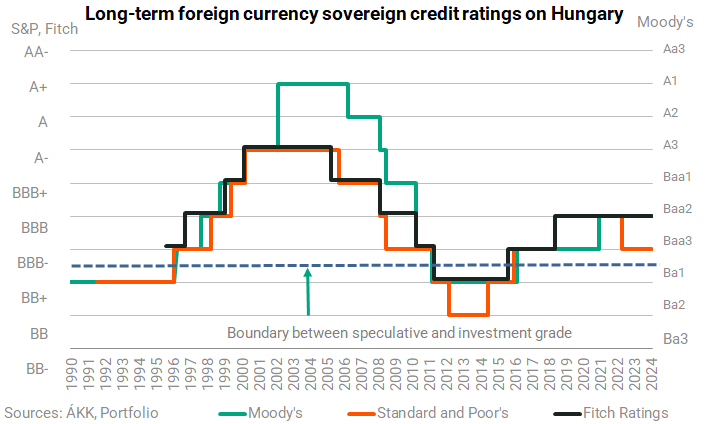
Although credit rating agencies play a smaller role in investors' risk assessments, the rating still matters, especially when it comes to deciding between the two broad categories of "investment grade" and "non-investment grade" (i.e. "junk" or "speculative").
A one-notch downgrade by S&P would have landed Hungary's debt rating in junk grade. Exactly what automatic action (forced sell-off) this would trigger is not entirely clear.
On the one hand, most financial institutions prefer to rely on the majority opinion of the big three rating agencies, but on the other hand, to avoid market turmoil, financial market participants may bring forward such decisions if they expect the other rating agencies to follow suit soon and downgrade Hungary to non-investment grade.
Knowing how credit rating agencies work, this cannot be too close, because although the economic calendars show that the other two institutions will also have rating reviews on Hungary this year, they still have Hungarian long-term sovereign debt rating two notches above junk.
What has changed at S&P?
S&P last issued an opinion on the Hungarian economy and the factors affecting its debt rating just six months ago. At the time, the rating agency's experts focused on fiscal policy, stressing that they believe the government will keep the deficit at around 4% of GDP, which will allow Hungary to stabilise public debt in the medium term.
They also projected that the debt-to-GDP ratio would jump to 75.6% this year, stagnate at the same level next year, and even rise to 75.7% in 2026, from where it could start to fall.
The rating agency had already identified slippage in the budget as a risk in its analysis, although since then the government has intervened in two stages ([putting off investments and raising taxes). At the time, the Hungarian economy was forecast to grow by 2.2% of GDP this year.
What next?
As we reported earlier, the next few weeks could also bring some excitement on the rating side in terms of investor sentiment towards Hungarian assets. Moody's is up next on Hungary's debt rating, followed by Fitch. For both ratings, Hungary is one notch higher than S&P, but Fitch has a negative outlook since January 2023.
Cover image (for illustration purposes only): Getty Images





