Hungarian growth could be surprisingly anaemic also in 2025, Erste cuts forecast


Hungary's gross domestic product contracted by 0.7% quarter on quarter in July-September this year, undershooting the market's call substantially.
In a research note published on Friday, analysts at Erste Bank in Budapest reminded that details of the figures are not available yet, and the Central Statistical Office (KSH) will publish them in early December.
According to preliminary information, industry, construction, and agriculture were the most significant negative contributors. Services probably contributed positively to the GDP; however, their performance was not strong enough to offset the setbacks in the production sectors. On the final use side, given still low business sentiment and weak corporate lending activity, investments might have continued the declining trend.
On the other hand, households’ consumption probably remained a positive contributor to the economy in July-September,
the analysts said.
"Challenges related to the outlook of industrial exports do not seem to be resolved in the short term," they added. Thus, they expect only a tiny quarterly growth for the fourth quarter, making the latest 1.4% forecast for the 2024 annual GDP growth unachievable.
Therefore, even without knowing the exact breakdown of the 3Q24 statistics, they have reduced their our forecast for the 2024 annual GDP growth to 0.5%.
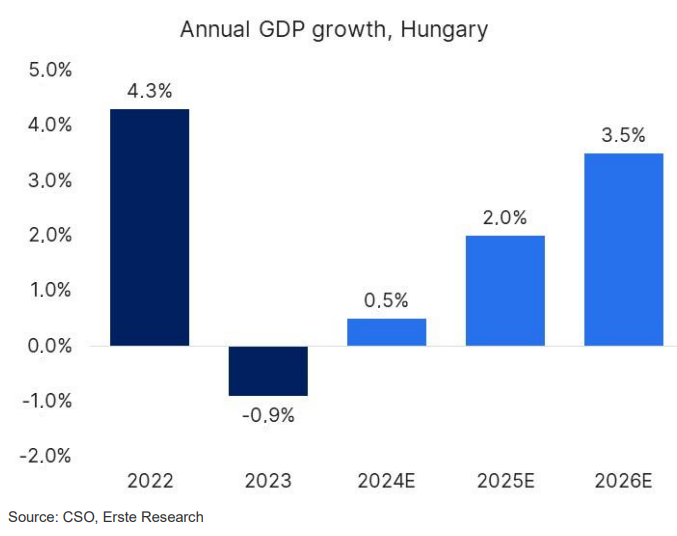
As for next year, they see a gradual recovery from quarter to quarter.
"Underlying processes are still weak; however, some factors support the economy next year. On the back of wage increases, a rebound in consumption would continue. Additionally, fiscal policy should be more supportive than this year, as delayed state investments are set to take place in 2025," the analysts said.
Among the main economic branches, agriculture could improve next year after this year’s poor performance, they added. As for the industry, the start of production at the BYD, BMW, and Mercedes plants should improve prospects for industrial exports.
However, this remains dependent on the overall state of Hungary’s main export markets.
As the statistical carry-over effect from this year is unsupportive, despite the expected gradual, quarter-to-quarter recovery, they see the annual GDP growth just at 2% in 2025. A faster-than-expected rebound of the German economy, however, could pose an upside risk to our forecast, they concluded.
The government expects average GDP growth of 3.4% next year to 2025, according to the draft budget presented yesterday. In September, the National Bank of Hungary (MNB) still expected growth of 2.7%-3.7% in 2025, but the weak third-quarter data were not known at the time.
Cover image (for illustration purposes only): Getty Images





