Big surprise in Hungary's October inflation!


The primary reason why inflation has now started to accelerate is that price dynamics were very subdued in the final months of last year, as prices were affected by the strengthening of the forint, the downward correction in energy prices, the stabilisation after the food price boom and the subdued repricing behaviour of the recessionary economic environment (except for the retrospective price hikes in services).
These factors created a low base for the 12-month price index. However, analysts also expected that there would have been a meaningful monthly repricing this October, which would have contributed to the acceleration in inflation. This seems to be the surprise factor, as the total consumer basket, which measures inflation, was only 0.1% more expensive than in September, while core inflation showed no sign of a price increase on a monthly basis, according to the Central Statistical Office (KSH).

In other words, overall we saw hardly any repricing in the Hungarian economy in October, which is good news for the inflation outlook. Looking at the specific figures, we find that food prices did go up (0.7% m/m), and seasonally adjusted clothing price increases were also apparent in the price statistics (3%). However, the increase in motor fuel prices was perhaps less than expected in October (0.8%).
The real surprise came from services, where inflation has been very stubborn: on a monthly basis, the KSH recorded a 0.9% fall, bringing the annual price index down to 7.2% from 8.4%. The main factor here was the nearly 7% monthly fall in telephone and internet subscriptions.
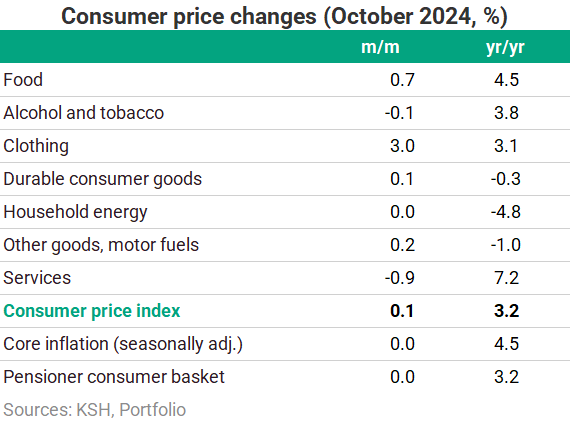
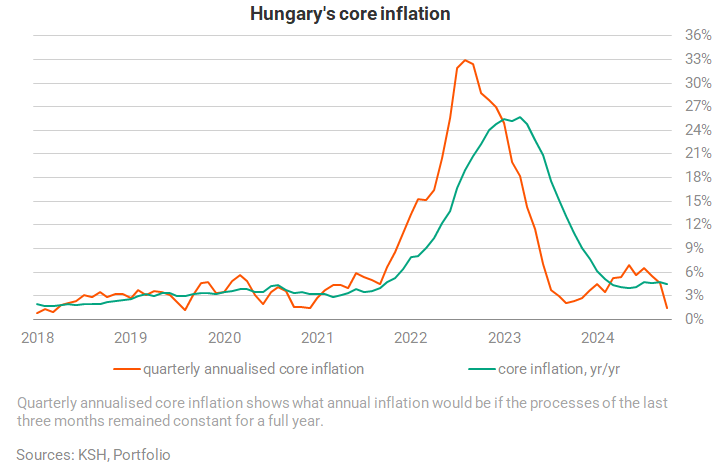
The decline in core inflation to 4.5% from 4.8% yr/yr points to easing inflationary pressures. Even more striking is the spectacularly low (seasonally adjusted) core inflation over the last quarter, at only 1.4% annualised.
Inflation does not reflect the substantial forint weakening thus far. This is particularly evident in the case of consumer durables, where there was a marginal deflation on an annual basis. This also points to uncertainty about the outlook: repricing may intensify in the coming months as a result of the weak exchange rate.
At the same time, the subdued pricing decisions of recent months suggest a lower-than-expected inflation path. The big question is how the combined effect of these two factors will shape inflation in the run-up to December. More uncertainty factors will come into play next year, one of the most important being the upward impact of tax increases, but the uncertainty about the wage agreement does not make forecasting any easier, either.
Among the many influencing factors, one should also highlight the rampant retrospective price hikes in services last year, based on past inflation. In many cases, this led to price increases of 15-20% last year, but now we can only expect price hikes of less than 4%, which theoretically dampens the 12-month price index.
It is worth noting that the surprisingly low autumn inflation occurred against a background of real wage growth of around 10%. This, combined with weak retail sales data in October, suggests that the Hungarian economy is not exactly bubbly, to put it mildly.
As for the details, within the monthly average increase of 0.7% in food prices, the price of flour and seasonal food (potatoes, fresh vegetables, fresh domestic and tropical fruit in total) increased by 3.5-3.5%, the price of butter spreads went up 3.4%, cheese by 3.2%, cooking oil by 2.7%, milk by 2.1%, eggs by 1.6%, dairy products by 1.4% and poultry meat by 1.2%. Pasta cost 2.3% less, while the price of Bologna sausage (informally baloney) and sausages dropped 1.2%, margarine and sugar prices decreased by 1.1% and 0.5%, respectively.
The change of season brought a 3.0% rise in the price of clothing. Prices of automotive fuel increased by 0.8%. Household energy prices remained stable on average, with cylinder gas 0.5% and electricity 0.2% more expensive, firewood 1.1% and piped gas 0.1% cheaper. The price of services fell by 0.9% on average, including a 6.8% drop in the price of telephone and internet services and a 1.1% moderation in the price of holiday services.
Cover image (for illustration purposes only): Getty Images





