Hungary will soon have 1 million people earning minimum wage and the guaranteed wage minimum


Currently 214,000 people earn minimum wage and 325,000 the guaranteed wage minimum in Hungary, according to government documents obtained by Portfolio. There are almost 200,000 people between the two minimum wages, meaning that nearly 740,000 workers earn no more than the guaranteed wage minimum.
The interesting part of the story is that in the long term, we see a basically downward trend in this, as the overall skill level of workers improves and the economy whitens.
However, the trend is expected to reverse in the coming years, with more and more people earning the minimum wage and the wage minimum for skilled workers.
This is essentially linked to the government's ambition to see the minimum wage rise to half the average (regular) wage by 2027, up from 44% last year.
This would require the minimum wage to grow faster than the average wage in the coming years. This, according to government calculations, will result in more people taking home the lowest wage.
- According to an analysis obtained by Portfolio, the number of people taking home the minimum wage will rise to 341,500 in 2027 from 214,000 currently.
- Also, the number of those earning the guaranteed wage minimum will go up to over 600,000 from the current 325,000.
- Meanwhile, there will be "only" 187,000 employees earning between the two wage categories instead of the 199,000 currently.
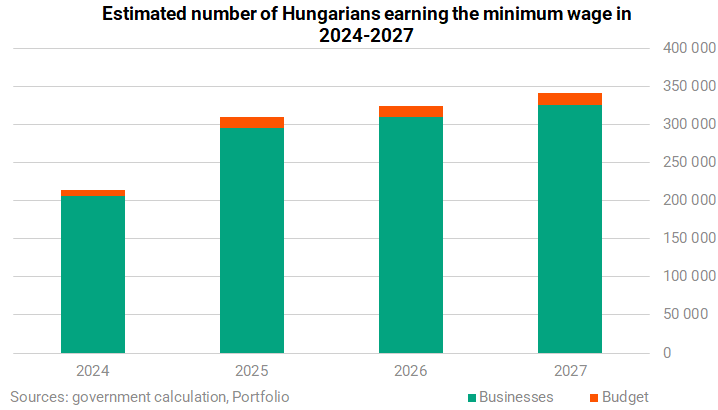
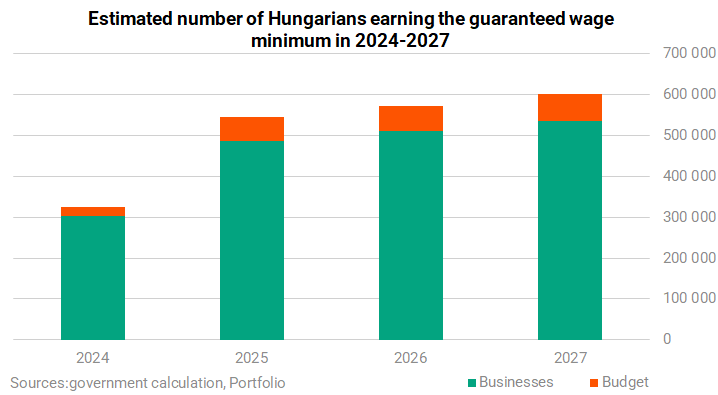
Overall, if, as the government intends,
the minimum wage increases significantly in the coming years, while the average wage does not, there will be more and more people whose earnings will match the minimum wage.
These are mostly those whose gross wages are still only slightly above the minimum wage and the wage minimum for skilled workers.
It is estimated that by 2027, 1.13 million people could be earning up to the guaranteed wage minimum. This means that the number of people whose wages are determined at the meetings of the Permanent Consultation Forum of the Private Sector and the Government (VKF) would increase by more than 50% compared to this year.
Cover photo (for illustration purposes only): Getty Images





