We'll have to wait a while for the next rate cut in Hungary - analysts


At its latest policy meeting, the National Bank of Hungary left the interest rate unchanged at 6.5%. At the post-meeting press conference, Deputy Governor Csaba Kandrács said that the central bank may keep interest rates at this level for a long time to maintain the forint's interest rate premium against the dollar. The last rate cut was in September and this could well be the last easing for some time.

All economists surveyed by Portfolio expect interest rates to remain flat in November and December. Expectations for next year are mixed, with forecasts for the end-2025 base rate ranging between 4.75% and 6.25%.
the market is also split over when the easing could continue.
Most of them see a chance of this in the first or second quarter of 2025, but there are also forecasts that the rate cut will not resume until the autumn. However, most respondents think that a rate hike is unlikely: only one analyst mentioned this scenario, but he can only envisage a temporary tightening in the "extreme case".

Cenbank to hold rates despite lower-than-expected inflation
Inflation in the autumn was below expectations, with the October figure (3.2% yr/yr) also surprising on the downside. Analysts surveyed by Portfolio projected inflation to pick up to 3.5% from 3% in September, i.e. the acceleration was much smaller than expected.

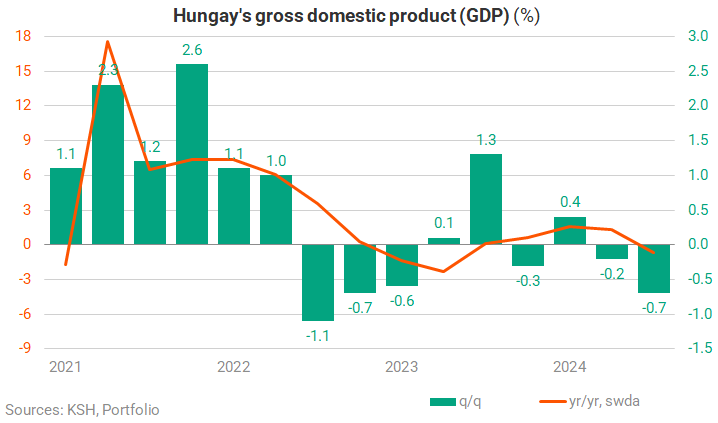
"Although the positive surprise factor in the latest inflation data and the negative surprise factor in the third quarter GDP data would allow for further monetary easing, other factors are likely to be the main concern of the Monetary Council," Orsolya Nyeste, chief economist at Erste Bank in Budapest, wrote in an e-mailed response to our questions.
On the risk perception front, the situation has deteriorated further since the end-October rate decision meeting,
she added.
"The forint has continued to weaken and is showing high volatility against both the euro and the dollar. Interest rate expectations have also materially repriced in the market and volatility has increased on interest rate expectations," wrote Nyeste.
She pointed out that the outcome of the US presidential election has also been revealed since the last meeting, triggering intense market reactions and rapid dollar strengthening, leading to a weakening of emerging market currencies, including the forint.
"As the MNB's decisions have been largely influenced by the stability of the money and capital markets for some time now, and the risk of a possible spillover of the forint's weakening into inflation is also an important consideration, the MNB is not expected to keep cutting interest rates and will also try to maintain a strict tone in its communication," said Orsolya Nyeste.
CIB Bank considers it out of the question that the MNB will lower its benchmark rate in the current market situation.
"The post-meeting statement of the MPC in October made it clear that adverse changes in the external risk environment and a deterioration in the country's risk perception could lead to a more prolonged pause in the normalisation cycle, even if domestic fundamentals provide room for continued interest rate cuts," wrote Mariann Trippon, the bank's chief economist, in her e-mailed response to our questions, referring to subdued economic activity, a strong external balance position and tame inflation in Hungary.
Mariann Trippon highlighted that the new data and information received since the October meeting clearly reinforce the need for caution.
"Following the US presidential election, the dollar strengthened substantially, Fed rate cut expectations eased and overseas risk-free yields climbed even higher. These shifts have not benefited emerging market assets," she wrote.
Trippon reminded that the EUR/HUF cross jumped to 412 after the election, and although it has since stabilised in the 405-410 range, the forint's perception remains fragile. The long end of the yield curve for government bonds has shown a similar movement, but the 10-year yield is still higher than at the time of the October rate decision. In the short term, the decline in interest rates has been fully priced out of futures.

We expect interest rates to be maintained in line with central bank guidance and a weakening forint,
said Sándor Jobbágy, senior analyst at Concorde. He added that the weakening of the forint between 15 October and 15 November was greater than the weakening of other regional currencies and even most emerging market currencies.
"The October inflation figure was lower than expected, but this did not materially improve the longer-term outlook (significant one-off effect and core inflation still above 4% and slowly declining)," he highlighted another aspect of inflation.
No reason to raise rates either
According to Zoltán Arokszállási and Márta Balog-Béki (MBH Bank), the lower-than-expected inflation data in October and weak economic performance could justify a rate cut, but the forint which has eased considerably since end-September - hit also by the significantly stronger US dollar and intensifying rate cut expectations overseas - is unlikely to allow the MNB to continue cutting rates for several months. The analysts also addressed the issue of a possible interest rate hike.
There have been moments in recent weeks when the market has been rather pricing in a modest rate hike for the coming months, but we do not think this is warranted,
they wrote.
According to MBH, a further significant weakening of the forint is less likely from a fundamental point of view: for example, a large current account surplus would not really support a continued weakening of the forint.
"Of course, the strengthening of the US dollar is not good for emerging market currencies. At the same time, the dollar has already strengthened a lot in the weeks leading up to the US presidential election, and while Donald Trump's victory has indeed increased the likelihood of a higher overseas interest rate path, it is quite uncertain what measures the president will implement. Thus, in the dollar market, a significant part of the potential measures could already be priced in," the MBH analysts wrote.
In addition, the political relationship between the Hungarian government and the new US administration is expected to be strong, and while it is difficult to see the possible positive economic consequences of this at the moment, this factor could support the forint market from a sentiment side, they added.
The MNB may cautiously restart rate cuts in the second quarter of 2025,
the wrote.
Although the economy would benefit from lower interest rates, investors should not expect the new governor to take a big risk on monetary policy after György Matolcsy's mandate expires in March, Gergely Gulyás, the minister in charge of the Prime Minister's Office, told Bloomberg last Thursday.
He acknowledged that Finance Minister Mihály Varga is widely expected to succeed Matolcsy, although he said the decision is up to Prime Minister Viktor Orbán, but Bloomberg reports that he appears to have 'spilled the beans' immediately afterwards, saying that those who know Varga understand that he will not engage in sharp monetary easing that would shock the market.
Acocrding to the MBH, these remarks did good to the market. "Given the stronger dollar, the more uncertain market situation, the still relatively high inflation expectations for next year (think of the inflationary impact of the weak forint and significant minimum wage increases, and still high household inflation expectations), caution is warranted. At the same time, the weaker-than-expected GDP data suggest that the cyclical position of the economy could have become even more disinflationary," they wrote.
In our view, inflation should remain within the tolerance band for most of 2025, leaving room for interest rate cuts next year.
"This may be supported by the fact that the Fed (fear of Trump or not) is expected to lower interest rates further next year. Thus, from the second quarter of 2025, a cautious resumption of interest rate cuts in Hungary is likely, with a 5.75% base rate expected by the end of next year," wrote Árokszállási and Balog-Béki.
According to the central bank's forward guidance, the base rate could remain at the current level until February next year, which is essentially caused by the volatility of the forint rather than the underlying inflation rate,
wrote Péter Kiss, investment director at Amundi Fund Management. However, he said that tying monetary policy to the forint exchange rate to such an extent could be dangerous, especially when the measures introduced by the newly elected US president could cause more volatility in currency markets.
The theoretical scenario of a possible interest rate hike was also mentioned by Zoltán Varga (Equilor): "In the first or second quarter of next year, we expect a further 25 basis point rate cut in the base case. However, if the forint were to weaken further sharply, the continuation of the easing cycle could be delayed, and in the extreme case, a temporary tightening of monetary conditions cannot be ruled out." Zoltán Varga does not expect a rate cut on Tuesday either.
New MNB chief will not be able to cut at once
A few months ago, the central bank communicated that at each rate-setting meeting, the question was whether to leave the base rate unchanged or cut it slightly (by 25 basis points).
Since then, the world has changed dramatically, and easing is out of the question, despite favourable inflation data,
commented Gábor Regős, economist at Gránit Fund Management. He pointed out that the forint has weakened significantly over the past month and a half, from around 390-395 to around 410, and that this appears to be the equilibrium exchange rate.
"And this is not pleasant for the central bank because of its two mandates: on the one hand, it drives inflation higher, and on the other, it reduces confidence in the forint, which leads to the conversion of savings into foreign currency, or possibly to their transfer abroad", wrote Regős.
In his view, the question is not whether the central bank can lower the policy rate, because it clearly cannot do so,
but rather how it can stabilise and strengthen the forint.
"The question is also whether the central bank wants to take action now or whether it will maintain its wait-and-see stance. The risk of holding off is that if another weakening is triggered by some bad news or international event, then greater tightening may be needed, which the central bank clearly wants to avoid."
Gábor Regős, however, said that raising the base rate is probably not even an option, as it would undermine the central bank's prestige. Thus, if the central bank takes any action to strengthen the forint, it could be a move that does not affect the base rate, but involves some kind of tightening, either through changes to the central bank's toolkit or by tightening liquidity.
"It is also clear that communication is no longer enough: before the previous interest rate decision, the central bank made three verbal interventions, which failed to prevent the weakening of the forint," Regős recalled.
He also thinks that the longer term is a question: the current situation seems to indicate that there will be no chance to relax for a while, and that we will have to wait.
It is unlikely that the new central bank president will be able to start his mandate with this, as the market would react violently to such a move,
he underlined. "Easing, as things stand now, could therefore come next autumn - of course, a lot could change in any direction before then. Until then, hopefully our interest rate differential with the major central banks and our regional peers can widen," the analyst wrote.
In this regard, he thinks that the key question is how the Fed's monetary policy changes, as the market has recently started to price in fewer rate cuts than previously.
The upcoming interest rate decision meeting is sure to be of particular importance for international and domestic investors,
pointed out Péter Virovácz (ING Bank). However, he said the story is unlikely to be about the November interest rate decision itself, and in his view, the central bank's communication itself will be much more interesting.
"Although there are some voices in the market suggesting that the MNB may already decide on some kind of liquidity tightening measure or verbal intervention, which, conditional of course, could signal the reality of an interest rate hike, I disagree," he added.
So he thinks
it's worth cooling tempers a bit.
"On the one hand, whatever liquidity-tightening measures are discussed (because there are plenty of options), everything is possible on paper, but in reality each instrument would have some kind of limitation or drawback that would ultimately make premature application a bad idea.
"The same could also apply to the inclusion of interest rate hikes in the narrative. If the central bank is already talking about this, it can easily put itself in the cross-hairs. And large investors will not be afraid to test the theory, forcing the central bank into the very step it would have liked to avoid by such a prior communication," Virovácz commented.
He thinks the central bank will deliver a pack of meticulously deliberated messages that will clearly put prudence, as well as price and capital market stability above all else, it is unlikely that even the theoretical possibility of an interest rate hike will be on the table now.
However, the pressure on the forint is unlikely to ease, he said, adding that the international and domestic economic developments in the near future will make for a rather difficult period for the regional currencies.
"The persistent strengthening of the dollar, geopolitical uncertainties, the vulnerability of countries sensitive to trade developments and, of course, domestic events (change of central bank leadership, intensification of the electoral narrative, possible deterioration of the fiscal situation) are all squeezing the MNB," wrote Virovácz.
He added:
Based on all this, I would now say that the central bank led by György Matolcsy will not be able to deliver further rate cuts.
"Moreover, the new central bank governor may well take the helm at such a difficult time that, even if the market thinks about the exertion any political pressure, there will be little chance of that. Or there will be, but at a very high price," he added.
In his view, it is perhaps no coincidence that, unusually, the government (or more precisely Gergely Gulyás, representing the government) has been open about the fact that he does not see any risk of a drastic change in the direction of monetary policy under the new central bank leadership.
Cover image (for illustration purposes only): Portfolio





