Hungary's public debt took some beating this year


The main economic developments affecting public debt this year were quite different from what the government had planned at the beginning of the year. The (cash flow) budget deficit to be financed has become much larger, economic growth is below all expectations, the forint has weakened substantially and inflation will be much lower than expected. At first glance, these factors all point towards an increase in the debt-to-GDP ratio.
So much so that, given these factors, it is questionable whether public debt will actually fall this year.
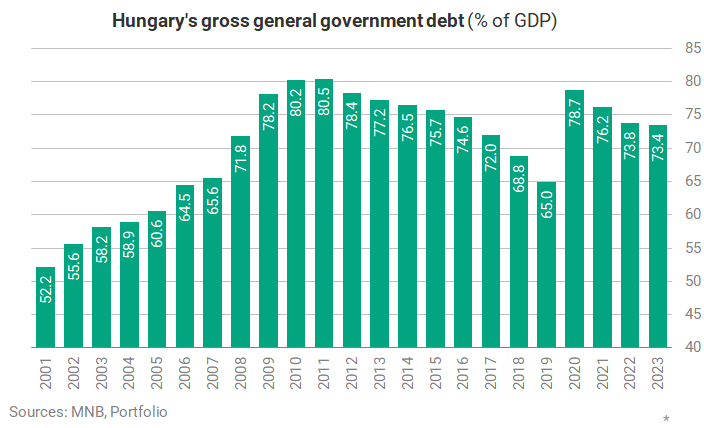
In fact, the issue is a little more complicated than that, as despite the adverse trends, there is already evidence of a government drive to bring public debt below the end-2023 level. But it may still not work. Below, we dive (but not too deeply) into the context of public debt developments and show the effort needed to achieve a reduction in public debt.
This is how we calculate
Because of fluctuations during the year, we tend to look at the evolution of government debt using only the year-end stock change, i.e. government debt goes up if the debt ratio at the end of the year is higher than at the end of the previous year.
The debt ratio is obtained by dividing the debt stock at the end of the year by GDP for that year. For example, at the end of 2023, the debt ratio was 73.4% as the ratio of debt of HUF 55,142 billion to GDP of HUF 75,086 billion.
The change in the indicator therefore depends on the change in government debt and GDP. In forint terms, government debt increases in one year by the amount by which net debt issuance, i.e. the difference between maturing and newly issued debt, increases. It would be logical that this amount should be close to the annual cash deficit of the budget, which is what we have to finance. Government debt is also affected by changes in the exchange rate, which changes the value in forint of government bonds issued in foreign currency.
The nominal value of the denominator of the debt ratio (GDP) increases with economic expansion and inflation. More specifically, we should take into account real GDP growth and the GDP deflator (see below).
Our table below shows how the important factors have changed since the end of 2023:
| Changes in the direct impacts on Hungary's end-2024 debt-to-GDP ratio | ||
| 2023. dec. | 2024. nov. | |
| Net debt issuance plan (2024, bn HUF) | 2,643 | 3,706 |
| Cash flow-based budget deficit target (2024, bn HUF) | 2,514 | 4,790 |
| EUR/HUF exchange rate (as of 31 Dec 2023 and 14 Nov 2024) | 382.8 | 408.0 |
| GDP growth expectation (2024, annual average, %) | 3.6 | 0.7 |
| Inflation forecast (annual average, 2024, %) | 5.2 | 3.7 |
| GDP deflator (for 2024, %) | 4.5 | 8.0 |
| General government debt (% of GDP, end-2024) | 73.2 | 73.2 |
| Source: Portfolio research | ||
The table above shows that since the end of 2023, all economic parameters that directly affect the general government debt ratio have changed significantly. The only thing that remains unchanged is that the government still expects a ratio of 73.2%.
If the numbers add up, the ratio will go up
Taking into account the variation in the factors that influence the debt trajectory, the following simple conclusions can be drawn. The deficit to be financed this year is much larger than expected, and the weaker forint will push up the value of foreign currency debt in forint terms.
Also, at first glance, lower economic growth and inflation mean that this has to be seen in relation to a lower GDP than expected. In other words, everything is in place for an upward trajectory. In reality, however, the picture is a little more complicated than that, with two important factors significantly improving the picture.
- Not everything needs to be financed. This year, the cash deficit of the budget is projected (after several upward revisions) to be HUF 4,790 billion. In principle, this is what net financing should be (as this money has to be raised somehow), and this is how much nominal debt would increase. But the state always has some liquid financial reserves in the Treasury Single Account (KESZ), which means that it can finance part of the deficit for longer or shorter periods. This is clearly what is happening this year: of the HUF 4,790 billion deficit, only HUF 3,706 billion is financed by new debt, the rest by the state's liquid financial assets. This means that, compared to the end of last year, there will be about HUF 1,000 billion less in the KESZ at the end of this year.
- Invisible inflation. As described above, the denominator of the debt ratio, GDP, should be much lower than projected at the beginning of the year, as inflation and real growth have also been well below expectations. But this is not the case. While official inflation, the change in consumer prices, has fallen dramatically, GDP is not only made up of household consumption, but also of investment, exports, community (public) consumption and a few other smaller items. The change in prices per total GDP (GDP deflator) is not 3-4% this year, like inflation, but around 9% in the first half of the year. Indeed, the government now expects it to be around 8% for the year as a whole. For this reason, nominal GDP could be even marginally higher than forecast at the beginning of the year.
Although not strictly related to our topic, it is worth noting how there can be such a huge difference between consumer inflation and the price increase measured on total GDP. The answer is that the price of almost everything within GDP is rising much faster than consumer inflation. For example, investment got 13.3% more expensive and public consumption got 10.6% pricier in the first half of 2024. It is not a gross oversimplification to say that where the state is present, inflation has remained high.
So, will there be a reduction or not?
After this longish introduction, let's see what the numbers show. As the end of the year is near, there are very few uncertainties, so we can make a relatively accurate forecast. Calculating with a
- GDP growth of under 1%;
- a GDP deflator of around 8%;
- net financing of around HUF 3,706, as per the debt financing plan;
- an EUR/HUF exchange rate of 408
we get a debt-to-GDP ratio of between 73.3% and 74.1%.
There is, of course, still some uncertainty about this, but we can cautiously conclude that the country's public debt processes, which are plagued by the likely overshoot of the deficit target and forint depreciation, are much improved by low debt financing relative to the deficit and inflation.
But even so, it is highly doubtful that the debt will actually be lowered: compared to 73.4% at the end of 2023 (based on our forecast range), it is highly likely that we will see a higher number in December this year.
And then you remember that 'Hey, we can surely 'tweak' this a bit. Indeed, in recent years we have seen several "debt adjustment" manoeuvres from economic policy. One way to go is to prop up the HUF at the end of the year, which reduces the value in forint of debt denominated in foreign currency.
There may be an opportunity to do so now, as there is room to remedy some of the forint's nearly 7% weakening this year, and all it would take is the 'burning' some of the foreign exchange reserves.(HUF depreciation this year will increase the debt ratio by about 1.5 percentage points.)
The other option is to further curb debt issuance, i.e. to ensure that debt financing falls short of the budget deficit not only by the HUF 1,000 billion currently planned, but by even more. (In practice, this could be done by the government stopping issuing debt securities and/or buying back some of them at the end of the year, both of which would lead to a further decline in the ready cash deposit (KESZ).)
But this year there are some obvious limits to this solution. At the end of last year, the government had deposits of HUF 1,500 billion, and this is reduced to around HUF 500 billion by the negative net debt financing of HUF 1,000 billion. (Although the government account still showed a HUF 2,500 billion balance at the end of October, make no mistake, it will shrink enormously in November and December.)

Although the state has other, lesser-known liquidity tools, it can still be said that the HUF 500 billion KESZ balance is abnormally low, the last time the indicator fell so low was before the 2008 financial crisis. That is why they should seriously consider how much lower it is worth reducing the state's liquid reserves. Especially in the run-up to a period as difficult to predict as the first quarter of 2025 (with its large retail government bond flows).
And all these risks have to be assumed in order to achieve debt reduction, while they might not even do the trick. The unexpectedly weak performance of the economy may have an impact on fiscal developments in the last months of the year, and there is a long tradition of year-end profligacy in Hungarian fiscal policy.
In other words, it may well be necessary to boost this year's debt issuance by a few hundred billion forints, after which it will be completely unnecessary to burn foreign exchange reserves or to seriously exhaust liquid reserves.
On this basis, it may well be a more rational decision to simply let go of this year's debt reduction commitment.
Cover image (for illustration purposes only): Getty Images





