Back to the office? Working only from home? Let's lay these stories to rest at last!


The questions to be answered in this article:
--- How many people work from home in Hungary?
--- How has the situation changed since Covid?
--- How about remote work in manufacturing and in the services sector?
--- Is remote work more widespread in Budapest on in the rural areas?
--- What educational attainment is necessary to be able to work from home?
--- Which companies could tighten remote work rules and which firms could leave them unchanged?
- Returning to the office. Returning to the office has been a hot topic in recent months. Experts predict a continuation of this trend. Many believe that, in time, the possibility of working from home will disappear altogether.
- Other companies complain that they can only recruit if they offer remote work for almost every working day of the week. The first question candidates ask is whether telework is on the menu, and if not, they slam the door behind them.
Two completely contradictory pieces of information are now circulating in the labour market. Indeed, in the US and Western Europe, companies have recently announced that they are ordering workers back to the office.
In Hungary country, however, we have seen only very few examples of companies tightening up significantly. Even then, it was usually mostly due to central company guidance or government tightening.
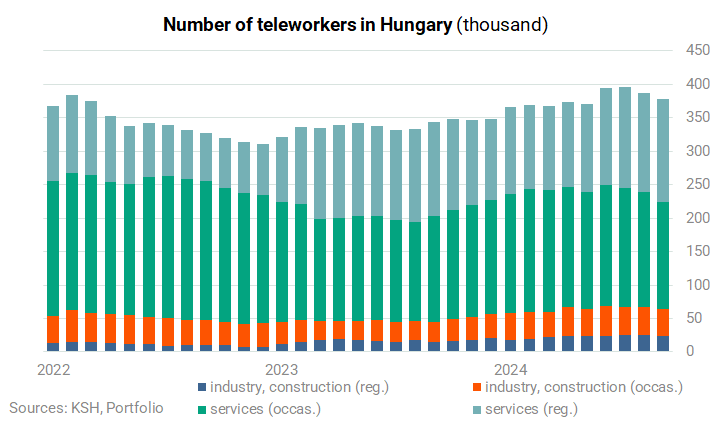
In Hungary, the number and proportion of people working partly or entirely in work-from-home jobs has been stable at between 7-8% since the Covid waves passed.
In fact, as the graph below shows, the number of jobs offering more flexible working has even increased slightly over the last 18 months. The number of people working occasionally or regularly from home has risen from below 350,000 at the beginning of 2023 to 380,000-400,000 now, according to the Central Statistical Office (KSH). So in Hungary, it looks as if return to office is dead in the water.

During the coronavirus pandemic, there were 600,000 to 700,000 people working remotely, representing 13-15% of the workforce, but you can see that in the third wave, companies were much less lenient than in the first two.
As Covid has subsided, the share of people working from home has stabilised at 7-8%, a huge jump from 1-2% before SARS-CoV-2. In other words, the coronavirus crisis has brought about a lasting change in the world of work, as it has become clear that many people can work effectively in hybrid working arrangements.
It seems that a new world has emerged in the Hungarian labour market after Covid, which has brought stability in the ratio of office work and working from home due to a number of factors (e.g. the power relations between employees and employers, the changing work-life balance, the realisation of how efficient teleworking could be).
About the survey
Of course, you could say that the statistical office is also working on the basis of "just a survey". This is true. But it is the largest and most comprehensive survey in Hungary. The one that also gauges national employment and unemployment. They don't survey 500 or 1,000 workers/employers once every one or two years, but they probe more than 35,000 people continuously. They don't just look at one sector or region, but the whole country.
According to the KSH, the Labour Force Survey is the agency's "largest continuous population data collection, which aims to provide comparable data on the labour market situation, employment and unemployment in the country". Responding households are selected by random sampling in different municipalities across the country.
The data sent to Portfolio by KSH shows that, unsurprisingly, most people work from home in the services sector, where it is easiest to work from virtually anywhere with a laptop and a basic internet connection.
But there are also opportunities for some workers in industry and construction to work from home, obviously among white-collar workers.
Working from home seems to have become essentially the privilege of the intellectuals in Budapest. More than 20% of all employees in the capital work partly or entirely from home.
This is not surprising given that the service sector is the most important and teleworking generally requires self-employment, which is associated with higher levels of education.

Outside Budapest and Pest County, the share of those working remotely is below 5% everywhere, as industry, construction and agriculture are mostly concentrated in these regions.

- The above results suggest that in fact only a few multinational and high-paying domestic companies have been able to tighten their work location standards substantially without losing competitiveness in the recent period. These are the businesses that offer salaries above the market average. They could be in such a position because if the employees, for some reason, perceive their working conditions as worsening, they may start to look for another job. But as they cannot really find anything offering such a high pay, they will stay put even though they are required to show up in the office more. Regardless of what anyone claims, wages are still the most important consideration for Hungarian workers. This is especially true after the livelihood crisis.
- Companies that just "match" the market average in terms of wages, or pay even slightly less, but wanted to maintain staffing levels, could not tighten the rules markedly. Going down this road carries the risk of losing key employees whose absence could put a crimp in the works of the whole company.
- However, if a larger reduction in the workforce or a greater fluctuation would not cause a problem (e.g. because they are planning layoffs in a recessionary period, and in-house unemployment is becoming more severe in any case), the return-to-office mandate could be made rigorous. It could even help as employees might leave on their own accord so they would not have to be fired.
That was until now. When the relatively high number of vacancies and relatively low unemployment have been a drain on workers. But labour shortages are easing, albeit slowly, while unemployment has started to rise in recent months, as GDP has stagnated for longer and the recession has returned.
If unemployment across a wide range of sectors were to rise temporarily, in parallel with a fall in labour shortages, firms could toy with the idea of abolishing remote work.
However, companies will certainly not want to take advantage of the worsening labour market momentum to implement harsh tightening measures, as the coming years may again be about convergence to full employment and increasing labour shortages.
The definition of telework
The current definition of telework is based on the KSH Labour Force Survey (MEF): teleworkers are defined as employees who regularly or occasionally work from a place other than their place of work (from 2023 onwards, at home), using IT and telecommunication equipment. (Home office workers are also included here.) From 2023, only those who have worked from home regularly or occasionally in the last four weeks are asked whether they teleworked, KSH said in response to an enquiry by Portfolio.
The telework is considered to be regular if the respondent has spent at least half of the time spent working in the last four weeks in this form. If the time spent with telework does not reach 50% of the time spent working, but has occurred in the last four weeks, it is considered occasional.
Cover image (for illustration purposes only): Getty Images





