Verdict to be delivered on Hungary on Friday, critical days ahead for the forint


Global equity markets were struggling to recover from the previous week-end slump last week, when Wall Street's post-election rally stalled. The Dow ended the week up 2%, while the S&P 500 and Nasdaq closed up 1.7% each.

The EUR/USD exchange rate pair has been more volatile this week. The Euro weakened significantly against the US Dollar, influenced by economic data and Fed communications. Market participants have been paying close attention to statements from the European Central Bank and the Federal Reserve, weighing up their potential impact on future monetary policy.

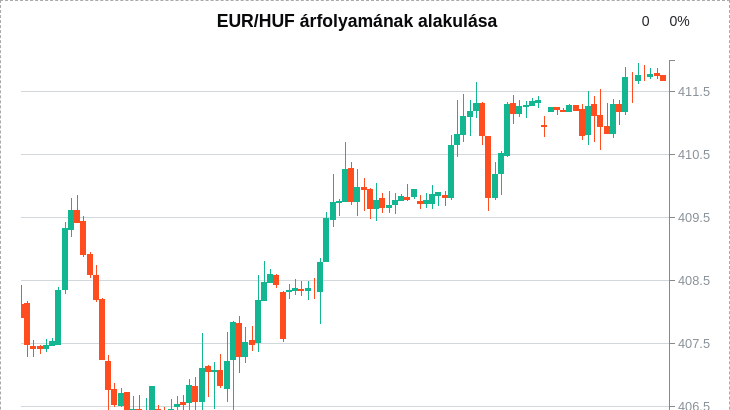
The forint was particularly hurt by the strengthening of the dollar: the Hungarian currency fell to a new two-year low against the euro, with the exchange rate already above 412.4 on Friday.
What should we pay attention to this week?
On the first day of the week, the focus is on the German Ifo index, which reflects economic sentiment in the eurozone's largest economy. The index is particularly important now as the weakness of the German economy continues to raise questions about Europe's growth prospects.
On Tuesday, the Conference Board sentiment index and new home sales data from the United States will shed light on the evolution of consumer and housing demand.
In the evening, the minutes of the Fed's latest meeting could provide clues on the future path of interest rates, which could also have an impact on global financial markets.
Wednesday will be an important day for US macro data, with the release of the PCE inflation (the Fed's preferred inflation indicator) report, the final estimate of third quarter GDP and the new jobless claims report. These data will be key to understanding the resilience of the US economy and inflationary pressures.

In the United States, there will be a Thanksgiving trading holiday on Thursday, while in Europe attention will turn to inflation data. Fresh inflation figures are also coming in from Spain and Germany, which ECB followers will be watching closely for the possibility of further monetary tightening.
Also, we will finally see data from Hungary at that time, with the Hungarian Central Statistical Office (KSH) publishing data on vital statistics and accommodation turnover.
Japan's retail sales data will open the day on Friday morning, reflecting consumer activity in the Asian region. In Europe, alongside inflation data from Germany and France, the German unemployment rate and Eurozone inflation data will be in focus. These data will help to provide a picture of the state of the European economy as the year draws to a close.
Hungarian data from the Hungarian Central Statistical Office (KSH) is back with unemployment and industrial producer prices for October, which could provide important clues about the labour market and inflationary pressures. Also on Friday, third-quarter services and external trade statistics will be released, which can provide a comprehensive picture of the Hungarian economy's international relations and the situation of domestic demand. In particular, the breakdown from the statistical office may be of interest given the deterioration in exports in the recent period.
And later in the evening, Moody's will issue its second credit rating review of Hungary this year.
Last time, at the end of May, no change was made to Hungary's debt rating, and in October S&P Ratings did not touch Hungary's rating either. Moody's maintains a stable outlook on Hungary with a Baa2 rating. The main downgrade risk is a further significant deterioration in EU relations, which would further delay access to funds. This would have a very negative impact on creditworthiness, as
it would weaken trend growth and fiscal indicators and negatively affect Moody's assessment of the quality of Hungary's institutions, according to the organisation.
The weekend will not be uneventful either: on Saturday, China's manufacturing and services PMI indicators will be released, showing the activity of the world's second-largest economy and giving a glimpse of the effects of the recent stimulus in the ailing Asian country.
On Sunday, the OPEC meeting will close the week, where decisions on crude oil supply and global price developments could be taken.
Some member states, such as the United Arab Emirates, are calling for an increase in production quotas, while others are in favour of maintaining current production cuts to stabilise oil prices.
According to analysts speaking to Reuters, increasing output would be risky in the current weak demand environment, while the likelihood of deeper cuts is low given internal resistance. Earlier decisions to gradually cut oil output are expected to be delayed again, showing that the organisation dubbed the oil cartel has less and less room for manoeuvre. The outcome of the meeting could be critical not only for member states but also for the global economy, as oil price developments have a direct impact on inflation and economic activity worldwide.
Cover photo (for illustration purposes only): Getty Images





