Hungary's inflation shows slight acceleration in the penultimate month of 2024


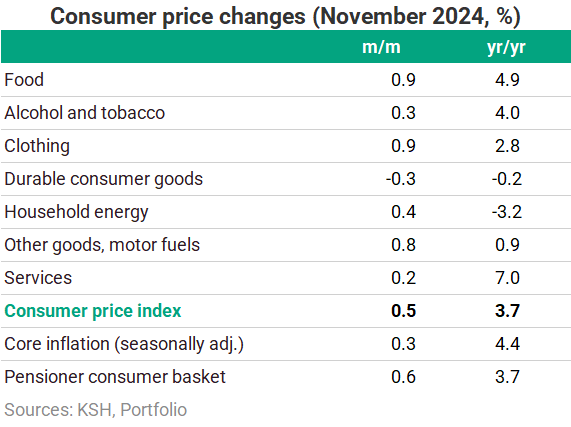
In September, inflation was just at the central bank's target of 3%, from where it accelerated to 3.7% in November. This is a seemingly negative trend, but several factors are significantly improving the overall picture. On the one hand, the overall acceleration in the autumn is much lower than experts had previously expected and, on the other hand, the core inflation rate, which captures the more persistent trends in price increases, has fallen from 4.8% to 4.4% over the same period.

Two questions have been raised by analysts in the run-up to today's data: will the weakening of the forint be reflected in a stronger willingness to reprice, and what will happen to telecoms service charges, where the KSH reported a sharp fall in October?
The answer to both questions seems clear enough from today's figures. The average price level of the most exchange rate-sensitive consumer durables fell by 0.3% in November compared with the previous month, meaning that the exchange rate had no impact on inflation. The price level of telecommunication (telephone, internet) service charges remained unchanged compared to the previous month, meaning that the 6.8% monthly fall recorded in October is now sustainable. This also means that it was not the discounts introduced during the flood but more general price reductions by large operators that led to the price drop.
Although the above two point-price drivers were not present in the statistics, this also implies a risk that there may still be "inflation buffers" in the economy going forward. The acceleration in inflation in November was therefore not due to these factors, but to the classic ones: fuel prices (2.4% month on month) and food prices (0.9% month on month). As food prices were less expensive (0.5%) and fuel prices fell sharply (-3.6%) at this time last year, the increase in the annual price index was also driven by base effects.
Price developments in recent months have, on the whole, matched the very low price dynamics of last autumn (at least in terms of the core inflation indicator).
If the Hungarian economy had a year of price developments like those in the autumn months, inflation would be below 2%.

Inflation is also expected to rise in December, due to last year's depressed exchange rates, and is likely to move out of the central bank's target range of 2-4%. However, the fate of inflation is more likely to be decided early next year. Price increases, tax hikes, wage rises and a weak forint in the early part of the year could boost price increases, while weak consumer confidence and the much weaker impact of backward-looking pricing could dampen the indicator.
On the details
Consumer prices rose by 0.5% on average over a month. Within the 0.9% average increase in food prices, eggs rose by 11.9%, fruit and vegetable juice by 3.8%, seasonal food (potatoes, fresh vegetables, fresh domestic and tropical fruit in total) by 3.0%, non-alcoholic beverages by 2.8%, dairy products by 1.7%, pork by 0.7%, flour by 0.5%, sugar by 3.7%, edible oil by 1.7% and milk by 0.3%. Vehicle fuel prices rose by 2.4%. On average, household energy was 0.4% more expensive, including cylinder gas by 1.5% and piped gas by 0.9%. On average, the cost of services increased by 0.2%, of which rents were 0.8% higher and holiday services 0.3% lower.
Cover photo (for illustration purposes only): Getty Images





