Central bank's recent forecast reflect a long-term optimism about the Hungarian economy


The National Bank of Hungary (MNB) expects a gradual economic recovery for the Hungarian economy, but its latest GDP growth forecast for next year is still just below 3%. The central bank has revised up its 2025 inflation forecast. We know this because two days before the release of the inflation report, the National Bank of Hungary published its two main forecasts, as is customary.
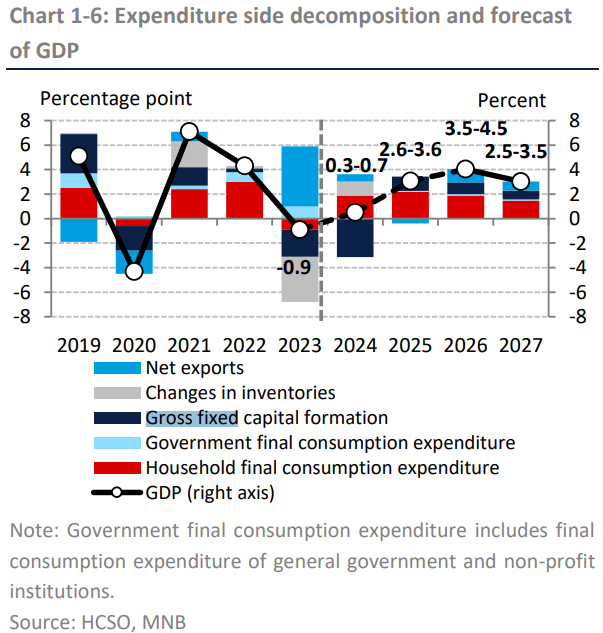
The most predictable change was in this year's GDP growth. After the third-quarter GDP data (which, incidentally, sent the Hungarian economy back into recession), it became clear that the September forecast of 1.0-1.8% annual average growth was not sustainable. In December, the National Bank of Hungary lowered it further to 0.3-0.7%.
The fact that half a year ago central bank experts were still expecting economic growth to reach 2-3% this year illustrates the sharp deterioration in the growth outlook.
The forecast for next year was understandably preceded by greater expectations. Here, the central bank also lowered its forecast from June to September, from a range of 3.4% to 4.5% to 2.7% to 3.7%. Now, the central bank has only revised its numbers down slightly, with a GDP forecast of 2.6-3.6%. The mid-point of this is 3.1%, which means that the central bank is forecasting just enough economic expansion to meet the government's growth target of over 3%. However, the central bank's forecast is lower than the official government forecast of 3.4%. The central bank expects a real big recovery in the second half of 2025.
Key messages
- After a temporary rise in inflation, the disinflation trend is expected to resume in the first quarter of 2025. The CPI returns to the central bank target of 3% on a sustained basis in early 2026.
- The inflation forecast for 2025 is up from the September forecast, reflecting exchange rate depreciation in recent months and supply effects.
- Economic growth is expected to accelerate from mid-2025 on a broad-based path. In addition to consumption, the expansion will be supported by the expected improvement in the external environment, the new capacity coming on stream and government programmes.
- The improvement in the economy is tightening the labour market again, so real wages will continue to rise dynamically, helped by the announced increase in the minimum wage.
- The current account surplus is expected to rise over the forecast horizon. The rise in external balance indicators is mainly driven by an improvement in the external trade balance.
According to the latest forecast, inflation will rise temporarily for a few months, but then start to fall again in the first quarter of 2025, and for most of the year the indicator will remain within the central bank's tolerance band of 2-4%. Inflation will be held in check by the end of the practice of overpricing, which has been a source of profit increases, mainly due to tight domestic demand. A notable risk, however, is that surveys suggest that price increases are gaining momentum, although it is not yet clear whether this is due to seasonal or more persistent reasons.
Growing real income
After high real earnings growth this year, a smaller but still significant expansion is expected next year. Together with other types of income, real incomes in the country are expected to grow at around 4%.

Household consumption will be boosted by an increase in lending and a stabilisation in the financial savings rate.
Investment: delays and overcapacity
The fall in investment this year has been a huge surprise. Next year, the MNB expects a clear improvement, even though capacity utilisation in the manufacturing sector, which is the hardest hit, does not give reason for a huge investment boom. However, the beneficial effects of government stimulus programmes will be felt from 2025 onwards, all the more so as the subdued investment activity in the corporate sector so far has been partly held back by the wait for funds.
The growth curve
GDP growth on an annual basis will just barely return to positive territory in the last quarter of 2024, with really high indices from the second half of 2025, according to the central bank.

What has changed?
To summarise, the central bank's latest forecast paints the following picture of expectations for the year 2024, which is now effectively behind us (but far from statistically closed):
- Economic growth will be lower than the September forecast, mainly due to a larger-than-expected fall in investment and weaker export performance.
- As a result, the labour market is also slightly weaker, at least in terms of employment and unemployment, but wages are expanding at a rapid pace, as previously expected.
- The inflation path has been in line with expectations.
For 2025:
- Household consumption could pick up more strongly and investment growth could also be much higher than previously expected, according to the MNB.
- However, export momentum may be lower than previously forecast.
- As a result of these changes, the GDP forecast is now little changed.
- In the labour market, we see a continuation of this year's changes: employment is likely to be more modest and unemployment slightly higher than forecast in the autumn, but wage dynamics could still be higher than previously expected.

Cover photo: MNB





