Hungarian survey reveals scary price hike intentions


In just one month, the proportion of companies planning to raise prices has increased significantly. According to a survey by GKI Economic Researcher, which uses EU methodology,
the proportion of firms planning to raise prices has increased in all sectors.
This is not surprising, given the regular price adjustments at the beginning of the year, but it also reflects the increase in the minimum wage and the guaranteed wage minimum, which will bring about a marked cost increase for companies. And many companies are trying to shift this burden onto the public, especially now that demand is growing, albeit slowly.
Price hike intentions are weaker in industry and services, and more pronounced in construction. The latter is not surprising, given that most expect the housing market to make a substantial recovery this year.
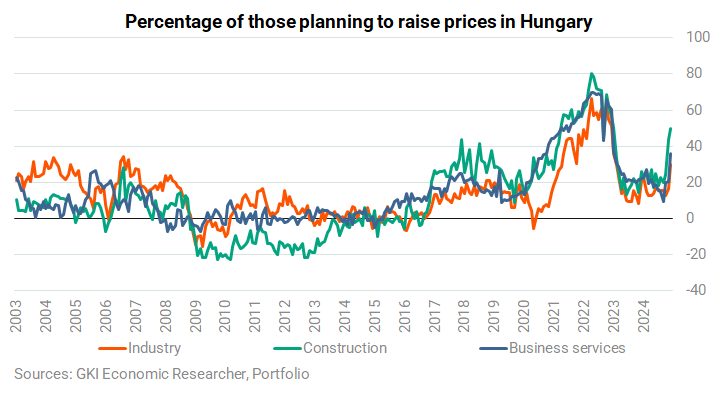
However, as shown in the graph above, the intention to raise prices can be considered historically extremely high in all sectors.
The share of companies planning to raise prices is at an all-time high in construction, disregarding the 2022-23 inflation crisis.
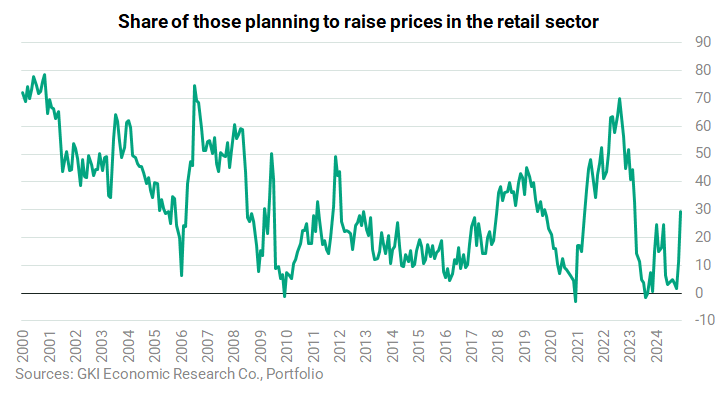
In the retail sector, too, more and more firms are looking to raise prices again, but growth is still subdued by historical standards. The subdued price hike intentions seen in the second half of 2024 are now a thing of the past, and it looks highly likely that companies will not shy away from asking steeper prices.
Consistent with the above, inflation expectations have been on an upward path again in recent months.

Rising demand can lead to higher prices, especially if wages also rise significantly. According to a survey by the Institute for Economic and Enterprise Research of the Hungarian Chamber of Commerce and Industry (MKIK IEER), "the most common reaction of businesses to increases in the minimum wage and guaranteed wage minimum is to raise prices, and in the case of larger firms, to increase the wages of those earning above the minimum".
MKIK IEER also examined the reactions of businesses through a representative sample and an online survey. "Among the most affected firms, the share of those planning to raise prices and of those planning to raise prices a lot is higher. This suggests that the most affected firms are immediately incorporating the increased wage costs into the price of their product/service, risking even a fall in demand," the study says.

Overall, we see significant price hike intentions in industry, construction and the services sector too. Construction companies must be expecting a pickup in the housing market, but obviously all actors see higher demand ahead. However, the share of firms planning to raise prices in the retail sector, which is key to meeting the everyday needs of the population, is historically even more subdued. But the bad news is that surveys show that companies are increasingly looking to the public to pay for wage increases.
Cover photo (for illustration purposes only): Getty Images





