Hungary's inflation accelerates more than expected in December 2024


Inflation was still at 3% in September, from where it jumped out of the central bank's 2-4% target range in December. Previously, experts had expected three main reasons for the December jump in inflation:
- The weak price pressures at the end of 2023, caused by the recession and the fall in energy prices, so that the low base already causes the annual price index to rise for an average month in December (this effect was particularly strong for fuels.)
- Rising commodity prices, mainly reflected in the accelerating pace of food price increases.
- The weakening of the forint, which may be responsible for the rise in the price of imported goods.
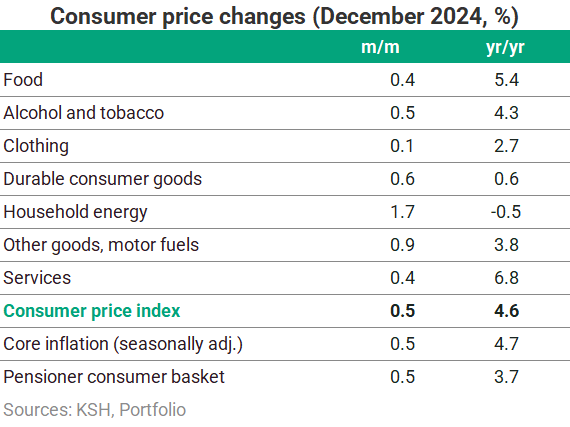
A quick look at the latest data shows that expectations have been fulfilled. Food prices increased by 0.4% on a monthly basis and by 5.4% on an annual basis, meaning that the rate of increase for the most basic product group exceeded the average inflation rate during 2024.
Food inflation was still below 1% in the spring, and after 4.9% in November, it was already foreseeable that it would be well above 5% by the end of the year.
The weakening of the forint has indeed been reflected in prices. Consumer durables (which have a very high import share) rose by 0.6% on a monthly basis. We have not seen this in two years in a product group with very subdued price movements.
At the end of 2023, the price shock was also due to a sharp HUF depreciation. This shows that the weakening of the forint has once again crossed the threshold where importers start to more intensively pass on the depreciation effect in their prices.

One surprise factor was the hard-to-predict, rather technical estimate of piped gas prices, with a 3.3% increase on a monthly basis, which was probably calculated by the KSH as a result of higher consumption due to the cold weather.
Overall, today's data suggest that inflationary pressures in the economy are intensifying, as indicated by the rise in core inflation, which captures more persistent price movements. The indicator moved from 4.4% in November to 4.7% and the short-base index also leaped.
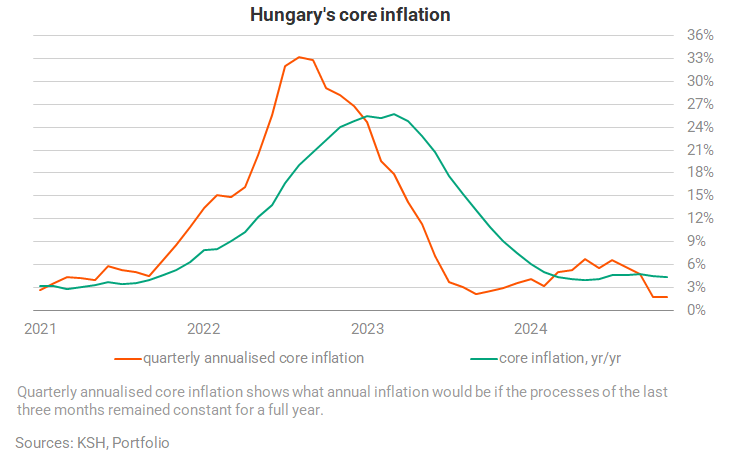
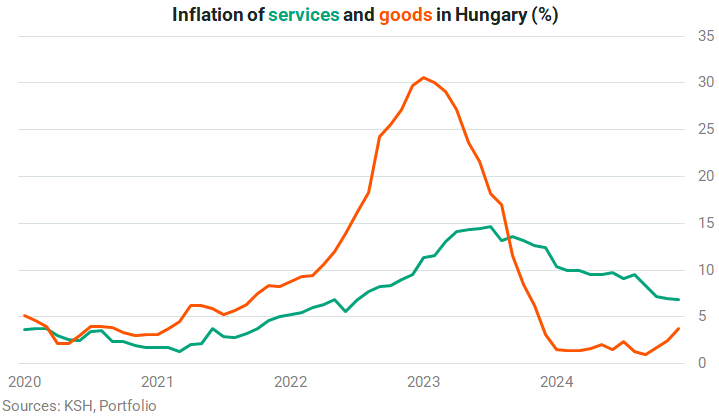
So in 2024, prices rose by 4.6% over the year, which means that between December 2023 and December 2024, life became that much more expensive. The indicator is far from the central bank's 3% target, mainly due to strong inflation in services, especially in the first half of the year.
It was only in the second half of the year that operators with retrospective pricing, which typically applied steeper price hikes than actual cost increases, were willing to go easier on consumers.
An important caveat, however, is that while we saw price stability for goods in the first half of 2024, by the end of the year the inflation curve had risen very sharply, mainly due to the aforementioned food price increases.
This suggests that a new inflationary cycle is unfolding in Hungary. This is certainly not consistent with a monetary policy that does not prevent an intensive exchange rate depreciation.
For those who feel even higher inflation in the shops, it must be a real shock that in a year the price of flour has risen by 36.2 %, eggs by 21.9 %, milk by 19.5 %, fruit and vegetable juices by 17.3 %, butter and spreads by 16.4 %, cooking oil by 13.7 %, chocolate and cocoa by 9.9 % and soft drinks by 5.5 %. (In addition, the price level for restaurant meals has increased by 7.8%.)
As a small consolation, within the food product group, the price of pasta fell by 7.1%, that of pork, bologna sausage and other sausages by 3.4%, that of margarine by 3.0% and that of sugar by 2.6%.
In 2024, the average annual inflation rate was 3.7%.
This is what you should use when calculating the interest payment on an inflation-linked government bond next year.

After today's data, the likelihood that this year's inflation will be higher than last year's is increasing. This was already the view of analysts before today's data, with analysts projecting annual average inflation of 4% in 2025, up from 3.7% in 2024, according to the Portfolio consensus. In view of the latest figures it would not be surprising if economists were to adjust their forecast for this year slightly upwardly.
Cover image (for illustration purposes only): Getty Images





