Wage hike dreams may be shattered in Hungary


The questions that will be answered in this article:
- How much companies plan to raise wages?
- How large wages increases do employees want?
- How are wage talks progressing?
- What's the situation at smaller and at larger companies?
- Will blue-collar or white-collar workers be better off?
Last year's strong pace of wage growth is a thing of the past, according to a recent Portfolio survey. While average wage growth in 2024 was well above 10%, it could be much more subdued this year, based on the wage negotiations that are unfolding at corporations.
Last year the minimum wage was raised by 15%, this year only by 9%, and the guaranteed wage minimum goes up 7% this year instead of 10% in 2024. Meanwhile, the economic situation has not improved much, so companies are being very cautious about wage increases.

Several employers' initial wage increase offers range between 3-4 percent,
Imre Palkovics, President of the National Federation of Workers' Councils, told Portfolio.
"The unions see that realistically, without confrontation, wage increases of between 5 and 7 percent are achievable," he said.
Companies that can sell goods or services abroad will typically get through a 9-10% wage increase,
underlined Melinda Mészáros, Chairwoman of the LIGA Trade Unions.

Exporting companies are basically in a better position now, helped by the weakening of the forint. As a result, they can expect higher export revenues, simply because of the HUF depreciation.
However, the easing of the forint is also reflected in inflation. Therefore, workers feel that prices, are getting higher, especially when it comes to food.
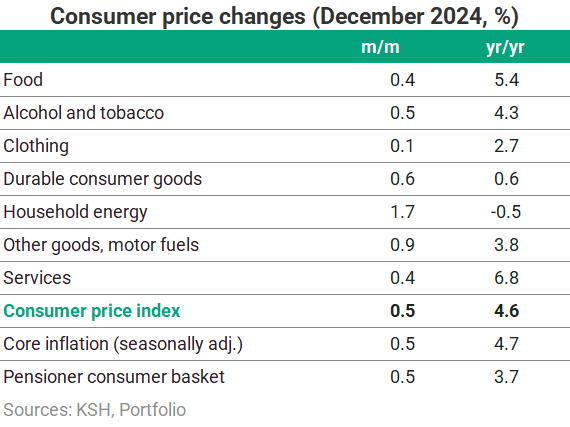
Employees have much higher expectations and demands than employers offer,
said Melinda Mészáros. This is because basic food prices are rising again, and the cost of living has increased further, she added. "There is a legitimate feeling among workers that they want to adjust their wages accordingly".
Employers, however, cite inflation that can be expected this year, she added. And inflation is expected to be around 4% in 2025, according to the latest analyst surveys.
She said that in some places employees have steep wage demands, e.g. for 10-12% pay rises at car parts and electronic components companies.
"Where a deal seems to be close, it tends to be between 5 and 8 percent. It's definitely a single-digit wage increase," said Mészáros. This is not surprising, of course, given that industrial production is weak and the automotive sector has not performed as poorly as it has for two and a half years.
In the automotive sector, wage increases for white-collar workers are typically lower than for manual workers.
The latter are more affected by the statutory minimum wage and wage minimum for skilled workers. For while-collar workers, on the other hand, the number of days that may be used for remote work has been increased or at least maintained, and cafeteria and health insurance are generally higher for everyone in these sectors. In some cases, particularly in higher positions, the latter is extended to family members too.
"In other manufacturing sectors where negotiations have been concluded, wages are raised by 8 to 9%. In some cases, the company did not reach an agreement with the unions and introduced higher wages on its own, but not everyone's wages were raised to the same extent," said Melinda Mészáros. She also mentioned that in the food industry, companies are offering wage increases of between 5 and 7%, plus larger amounts of cafeteria payments.
In Hungary, fringe benefits or non-salary compensation are regularly referred to as 'cafeteria', which should not be mixed up with a self-service restaurant. The various fringe benefits or cafeteria elements, which often involve targeted spending, are taxed differently from regular salary, where the employer pays social contribution tax on the gross salary, while the employee pays personal income tax and social security contribution. Instead, the employee receives net benefits, while the employer pays more taxes. However, the tax content of the fringe benefits is lower than the tax content of regular employment costs. The most well-known cafeteria element in Hungary is the Széchenyi Card (SZÉP card), which works very much like actual money, but sums sent there can normally be spent only on holiday accommodation, hot meals, and culture, managed in separate “pockets” of the card.
Micro and small enterprises are a white spot in the statistics on wage increases, according to union leaders.
Imre Palkovics, President of the National Federation of Workers' Councils, pointed out that where the minimum wage or the guaranteed wage minimum is the "official salary", this increase was implemented. Where workers received other (under-the-table) payment in addition to the official minimum wage or guaranteed wage minimum, companies typically planned to increase wages by a further 8-10%.
"For these companies, often only the visible part of the income increases. The daily livelihood of workers is not always helped by this, because often the official salary is raised at the expense of the off-record income," he described the situation of small companies. "Unfortunately, this is still very prevalent."
The current situation is that employers in private companies are practically not signing wage agreements for more than a year, as the economic situation is extremely fluid. People cannot plan ahead even for this year, let alone for several years. But what is certain is that this year will bring lower wage growth after last year's average increase of 13% in the whole economy.
Cover image (for illustration purposes only): Getty Images





