Nothing seems to stop the forint's weakening, but Trump's inauguration may shake markets again


On the last trading day of the week, the forint weakened further, reaching 414 against the euro in several waves before strengthening back below 413 by the evening. The appreciation of the dollar continued to have a negative impact on the domestic currency, which proved to be more sensitive to market movements than regional currencies.
The fluctuations in the forint's exchange rate may also reflect the uncertainty surrounding the inauguration of US President Donald Trump this Monday, which is prompting market participants to be generally cautious, according to currency traders.
Global markets were also influenced by the Chinese macro data on Friday, which briefly boosted sentiment, but the renewed strength of the dollar put pressure on the forint. The exchange rate against the euro stabilised around 413 by Friday evening, but the weakening trend in the domestic currency persists.
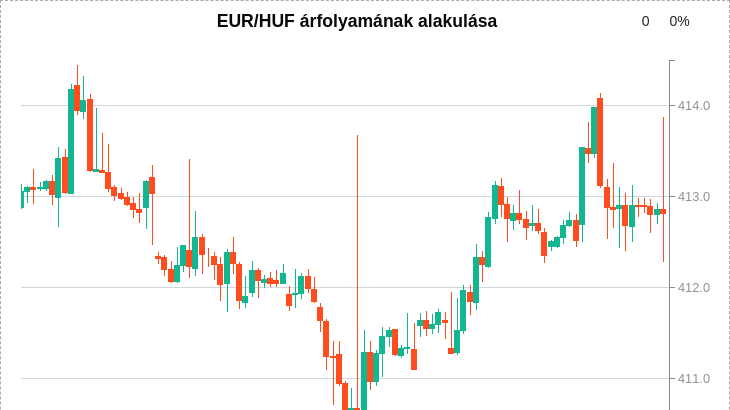
Although there was some stability in the middle of the week, the price movements were not sufficient to reverse the longer-term trend.
Global sentiment and macro developments in the US and Europe are likely to be the main drivers for the forint in the coming weeks.
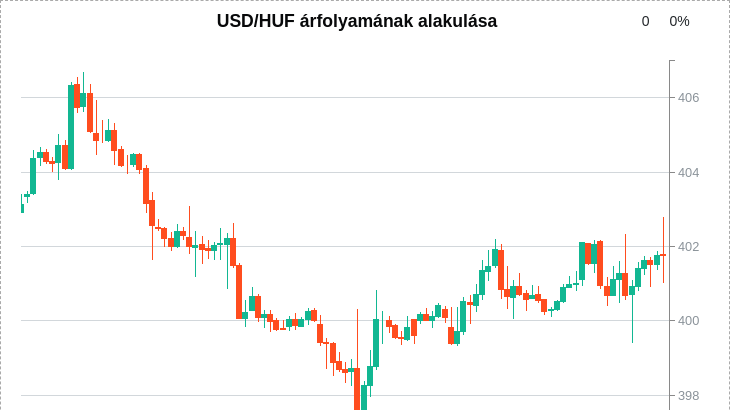
The forint strengthened against the dollar last week, following the movement in the EUR-USD exchange rate, but the Hungarian currency did not quite follow the same path. The forint weakened to above 406 at the beginning of the week, and then, on the back of better-than-expected US inflation data and market trends pricing Trump's arrival, the forint corrected back to 402 after temporarily breaking the trend line at the 400 level, thus entering a weakening channel.
What happened on the markets?
Trading in European and US equity markets rebounded after the release of US inflation data last Wednesday, as investors were keenly pricing in the Federal Reserve's interest rate cut, which had a positive impact on equities. Asian markets rose modestly on Friday and European stock markets continued their positive trend, but the momentum in US indices faded, with the Dow and the S&P 500 falling 0.2%.
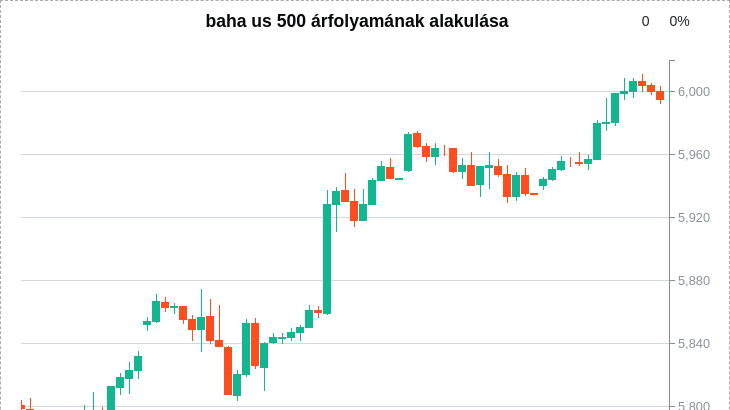
And the Nasdaq closed 0.9% lower, ending the previous day's rally.

The BUX index was also among the winners on Friday,
rising 0.9% to a new high and remaining above its 20, 50 and 200-day moving averages, confirming the upward trend of the domestic stock market.

Among the blue chips, OTP posted an outstanding 2.3% increase, while Magyar Telekom and Mol also closed in positive territory, up 0.9% and 0.2% respectively. Richter, on the other hand, fell by 1.2%.
What do we look out for this week?
Monday will be a busy start for international markets, with industrial production data from Japan for November, which could give an idea of the state of the Asian economy and global supply chains. In Germany, December's Producer Price Index figures will be released, which may also provide a glimpse of industrial inflation, as well as demand for German goods. In the United States, there will be a public holiday to mark Martin Luther King Day, so overseas markets will have a trading holiday.
In the evening, the world will be watching the inauguration of Donald Trump, an event that will have major political and economic implications.
The main reason for the excitement is that in the last decade, presidents taking office have started their work on the first night with a mass of decrees.
On Tuesday, Hungary's Ministry of Finance will publish detailed public finance data for December. This report will provide an important picture of the fiscal position at the end of the year and the evolution of public finances, which could be crucial for economic planning for 2025.

On Thursday, the Hungarian Central Statistical Office (KSH) will publish Hungarian earnings statistics for November, providing an insight into the evolution of domestic wage dynamics, which is particularly important in an inflationary environment. Internationally, Japan's external trade balance will be released, reflecting the state of the export-led country's economy. In the euro area, November industrial production figures and the European Commission's consumer confidence index will be released, providing information on the recovery of the EU economy.
In the US, weekly jobless claims data is due, which will provide an update on the current state of the labour market, which the Federal Reserve is watching out for as it eases monetary easing.
On Friday, the KSH will release the unemployment and employment indicators for December, the latest indicator of the state of the labour market. The third-quarter house price index, which gives an indication of the direction of the domestic housing market, will also be released. On the international front, inflation data will be published in Japan, while in Germany and the eurozone, the Purchasing Managers' Index (PMI), a key leading indicator of economic activity, is due to be released. In the US, the S&P PMI and the Michigan index will close the week, providing information on business and consumer confidence.
Cover photo (for illustration purposes only): Getty Images





