Let's see how much motorists saved in Hungary with the one-day e-vignette


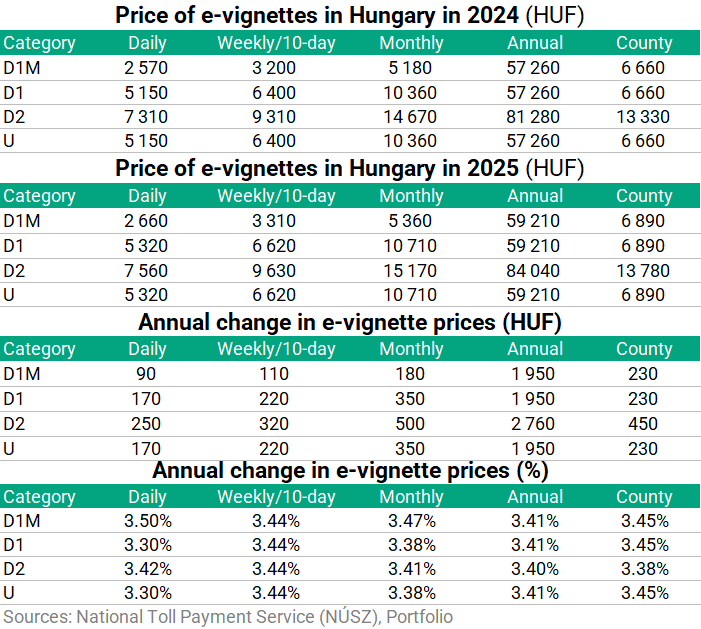
The one-day e-vignette was introduced by Hungary in spring 2024 under pressure from the EU. The price was set at the highest possible level of HUF 5,150, as the Eurovignette directive stipulated that it should not be higher than 9% of the annual fee.
The European Union's aim was to stop countries from making foreigners pay for road improvements by making the shortest available sticker longer term and relatively expensive.
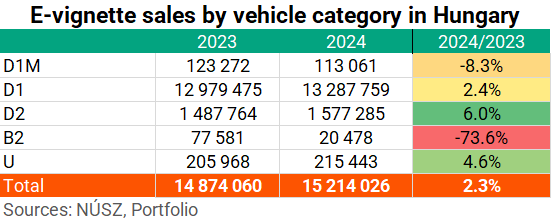
The daily e-vignette is also basically aimed at foreigners and although it is a product with an extremely low value for money, for those just passing through Hungary it is a saving compared to the previous cheapest 10-day sticker. Last year, 1.62 million units were sold, of which more than 1.1 million were for cars with foreign plates.
This way they saved
- HUF 630 if they were riding a motorcycle;
- HUF 1,250 if they were driving a passenger car or bought the e-sticker for a trailer (D1 and U categories); and
- HUF 2,000 if they were driving an RV, a minibus or a minivan (D2).
The National Toll Payment Services Ltd. (NÚSZ) has e-mailed us the detailed sales data broken down by category and type of sticker, which shows that
the introduction of the one-day sticker stripped the budget of HUF 2.1 billion revenue including VAT.
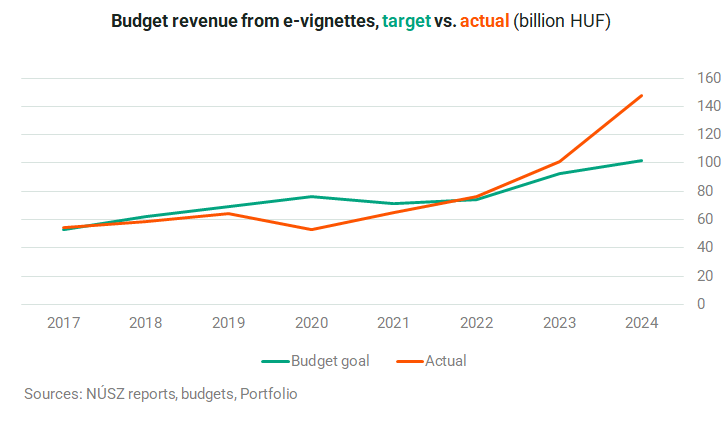
This is 1.4% of the total revenue from e-vignettes, as in 2024, HUF 148 billion gross were collected from this entitlement, 16.3% more than in 2023 (including pre-purchases).
This increase is roughly equal to the 16.4% price increase, which, incidentally, is linked to the consumer price index in August each year. The match is a coincidence, however, because in 2024 it was not only the one-day sticker that distorted the comparability of the figures, but also the fact that buses had to switch to a distance-based system from April. It was not even possible to buy an annual sticker for them in the first quarter.
Even so, a total of 15.2 million e-vignettes were sold last year, 2.3% more than a year earlier and 0.9% more than in 2022.
Sales of weekly and monthly vignettes fell by 14% and 26%, respectively, while more annual (+16%) and county (+19%) e-vignettes were sold than in 2023, the latter being particularly popular with motorists.

Besides the 16.4% price hike in 2024 it is also noteworthy that
- revenue from the sale of 10-day e-vignettes dropped 1.8%;
- revenue from monthly stickers went up less than the tariff increase by 8.7%;
- revenue from the annual e-vignette jumped 19.1%; and
- revenue from the sale of county e-vignettes leaped by 27.1%.
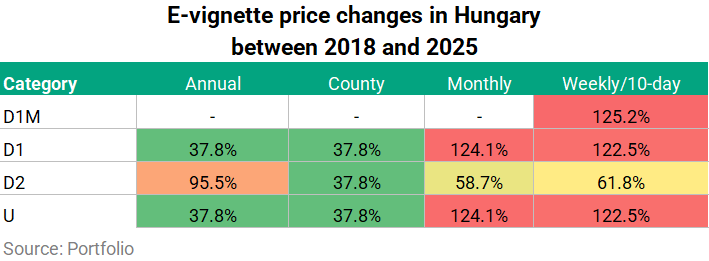
All this shows that the trend of motorists trying to spend less on e-vignettes, which has been going on for years, continues. The best solution is the county pass, which costs almost one-ninth of the annual sticker and is worth to buy it even if you need a 10-day or monthly sticker once or twice a year.
Forecasts vs. facts
As for the state budget's e-vignette receipts, last year was quite a success, considering that that goal of HUF 102 billion was overshot by 47%, while only a 9.9% year-on-year increase was projected. In 2023, the outperformance was 32% against a planned 25.4% increase, and in 2022 e-vignette revenue came in 17.9% higher instead of a 4.2% increase.
The government expects e-vignette receipts at HUF 118 billion this year, which would correspond to a 15.7% yr/yr growth. It also sees a 21.9% rise in e-toll revenue to HUF 447 bn, while last year it had much greater hopes for a nearly 45% growth. Total revenue from e-vignette and e-toll sales are expected at HUF 663 bn, up 20.8% yr/yr.
Price changes in 2025
Under law, e-vignette prices may be raised by the rate of annual inflation in August of the previous year, which was 3.4% in this case but the price of e-vignettes was raised by slightly more (3.5%) in certain categories. However, apart from the daily sticker in D1M it's the result of a round-up from 3.45%, so the difference is marginal.
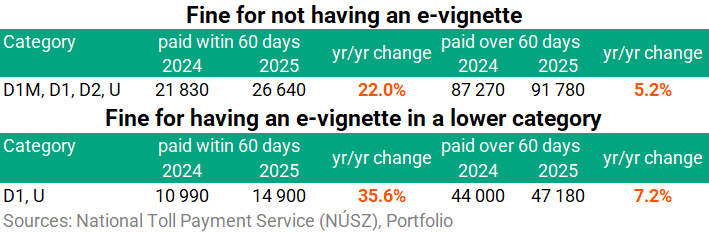
The fines for driving on toll roads without an e-vignette or having an e-vignette but in a wrong category (e.g. a D1 instead of a D2 vignette) have also changed as follows:
Cover image (for illustration purposes only): Getty Images





