Three interest rate decisions coming up this week may raise investor hackles


The most important event of last week was clearly the inauguration of President Donald Trump. Trump immediately began his second term with great enthusiasm. In addition to his growing interest in Greenland, Mexico and Canada were immediately hit with 25% tariffs, while China, instead of the planned 40%, will only get 10%.
Surprisingly, Europe has so far not been mentioned as a target for a tariff war, while Trump has spoken out in favour of increased oil production and against high interest rates.
Trump's first week has already caused turmoil in the currency markets, but now in the right direction. The president's actions so far have been softer than expected and, for example, the increase in oil production is also more favourable for the inflation outlook. This has led to a huge weakening of the dollar this week.

This has also had an impact on the forint market, with the forint exchange rate slipping from near 403 to below 388 against the dollar.
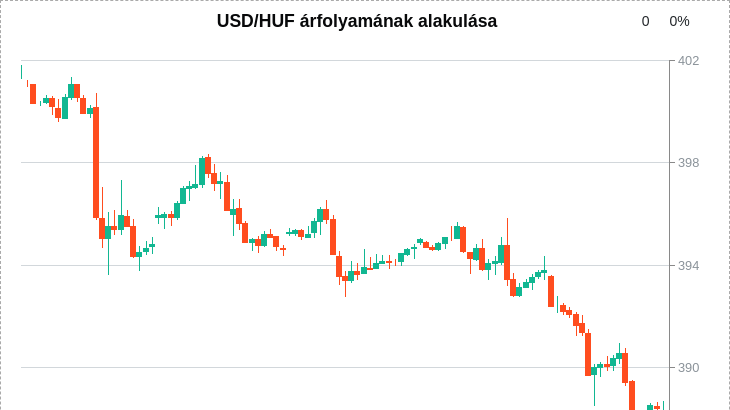
The forint was also able to benefit against the euro from the general weakening of the dollar, as the forint fell from around 413 to below 408.

The big question in the week ahead will be whether the dollar weakening will continue and whether domestic events can support further forint strength.
What happened on the markets?
Stock markets have also felt the first effects of Donald Trump's first actions. The increase in oil production, the winding down of the trade war and the announced $500 billion AI investment package have been extremely positive for international stock markets. Together, these measures could mean a reduction in inflation risks and an improvement in the growth outlook, not only in the US but also globally.

As a result, both the S&P 500 and the Nasdaq 100 rose by nearly 1.5% this week.
The BUX also rose by 0.34%.
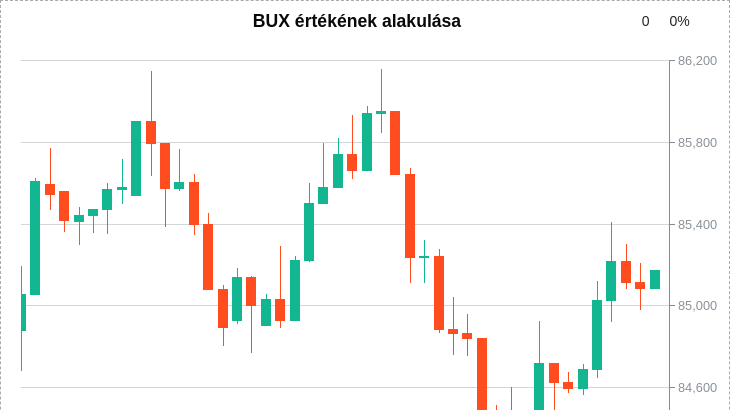
Among Hungarian blue chips, OTP rose by nearly 0.7%, MOL fell by 0.2% (due to lower oil prices), Richter fell by 2.8% and Magyar Telekom gained nearly 2.5%.
What will we be looking out for this week?
It is set to be one of the busiest weeks of the first quarter, with three interest rate decisions likely to rattle investor sentiment.
On Monday, Chinese purchasing managers' indices will be released, where the key question will be whether Chinese growth can improve meaningfully after the large monetary and small fiscal easing of the previous year. This data could be of particular interest for the commodity market and European stock markets. In addition, Germany's IFO economic sentiment index is due to be released, which may reveal how Europe's largest economy is recovering.
The National Bank of Hungary (MNB) will hold its first interest rate decision meeting of the year on Tuesday,
where the Monetary Council will present its assessment of the latest macroeconomic and financial market developments. In addition, US durable goods order books and house price index data will be released. Of the two, the former is the more important as its trend moves well with corporate profits, so equity investors will be watching this data with interest.
Wednesday will start with a German consumer confidence index and Spanish GDP, but the real fireworks will commence in the evening when the US Federal Reserve holds its rate decision meeting. At the previous meeting, the Fed announced that it would slow its rate-cutting cycle. In the time since then, incoming real economic data have been stronger than expected, while some data that have moved well with inflation could even point to a resumption of inflation in the next few months.
The big question is how the Fed will assess incoming developments, just as President Donald Trump begins his second term in high gear.

Thursday will be GDP data day, with French, German, euro area and, of course, Hungarian fourth quarter GDP data. There will also be Eurozone unemployment and inflation expectations, and the European Central Bank will hold an interest rate decision meeting in the afternoon, with most analysts expecting a rate cut due to the euro area's worse-than-expected performance.
Japanese inflation data will be released early on Friday, a week after the Bank of Japan was forced to raise interest rates due to the inflation trajectory. In the morning hours, German retail sales will signal the state of the economy, and inflation data from France and Germany will be released. Finally, we close the week with US PCE inflation data.
Cover photo (for illustration purposes only): Shutterstock





