Market does not pay heed to Hungarian central bank's message


On Tuesday, the central bank made an important change to its main message on interest rate expectations. The following sentence was added to the end of its forward guidance issued after the rate decision:
In the Council’s assessment, geopolitical tensions, a volatile financial market environment, and risks to the outlook for inflation warrant the maintenance of tight monetary conditions.
In the preceding month, the same closing sentence was this: "In the Council’s assessment, geopolitical tensions, volatile financial market developments and the risks to the outlook for inflation warrant further pause in cutting interest rates."
Although semantically there is not much difference between the two sentences, the removal of the term "cutting interest rates" from the communication is a significant change. MNB Deputy Governor Barnabás Virág made it clear at yesterday's background briefing that
this change can be seen as the end of the rate-cutting cycle.
In other words, the central bank has so far viewed the monetary easing that began 20 months ago as having stalled last autumn, but as soon as the obstacles are removed, it can be expected to resume. From now on, however, monetary policy should be seen as having completed its rate cuts. This means two important things:
- The odds of rate hikes and reductions have become more symmetrical.
- The central bank sees no chance of a rate cut in the near future.
It is worth looking at the second consequence because the situation is very similar to that of a year ago. Back then, financial market actors were so far ahead of the curve in terms of interest rate cuts that their expectations for the end-2024 base rate were already approaching 4%. The central bank thought this was exaggerated (rightly, as it turned out) and sent out a strong signal that no one should expect such a rapid rate cut.
The situation in early 2025 is very similar. The MNB, seeing the vulnerability of the forint, wants to keep market interest rates high by pricing out near-term rate cut expectations in the market. According to Portfolio's survey, analysts were expecting 2-3 rate cuts before yesterday's policy meeting (although there was a palpable sense of uncertainty in their responses, and a small number already saw no room for easing this year).
The consensus result of the survey was very similar to the picture suggested by market pricing. Indeed, the market was pricing in two rate cuts, one in September and one in December, in line with the path of the policy rate implied by forward rate agreements (FRAs).
However, the message from the central bank yesterday was that a rate cut in the summer is unlikely, and perhaps it is not in the cards even in December. We checked whether the market got the message: no, it didn't. The FRAs have not moved since the previous day (in fact, it is a better fit to the rate path to assume an August cut rather than a September one). In other words, the market is still pricing in two rate cuts this year.
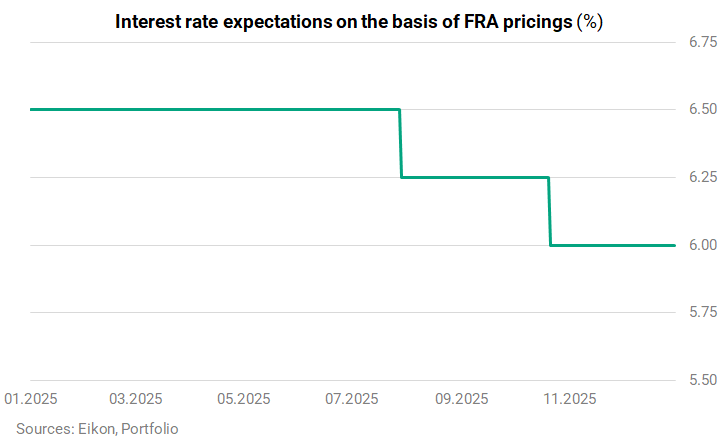
The question arises: why is the market not pricing out interest rate cuts, despite a clear signal from the central bank?
- The convenient explanation is that it is worth waiting a few days for the market to digest the new message. This can be reinforced through investor meetings and other semi-official but effective channels.
- Another interpretation is that there are two more important rate decisions this week, and the Fed and ECB messages could be important, so the market is waiting.
- The third explanation is that markets are cautious about the arrival in March of a new central bank Governor, Mihály Varga, whose monetary policy views are not yet known. If this explanation is more valid, it will be much harder for the MNB to make an impact through soft market moves until March.
Cover image (for illustration purposes only): Getty Images





