Hungary's retail sales show forlorn picture for end-2024


The volume of retail sales fell by 1.2% in December last year compared with the previous month, according to seasonally and calendar adjusted data. This means that previous growth in shop sales has come to a halt.
The stats office noted that the contraction is "partly explained by Christmas shopping brought forward to November and the increase in outbound tourism."
While this chimes together with the official government communication, the KSH does not provide any data to back up the reasons it gives for the drop in sales. And it is also strange that it would even bother with such explanations. In November, for example, it did not suggest that the data might have increased because people brought forward their Christmas shopping.
The fixed base (2021) data also show that the growth trend has stalled. Interestingly, although the KSH also explains the weak December with a surge in November,
the updated fixed base series shows growth of only 0.5% in month 11, down from 0.7% the previous month.
However, this can be adjusted by the KSH at a later stage, as is not unusual for data releases.
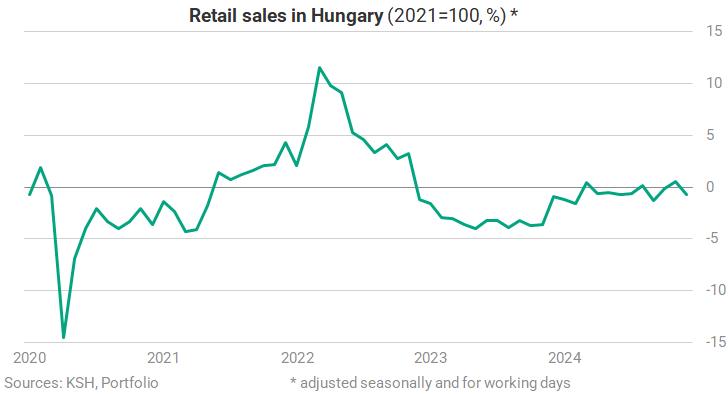
The weak end of the year is even more discouraging for the already sluggish retail trend. The last few months have seen more stagnation than growth in sales volumes. (For the statisticians, the average annual growth for 2024 is above 2% due to the carry-over effect rather than the expansion seen over the year.)
The volume of retail trade was 0.1% higher in December 2024 than a year earlier, according to data adjusted for calendar effects. The volume of sales grew by 1.2% in both specialised and non-specialised food retailing. The volume of sales increased by 1.2% in non-specialised food and beverage stores, which account for 78% of food retailing, and by 1.8% in specialised food, beverage and tobacco stores.
The turnover of non-food retailing increased by a total of 0.5% in volume. The volume of mail order and internet retailing accounting for 8.9% of all retail sales and involving a wide range of goods grew by 0.5%. The volume of sales in automotive fuel stations decreased by 6.9%.

Annual average growth fails to reach even 3%
In 2024, the volume of retail trade rose by 2.6%, adjusted for calendar effects.
The pace is very modest, especially given that real incomes grew by around 9% last year and total real incomes by around 6%. In other words, caution is still a factor in people's purchasing behaviour. Retail sales are also being held back by changes in consumer spending, with household consumption rising by around 4% last year, faster than retail sales volume growth.
The volume of sales rose by 3.7% in specialized and non-specialized food shops, by 2.4% in non-food retail trade and fell by 0.1% in automotive fuel retail trade.

Despite these figures, there is every chance that the growth that characterised October and November will continue in 2025. Real wages will continue to rise, and the caution that drove people to save last year may be dissipating.
In January, people received a substantial amount of interest on government bonds, some of which may have trickled down to the shops. Another piece of good news for retailers is that prices for services are not rising as much as last year, as inflation has been more moderate.
Cover image (for illustration purposes only): Portfolio





