Market starts to 'sober up' after Hungary's January inflation data


The Magyar Nemzeti Bank tightened its communication when it decided on interest rates in January, effectively saying that the cycle of rate cuts was over and that no one should expect any easing for a long time. The weak forint and uncertainty about inflation gave the central bank good reason to be cautious. But no matter what he hinted at, the market seemed to have shrugged it off: it was still pricing that the MNB will start cutting rates in the second half of the year.
As this was difficult to explain in fundamental terms, the most common interpretation was that market participants had not paying heed to the central bank's signals because they were waiting for a change of leadership in March. They were therefore no longer reacting to the messages of the current leadership, and they could not react to the new one as the monetary policy views of the incoming governor, Mihály Varga, are not yet known.
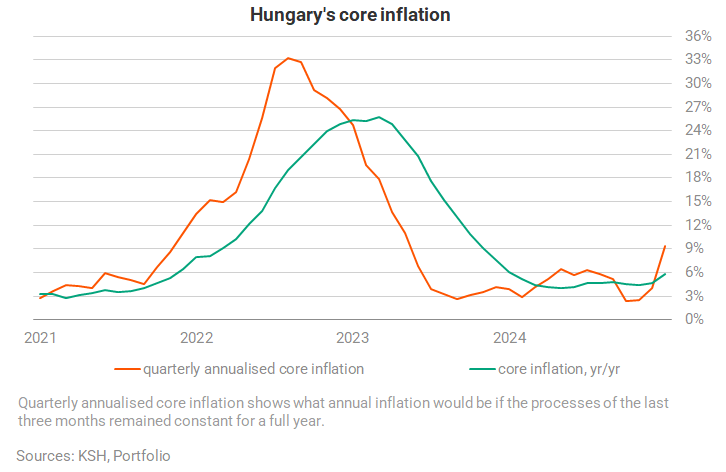
Then came the January inflation figure, which came in at 5.5% instead of the expected 4.9%, shocking the public. What we can see is that domestic inflation is being driven by a number of accelerating factors: the weak forint, the rise in global commodity prices, the government and tax hikes at the beginning of the year, and wage increases.
Moreover, this is happening in the middle of an intense repricing period of the year. This increases the risk that this year's inflation path will be significantly higher than expected. No wonder many analysts have already indicated that they are revising their previous forecasts.
As a result, the expectation for average annual inflation in 2025 could rise to around 5%. It is worth considering this in two contexts: (1) inflation may accelerate significantly from last year's 3.7%, (2) the MNB's end-December forecast of 3.3-4.1% has already been invalidated.
The forint reacted strongly to the new data. This is good news as it shows the credibility of the central bank. The market believes that the central bank is responding with a tighter monetary policy, i.e. it is trying to use its tools to bring inflation back on a path towards price stability.
If the exchange rate had moved in the opposite direction, it would have indicated that the market believes the central bank is resigned to higher inflation, which will lead to a weakening of the exchange rate.

This suggests that the market is finally getting the message: there is much less room for rates to fall. According to the path of the policy rate, as derived from forward rate agreements (FRAs), the market was expecting two more rate cuts last week, one in the summer and the other at the end of the autumn.
The market has moved in today's trading session, with medium-term government bond yields starting to rise and FRA expectations now suggesting that the market is expecting one rate cut rather than two.
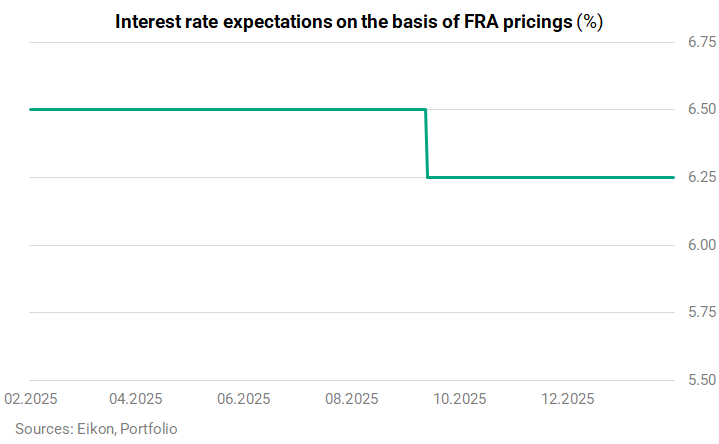
Today's change is not earth-shattering. In fact, the market is still slightly more optimistic than the central bank about the prospects for rate cuts. Meanwhile, some experts are now talking more about the question not of when to cut interest rates, but whether a rate rise would be more consistent with the current inflationary situation.
The MNB is clearly reluctant to talk about a rate hike, and it seems certain that this will not happen before the change of governor in March. The market seems to accept this for now, but the new leadership will probably have to take a longer-term view to convince everyone of its commitment to price stability.
Cover image (for illustration purposes only): Getty Images





