Inflation explosion has already been brewing in the deep - What next for Hungary?


Consumer prices increased by 5.5% on an annual basis in January 2025, according to the Central Statistical Office (KSH). No economist expected such a massive price rise. The figure was well above the government's expectations and the central bank's forecast.
However, the high rate of price increases was not without its precursors. Portfolio reported in January that the proportion of firms planning to raise prices had risen significantly over the previous month and that the public also expected prices to rise.
According to a survey conducted by GKI Economic Researcher using EU methodology,
the share of companies preparing to raise prices has increased significantly in recent months.
Price adjustments are common at the beginning of the year, while the rising minimum wage and guaranteed wage minimum (by 9% and 7% respectively) mean significant cost increases for companies. Many companies are trying to pass on this burden to the public, especially now that demand is growing, albeit slowly.
According to a survey by the Institute for Economic and Enterprise Research of the Hungarian Chamber of Commerce and Industry (MKIK IEER), "the most common reaction of businesses to increases in the minimum wage and guaranteed wage minimum is to raise prices, and in the case of larger firms, to increase the wages of those earning above the minimum".
MKIK IEER also examined the reactions of businesses through a representative sample and an online survey. "Among the most affected companies, the proportion of those planning to raise prices and those planning to raise prices a lot is higher. This suggests that the most affected companies are immediately incorporating the increased wage costs into the price of their product/service, risking even a fall in demand," the study says.
According to the GKI survey, the intention to raise prices is lower in industry and services and higher in construction. The latter is not surprising given that most people expect the housing market to recover significantly this year.
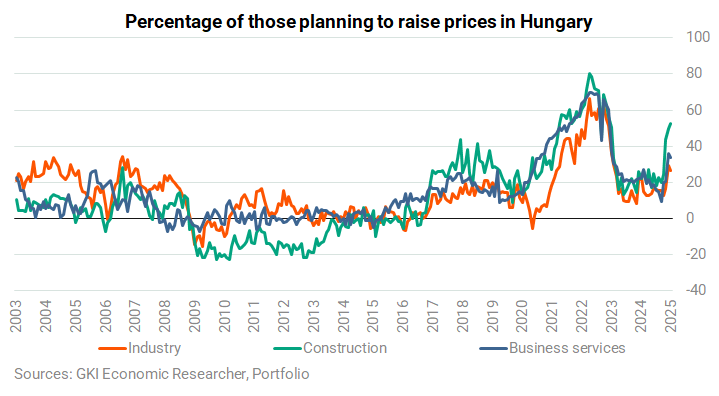
However, as shown in the graph above, the intention to raise prices is historically very high in all sectors.
And apart from the inflation crisis in 2022-23, the share of those planning to raise prices is highest in construction.
In the retail sector too, more companies are looking to raise prices again, but growth is still subdued by historical standards. The subdued price hike intentions seen in the second half of 2024 are now a thing of the past, and it is highly likely that firms will not shy away from charging higher prices.
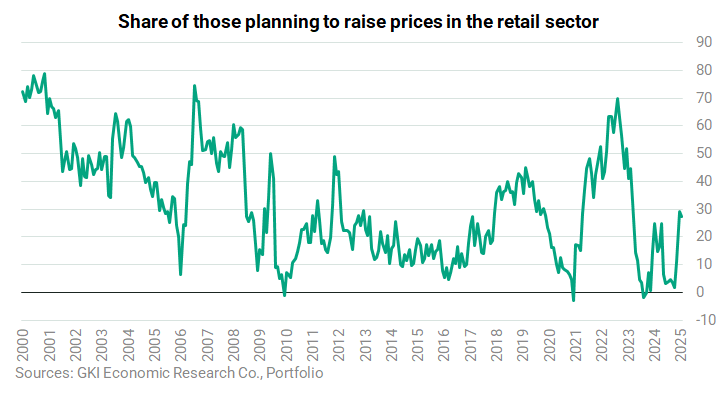
- This is underpinned by the KSH data too. Food prices rose by 6.0% in a year and by 1.9% in a month.
- In January, the price of milk was up 5.8%, edible oils 5.1%, coffee 4.9%, chocolate and cocoa 4.7%, seasonal food (potatoes, fresh vegetables, fresh domestic and tropical fruit in total) 4.4%, flour 3.8%, pasta 3.0%, dairy products 2.9%, margarine 2.8%.
- Prices for services rose by 2.2% on average, including telephone and internet 9.9%, postal services 6.0%, home repairs and maintenance 2.7%, tolls, car hire and parking 2.3% more, while domestic holiday services cost 0.4% less.
Not surprisingly, inflation expectations have been on an upward path again in recent months. All this had already pointed to a pick-up in inflation, but the rate still took the experts by surprise. And on the basis of the latest soft indicators, it seems very unlikely that inflation will collapse overnight.

Rising inflation will also require changes to full-year plans:
Cover image (for illustration purposes only): Getty Images





