Hungarian gov't extends state of emergency caused by mass immigration for another six months

The very brief draft decree states in its preamble that "on the basis of information from the National Police Commissioner and the Head of the Asylum Authority, the conditions for the imposition of a mass immigration crisis are met". The text then goes on to say that
the Government has therefore decided to extend the period of validity of the Government Decree.
Although a public consultation is called for, the validity of the decree - which, make no mistake, is to be extended again and again - is to be extended by another six months to 7 September from 7 March.
The state of emergency will have been in place for nine years.
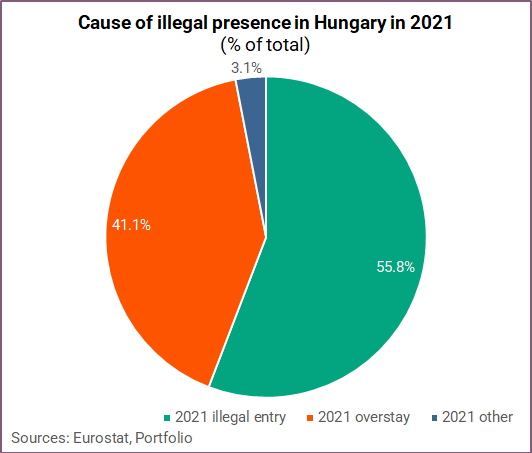
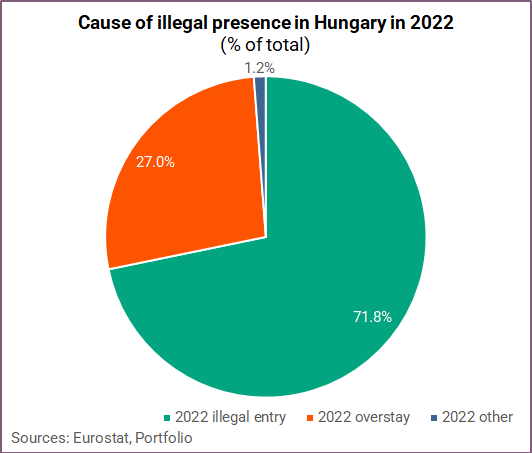
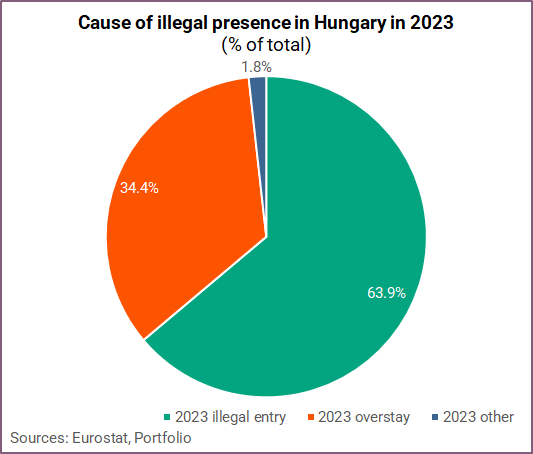
Here are two charts that may give you an idea of what an immense battle Hungary is waging against illegal migration.


In 2018 Hungary hosted a total of 263 445 immigrants, and by the end of 2023 this number had increased to 403 112. The primary reasons for requesting residence permits in 2023 remained employment, education, and family reunification: the figures reveal a consistent rise in applications for all 3 types of permit.
The impact of the war against Ukraine is evident in the statistics. In 2022, 33 273 requests were submitted for temporary protection, of which 29 847 were approved. From 24 February 2022 to December 2023 there was a total of 41 049 such requests, with 36 717 approved. The number of individuals with 'tolerated' status surged in 2022, increasing from 50 in 2020 to 1 728 by 2023. This increase is largely due to the fact that many people fleeing the war against Ukraine, who registered for temporary protection but left Ukraine before 24 February 2022, were granted tolerated status instead of temporary protection status.
The most significant decrease is observed in the number of asylum applications, which has dropped by 94% since 2019 (following the introduction of the new asylum system, the so-called 'embassy procedure', in 2020). This procedure severely limited access to asylum, and has remained in place despite an ECJ ruling in June 2023 stating that the system infringed upon migrants' rights. While 500 asylum applications were submitted in 2019, only 31 were submitted in 2023. Correspondingly, the number of recognitions also decreased dramatically.
Global mass displacement reached a record high of 65.3 million people by the end of 2015, according to the United Nations High Commissioner for Refugees (UNHCR). Approximately 21.3 million of these individuals were refugees, 40.8 million were internally displaced persons (IDPs), and 3.2 million were asylum seekers.
The migration crisis in 2015 hit Greece, Italy, and Hungary particularly hard. In 2015, Hungary was the second European Union country, behind Greece, to apprehend irregular migrants at its external borders with 411,515 recorded crossings.
A series of amendments to asylum legislation caused many changes in the arrival procedures and overall treatment of asylum seekers and beneficiaries of international protection in Hungary. A system of transit zones was also implemented in 2015, representing the only place where migrants can legally enter the country, in Röszke and Tompa. These measures led to an infringement procedure to be opened against Hungary, including a mammoth fine of EUR 200 million and a daily penalty of EUR 1 million, with the clock still ticking.
In 2015, Italy had nearly 154,000 third country nationals arriving to the country, while Greece had some 862,000, according to UNHCR data.
We have looked at Eurostat data to see how the number of third country nationals staying illegally in these countries changed over the years. The following chart shows our findings.

As for the reasons of the illegal presence of third country nationals, Eurostat has data only for the years between 2021 and 2023. These show that the cause was illegal entry in almost three quarters of the cases in 2022, a marked growth from 56% in 2021, but the ratio has dropped in 2023 to 64%. Overstay is the second most common reason, with readings of 41%, 27% and 34% for 2021, 2022, and 2023, respectively.