S&P issues stern warning on Hungary, says government plans could spell trouble


In October 2024, S&P did not change Hungary's BBB- rating, which is one notch above the 'junk' category. The ratings report, released on Tuesday, warns that tax
cuts announced by Prime Minister Viktor Orbán and rising spending could cause public debt as a share of GDP to peak in 2026, making it difficult to meet the 3% budget deficit target.
Hungary's Prime Minister Viktor Orbán made two important promises in his state of the nation adrress over the weekend: the government will extend the personal income tax exemption to mothers of three and two children, and pensioners will be able to get a VAT refund on certain basic foodstuffs.
On Tuesday, Economy Minister Márton Nagy published a table on the budgetary impact of the tax cuts to be introduced gradually:
- Next year, 110,000 to 120,000 mothers under the age of 40 could receive a personal income tax exemption worth 120 billion forints, which is the amount of budget revenue lost.
- In 2027, the tax exemption for twice as many women aged 40-50 will cost the state HUF 231 billion.
- In 2028, the 50-60 year olds will follow, causing a tax loss of HUF 248 billion.
- In 2029, the tax exemption for the over-60s (100,000 to 110,000 women) will cost the budget HUF 124 billion.
overall, the measure could have a budget impact of huf 800 billion by 2029.
The PIT exemption for mothers with three children (from October this year) will cost around HUF 200 billion in the 2026 budget, while the exemption for mothers with four children from 2020 will cost HUF 50 billion. From the above, it can be calculated that the budgetary impact of the new measures will be HUF 380 billion in 2026. Assuming no additional revenue-reducing measures, this could add 0.4-0.5 percentage points to the budget deficit as a share of GDP.
The budgetary impact of the previously announced doubling of the family tax credit for children is not included in the above figures, but could amount to almost HUF 400 billion next year. Thus, the combined effect of the changes in the personal income tax system from 2026 onwards will be to reduce budget revenues by HUF 750-800 billion.
S&P noted that rising trade tensions between the EU and the US could further weaken the already fragile growth prospects of Germany, Hungary's largest trading partner.
The rating agency pointed out that Germany accounts for around 25% of Hungary's goods exports, two-thirds of which are machinery and transport equipment. This means that a drop in German demand, especially for car orders, would have a direct impact on the Hungarian economy.
According to the report, the deterioration in Germany's growth prospects also poses a risk for Hungary.
S&P said that its updated forecast for Germany's annual growth rate in 2025 is only 0.5%, down from 1.2% previously. For 2026, the estimate has been revised down to 1.0% from the September forecast of 1.3%. The rating agency stressed that these weaker growth prospects could also affect Hungary's export-dependent economy, especially through the industrial sector.
Loss of EU funds is also a serious risk
According to the rating agency, limited access to EU funds and the depreciation of the forint pose additional risks.
As Portfolio reported in a detailed analysis today, by the end of 2024 the Hungarian government has lost €1 billion (HUF 402 billion) of frozen funds due to the EU's N+2 budget rule, leaving only €9.4 billion of cohesion funds to be released.
However, this amount has been reduced by €325 million as a result of a judgment of the Court of Justice of the European Union on shortcomings in asylum procedures, which includes a one-off lump sum of €200 million and a daily fine of €1 million to be paid on an ongoing basis. The first instalment of €293 million has already been deducted by the European Commission in a so-called offsetting procedure from the 2021-2027 Cohesion Fund, with a penalty rate of 11.5%.
"At the moment, we do not expect Hungary or the EU to change their political stance, which in our view makes a breakthrough in the disbursement of EU funds unlikely.
This increases the risk that the capital account balance will fall below our current forecast of 1.5% of GDP on average over the period 2025-2026. It could also have a negative impact on the exchange rate and broader economic growth,
said S&P Global.
Election-related risks
According to Gabriel Forss, an analyst at the rating agency, the 2026 general election could lead to further tax and spending pledges that could further worsen the fiscal balance. It could also reduce the central bank's room for manoeuvre to meet inflation targets, which could increase tensions between monetary and fiscal policy, Bloomberg reports.
According to S&P, the loosening of fiscal discipline could also lead to a loss of investor confidence. Although the forint has traded at a four-month high against the euro in recent days, market participants fear that it could depreciate again as the elections approach.
According to the rating agency's analysis, a weakening of the forint would increase the debt-to-GDP ratio by 1.4 percentage points as early as 2024.
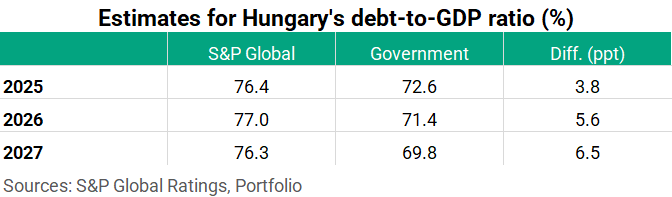
The baseline scenario projects the debt ratio to peak in 2026, followed by a moderate decline owing to fiscal consolidation.
According to S&P Global Ratings, the government is being overly optimistic about public debt and the actual figure could be much higher this year.
As inflation has moderated, the repricing of the government's inflation-linked retail bonds could help reduce the budget deficit, bringing the cost of financing the public debt to almost 4% of GDP this year, compared with almost 5% in 2024 (or more than 11% of fiscal revenues in 2024).
However, this fiscal path may require policy trade-offs due to the risks mentioned above, the rating agency said.
The rating agency is also much more pessimistic than the government about GDP growth, but its real GDP growth forecast of 2.7% for this year is higher than the market consensus of 2.2-2.3%. In 2026, S&P expects only 2.8% growth, while the government expects 4.1%, but in 2027 S&P expects only 2.4%, compared with the Hungarian government's forecast of 4.3%.
Bloomberg adds that the Hungarian central bank (MNB), which held its last rate-setting meeting under the current Governor György Matolcsy on Tuesday, also advised caution on fiscal policy.
The report highlights that Hungarian government bond yields and the forint exchange rate are sensitive to the government's economic policies. According to S&P, a negative market reaction could further complicate fiscal consolidation efforts if the government increases spending excessively or fails to meet planned deficit reduction targets.
Overall, S&P warns that Hungary's economic situation could become more vulnerable in the coming years if the government does not take steps to maintain fiscal stability.
Cover photo: Portfolio





