How Hungary emerged from recession: here is the detailed Q4 GDP data!


The Hungarian economy's performance in the last quarter of 2024 was 0.5% up on the previous quarter and 0.1% up on a year earlier (seasonally and calendar-adjusted). The year-on-year figure was 0.2% at the time of the preliminary release, so it was revised down slightly.
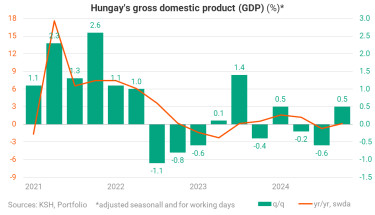
At the time of the preliminary release, the Central Statistical Office (KSH) had only indicated that the year-on-year increase was driven by the combined output of services, with growth held back by declines in agriculture, industry and construction. Today's detailed data release gives a better idea of what brought Hungary out of recession.
On the production side, we see that manufacturing has had a significant drag, with value added shrinking by almost 2% on a quarterly basis. The sector has contracted for the fifth consecutive quarter. Construction had a better quarter and, encouragingly, almost all branches of the services sector grew to a greater or lesser extent, with only real estate continuing its year-long recession. The main contributors to growth were trade, transport and communications.
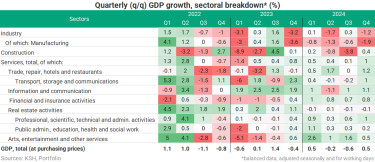
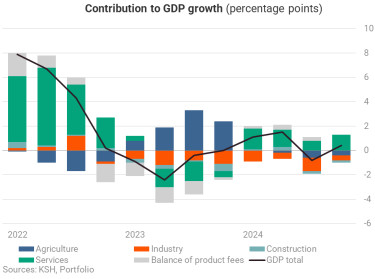
Services continued to be the only contributor to annual growth (0.4% unadjusted, 0.1% adjusted), with the performance of the other major sectors having a downward impact.
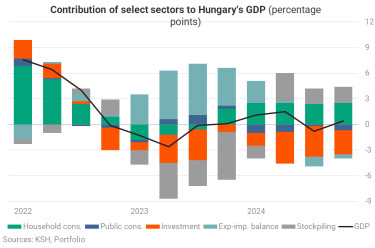
On the utilisation side, the pattern of growth shows the patterns of the last quarter. The freefall in investment has a huge downward pull, which is just about offset by household consumption and inventory activity. Portfolio has written several times about the reasons for the dismal domestic investment performance, but it is also worth noting the high level of inventory activity. In a favourable case, stockholding is subsequently reclassified by the KSH as a different type of use (consumption or investment). But if this is not the reason for the high level of activity, the most likely explanation is that the export sector is still producing for stocks in the face of weak external demand. This poses a risk in the short term, as production may undergo even more adjustment if the external conjuncture does not improve.
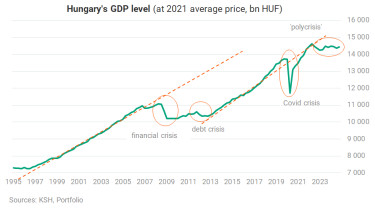
Although the Hungarian economy has emerged from recession, it is still not showing any signs of a boom. GDP has contracted in six of the past ten quarters and the strong recovery is still subject to risks. So far, neither industry nor construction are supporting economic expansion, meaning that growth is on a weak footing. But a pick-up is badly needed. As the graph below shows, we have slipped back off our growth path after the financial crisis, which could mean that the slowdown in our catching-up process is becoming permanent.
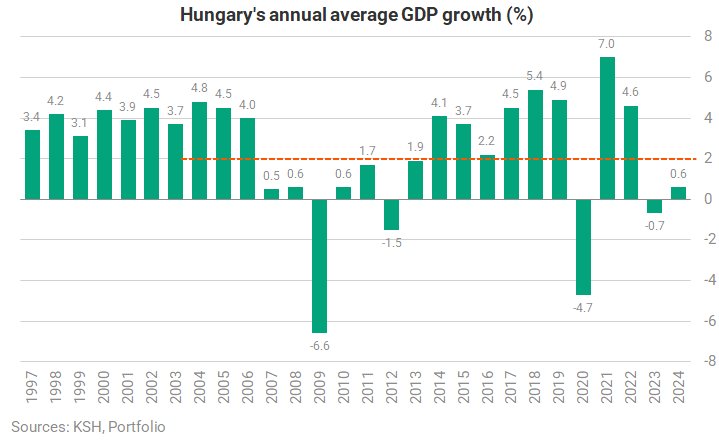
Last year GDP grew by 0.6% on average per year, and looking at GDP growth in 2023 and 2024 together, there have only been three times in the 21st century when a two-year period has been weaker than this. The regular slippages from the growth path mean that, despite growing at around 4% in the better years, the average annual growth rate since we joined the EU has been 2%.
This year's growth outlook is mixed. On the one hand, household consumption expenditure can be expected to continue to expand dynamically on the back of rising real incomes (last year, the KSH registered an annual average improvement of 5%). An even bigger relative improvement would be expected if the fall in investment in 2024 (which is close to 12% on a value-added basis) were to be halted. This is mainly due to the large investments (CATL, BYD, BMW) that are close to handover, and according to calculations by the National Bank of Hungary (MNB), the activation of these capacities and their production start-up at the end of the year could boost GDP by 0.6% this year.
At the same time, the adverse external environment appears to be weighing on export prospects and the US trade policy poses additional risks to export prospects.
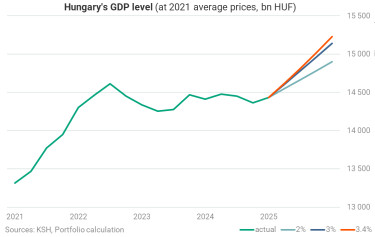
For the Hungarian economy to grow by 3.4% in 2025, in line with the official government forecast, it will need to grow by 1.3-1.4% quarter-on-quarter over the year. An average annual growth of 3% can be achieved with quarterly dynamics of 1.2%, and an average annual GDP expansion of 2% requires quarterly growth indices of 0.8% over the year.
GDP growth in many forms - How we look at it
The KSH publishes several GDP indicators in its report. There are three (annual) indices compared to the same quarter of the previous year:raw, working-day adjusted and adjusted seasonally and for working days. Of these, the Portfolio has consistently considered the seasonally and working-day adjusted index (swda) as the headline index since 2016. This is because the number of working days (especially if there is a leap day in the reference or base period) has a significant impact on performance, which is definitely worth correcting for. In addition, seasonal adjustment for annual indicators only makes sense if the nature of seasonality within the year changes. Since Eurostat refers to the swda figure for all countries, it makes international comparisons easier if this is taken as the main figure.
The (quarter-on-quarter) GDP index relative to the previous quarteris, of course, always seasonally and working-day adjusted, as each quarter has a very different weight and structure within GDP, otherwise it makes no sense to expect growth. In most places in Europe, this is the main number and Portfolio tries to treat this number as a priority because of its favourable characteristics. However, this indicator has the unfortunate feature of end-point weakness, i.e. that due to the nature of seasonal adjustment, the numbers change several times afterwards, but it is still very useful as a short-base business cycle indicator.
The unadjusted annual index is worth watching because analysts' forecasts are based on this figure, so the surprise factor in the latest data (in addition to the qoq data) can be measured on this basis.
Cover photo (for illustration purposes only): Getty Images





