Hungary among the worst countries for working women
The countries were ranked based on these ten measures:
- Higher education
- GMAT exams taken by women
- Labour-force participation rate
- Gender wage gap
- Women in managerial positions
- Women on company boards
- Women in government
- Net child-care costs
- Paid leave for mothers
- Paid leave for fathers
The charts below show how each country performed in 2024 (there are some ties):

Sweden came in first place, ending Iceland’s two-year winning streak. The Nordics always perform well on the GCI, thanks to policies that support gender equality and working parents, The Economist said. At the opposite end of the ranking, South Korea—which had always come in last place—advanced to 28th, pushing Turkey down to the bottom spot.
Hungary dropped the most in the rankings between 2016 and 2024.

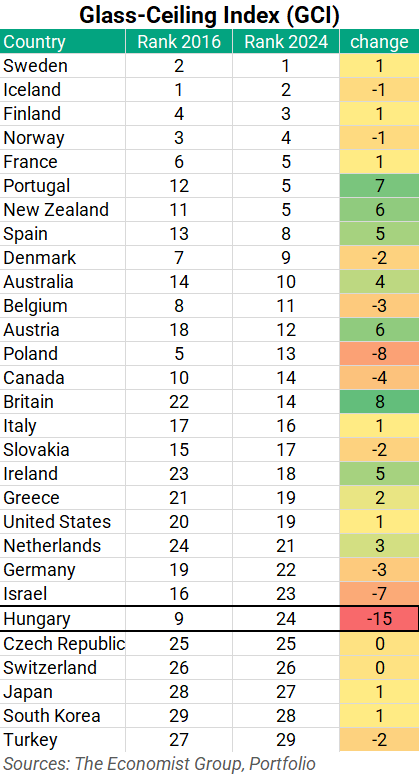
The glass-ceiling index is a broad and imperfect snapshot of the workforce. But it does help to show how countries perform on a consistent group of indicators over time. Although women are still struggling to break through the glass ceiling, most countries are at least changing for the better,
said The Economist.
Main takeaways:
- Across the 29 countries, median wages were still 11.4% lower for women than they were for men.
- In 2024, women in Sweden made 7.3% less than men, which is higher than the OECD average of 11.4%.
- 66.6% of working-age women had a job compared with 81% of men, but in Sweden, the number of working-age women is more than 82%.
- 45% of women from countries in the OECD had university degrees, compared to 36.9% of men. Despite this, labour-force participation remains lower for working-age women (66.6%) than men (81%).
- OECD women held 33% of company board seats in 2024 (up from 21%), and the amount of women in government seats hit an all-time high of 34%.
- In Sweden, 43.7% of women are in managerial positions, which is the best in the index, and 37.7% of women hold seats on boards in the Nordic country.





