Living in Hungary is more expensive - how to calculate real shop inflation


In January this year, inflation climbed to an unprecedented 5.5% year-on-year. Services (8.5%) were the main driver of the increase, but food prices also rose sharply, by 6%.
Methodology
Most people experience price increases through their daily shopping, so it is also worth calculating 'shop inflation', which is not reported by the Central Statistical Office (KSH), but can be calculated from retail data by dividing shop sales at current prices by the volume change calculated by the stats office. The result is the effect of price changes. This gives us the component of sales growth that is due to the change in price rather than volume.
Food is the largest component of shop sales, but they also include household goods, toiletries, alcoholic beverages, clothing and other non-food items. It is therefore misleading to restrict shop inflation to food.
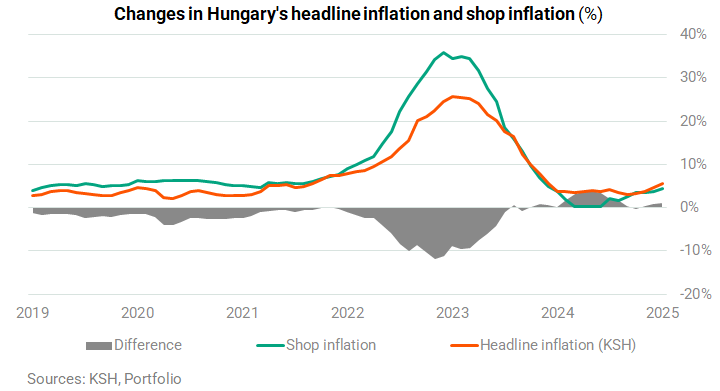
This particular 'shop inflation' was 4.5% in January, 1.5 percentage points lower than the rise in food prices.
This suggests that other (i.e. non-food) products have become less expensive. The Shop Price Index includes tobacco products, but we do know the inflation rate for tobacco products, which is reported separately by the KSH as 5.3% in January.
This is also higher than the 4.5% we calculated, but it was well offset by a number of other products available in shops:
- the price of non-durable household goods fell by 0.6%; while
- clothing prices rose by 2.2%;
- and the price of alcoholic beverages went up 3.3%.
A clear acceleration
However, this 4.5% is also a significant acceleration compared to previous months, and the rate was very close to zero at the beginning of 2024. The graph below shows the changes in food inflation and the Shop Price Index.

Even the overall national price index is currently a full percentage point higher than shop inflation. This is mainly due to higher prices for services.
Outlook
Tomorrow the Central Statistical Office will publish inflation data for February, which could come in at 5.3%, according to analysts polled by Portfolio. However, there could be considerable uncertainty in the figures as we do not know what effect the government's tussle with the shops has had. Speaking at the opening of the Hungarian Chamber of Commerce and Industry's (HCCI or MKIK) economic year on Saturday, Economy Minister Márton Nagy said that food inflation could rise above 7%, possibly as early as in February. If that happens, it will also push up the Shop Price Index significantly.
Looking a few months ahead, services inflation is expected to fall significantly as the significant price increases in early 2024 are removed from the base. However, food prices are not expected to drop considerably, so there may be a period where shop inflation is again higher than the headline CPI.
Food price freeze
In autumn 2021, the government introduced a price freeze on certain staple foods, initially on six products, and then on two more from November 2022, bringing the total to eight.
In the first round, the price of products was capped at their price on 15 October 2021. This group included granulated sugar, wheat flour (BL 55), refined sunflower oil, pork legs, chicken breasts, chicken back+rump, chicken back, chicken rump, chicken wings and ultra-high temperature treated (UHT) cow's milk with 2.8% fat. The price of hen eggs and table potatoes, could not be higher than the price on 30 September 2022. These two products were subsequently added to the range.
In addition to the price freeze, the government also introduced compulsory discounting, which is a less stringent measure than the price freeze but covers a wider range of products. The price freeze was introduced in 2023 and the mandatory discounts were phased out last year.
Cover image (for illustration purposes only): Getty Images





