Hungary sets new record for new battery electric vehicle registrations

Monthly data
Green momentum picks up
In February 2025, a total of 2,139 vehicles were registered with green licence plates in Hungary, 8.9% more than in January but 17.5% fewer than in the same month last year. There were five m/m drops last year in April (-13%), July (-10.8%), September (-26.1%), October (-6.1%), and November (-2.3%).
Green licence plate registrations have dropped four times in annual terms, in oct24 (-11%), Nov24 (-10.8%), jan25 (-0.8%) and feb25 (-17.5%) since July 2023.

The following graph shows the monthly tally of green plate registrations since January 2020 in the three main categories: Battery Electric Vehicle (BEV), Hybrid Electric Vehicle (HEV) and Plug-in Hybrid Electric Vehicle (PHEV).

The dramatic fall in the HEV and PHEV categories was triggered by regulatory changes (which are described in the box below). While we continue to receive monthly data on new passenger car registrations, including electric vehicle uptake for all engine types from the European Automobile Manufacturers' Association (ACEA), but the HEV and PHEV numbers in the future green licence plate reports of the Ministry of the Interior will continue show practically zero.
Extended-range, externally chargeable hybrid electric vehicles (5N) and externally chargeable hybrid electric vehicles (plug-in hybrid vehicles, 5P) have no longer been able to receive green number plates when first registered in Hungary since 1 September 2024. In addition, previously issued green number plates for these vehicles will have to be replaced by 30 November 2026 at the latest, beyond which date they must have regular licence plates.
Environmentally friendly vehicles (5E, 5N, 5P, 5Z) uniformly benefit from the following discounts: (i) exemption from vehicle tax, (ii) exemption from company car tax, (iii) exemption from transfer tax and (iv) zero registration tax.
With those in the 5N and 5P categories no longer deemed environmentally friendly from 1 September, they should be subjected to the vehicle tax, although the regulation does not define precisely what environmentally friendly means. If they were to further specify the definition in the vehicle tax law, vehicles classified as 5N and 5P will most likely be subjected to the company car tax too. These vehicles are also most likely to be subjected to the transfer tax and the registration tax (estimated to be HUF 76,000).
All electric
A total of 2,124 battery electric vehicles got green were newly registered in Hungary in February, an all-time high, beating the previous record of 2,108 registrations in March 2024.
This marks a 9.1% month-on-month and a 24.6% year-on-year increase.
The new registration of passenger cars in the BEV category, showed a 8.2% month-on-month rise and a 21.4% yr/yr increase. The latter marks the smallest growth since January 2024.


As for trucks, a total of 179 of them got green licence plates last month, up 19.3% over January (150, revised downwardly from 170) and 75.5% more than in February 2024 (102).

Last year, more pure electric cars than ever before - nearly 22,000 - received green plates in Hungary. This contributed to the fourth largest increase in 2024 in Europe.
The Energy Ministry continues to expect this trend to continue and
the number of electric-only cars to increase to 120,000 in 2026.
This target seems realistic only if they mean the end of 2026, considering that an average of 2,000 new all-electric passenger cars are newly registered each month. This figure was exceeded three times last year and again in February this year, with market developments suggesting that this trend will only continue to gain momentum. To reach 120,000 BEV registrations by January 2026 would require monthly registrations of around 4,000 BEVs, which seems out of reach.
The number of eco-friendly motorcycles reached 705 in February, up by just three units on a monthly basis, but 37% higher than a year earlier.

The continued rise in EV registrations is also linked to the government's support scheme, which was opened on 5 February 2024 and allows companies to apply for between 2.8 and 4 million HUF per car, depending on the battery capacity and vehicle category, for the purchase of green cars.
Depending on the number of employees, a company can receive between HUF 2.8 and 64 million in total to upgrade its fleet with climate-friendly vehicles.
The number of cars you can apply for depends on the number of employees:
- up to 9 employees can apply for 1 car,
- 10-49 employees for 5 cars,
- 50-249 employees for 10 cars and
- 250 employees and up for a maximum of 16 cars.
The amount of the grant depends on the net purchase price of the vehicle, the gross battery capacity and whether the application is for a car or a truck. Buying the EV(s) can take up to 20 months to complete from the start date, with a final deadline of 30 April 2026.
According to the latest figures shared by the Energy Ministry on Tuesday,
- more than 5,500 companies applied for subsidies to buy close to 6,400 cars;
- these include more than 5,000 passenger cars and about 1,400 vans.
Unlike in the past, the ministry has not disclosed the amount of subsidies applied for or actually paid out. A month ago, it said that 4,871 companies had applied for a total of HUF 22.2 billion for the purchase of 5,727 cars, with more than 3,800 applicants having already been awarded grants totalling HUF 17.4 billion. One third of the applicants were paid more than HUF 7 billion up to mid-February.
The geographical distribution shows that while at the beginning almost the same share of green licence plates were registered in Budapest (48.9%) than in the rest of the country (51.1%), the ratio has become much healthier by now, with 61.6% registered in the countryside and 38.4% in the capital. This translates to over 73,500 vehicles in the countryside and less than 46,000 in Budapest.

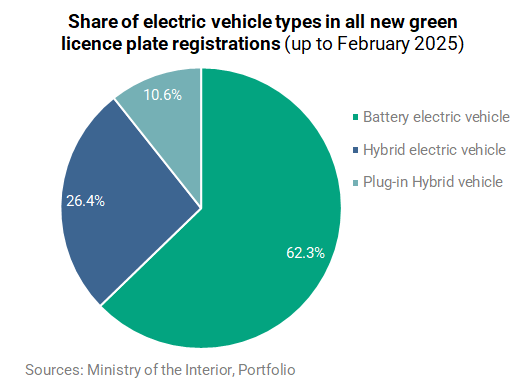
Of BEVs, including passenger cars, trucks, buses, and tractors, there were 74,456 registered in Hungary at the end of February, a nearly 45% annual growth and 9.6 times as many as in January 2020.
The number of HEVs totalled 31.552, up 17.5% yr/yr, while the number of PHEVs shows a 5.8% growth to 12,651. Although the figures shown in graph below represent a wider range of vehicles (as the note in the chart says), passenger cars comprised 93% of BEVs in February.

How popular are the different kind of EVs in Hungary?
Green licence plate registrations took off in the first half of 2022 compared to the H1 2021, then the growth petered out in January-July 2023 only to soar again in the first nine months of last year. The same pattern applies to BEVs, while HEVs showed a more modest but steady growth, and the popularity of PHEVs actually subsided.
Unless one of the ministries or the Central Statistical Office (KSH) decide to publish detailed statistics, i.e. a breakdown of EVs, we will be able to learn about the HEV and PHEV registrations only from the monthly ACEA reports, but those DO NOT include imported (second-hand) vehicles, while the Hungarian green licence plate stats do.
The graphs below show the 'popularity' of the three types of electric vehicles, but the light blue and dark blue columns have essentially become obsolete, unless we use them for comparison up to 2024 when the regulatory changes - excluding HEVs and PHEVs from getting green licence plates - entered into effect on 1 September.


Cover image (for illustration purposes only): Portfolio





