Hungarian government reveals retail margins estimates ahead of price control measures

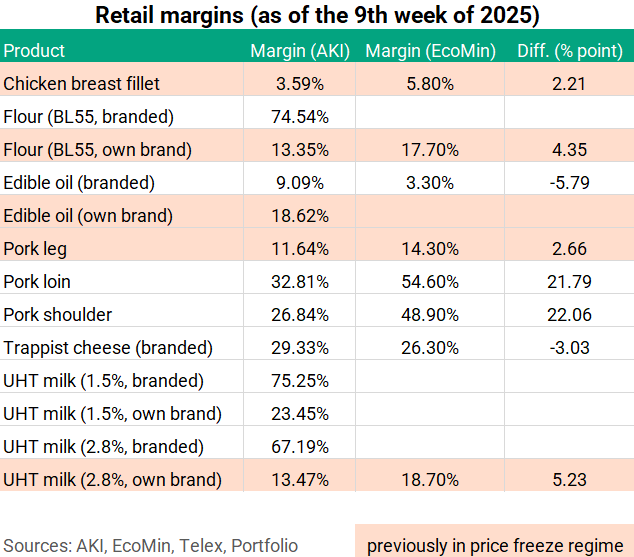
Minister Nagy Marton shared a video on Facebook on Wednesday revealing the government's assumptions about average retail margins for products that will be regulated starting Monday (17 March). The data's origin is unclear, as it differs from publicly available figures from the Research Institute of Agricultural Economics (AKI), which has Hungary's most comprehensive retail margin database.
The discrepancies are notable - for example, the ministry gives a margin of 14.3% for pork leg, while AKI data gives 11.64%, and for chicken breast fillet the ministry gives 5.8%, while AKI gives 3.6%. Sources indicate that neither AKI nor the Central Statistical Office (KSH) maintains an internal database that could be the source of these figures.
The data likely comes from a separate government study, as confirmed by Gergely Gulyás, the PM's chief of staff, at Thursday's press briefing. The methodology remains unknown, including whether smaller stores were included in the survey.
Smaller retailers typically operate with higher margins than large chains, though many will be exempt from the new regulations
as they apply only to businesses with annual revenue exceeding HUF 1 billion.
While the accuracy of the ministry's figures cannot be verified due to lack of accessible data sources, they provide insight into the government's baseline assumptions and expected price reductions.
Márton Nagy expressed optimistic expectations, predicting a 10% price decrease for the 30 designated food categories, leading to a reduction of almost a full percentage point in headline inflation and a two percentage points in food inflation.
Cover image (for illustration purposes only): Getty Images





