A cutthroat war of comments on Hungarian wages - Who is right in the debate?


300-400 laughing emoticons. 200-300 incredulous comments. Letters from readers. A tsunami of questions from friends. That pretty much sums up the impact the monthly KSH earnings release has had on my life.
And although not many people are interested in the consequences of an article, especially when it comes to the consequences for the author of the article, the interest cannot be accidental. That's why once a year we ask the Statistical Office how big the pay gap is.
Most people are generally sceptical about whether average gross earnings are really as high as the stats office claims. A salary of HUF 600,000 to HUF 700,000 may indeed seem surprising. But the reason for the outcry is that the majority of Hungarians earn less than the average wage. KSH sent Portfolio detailed wage data showing that
65.5% of workers took home less than the average gross salary last year.
This can happen because what many people think of as the average wage is actually the median wage. Because at the median, by definition, half the workers get less and half get more. But the average is pulled up by the exceptionally high wages of the top 10-20%. That's why most workers can - and do - feel that their wallets are thinner than the average salary. After all, almost two-thirds of workers are paid less than the average.
It is also worth looking at the size of the earnings gap. According to KSH data,
- the lowest paid workers received a gross monthly salary of HUF 226,000 last year, while
- the highest paid 10% received a gross salary of HUF 1,833,000.
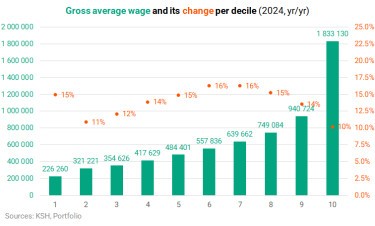
What is a decile?
The earnings decile (or tithe) is an indicator that shows the distribution of earnings by dividing gross wages into equal deciles. The bottom decile includes the 10% of workers who earn the least, while the top decile includes the highest earners.
The average gross wage last year was HUF 647,000, placing it in the 7th income decile, as shown in the graph above. Meanwhile, the median gross wage was HUF 520,000. In other words, the latter is the amount that 50% of employees take home less, while the same percentage of earners take home more.
If we look at the extremes, there is an eightfold difference between the bottom and top income deciles, which seems huge.
However, in the last two years there has been a significant decrease, as in 2022 the top tenth received nine times more than the bottom tenth. This is because the wages of the lowest earners have increased more over the last period. To filter out the extremes, we compare the 9th and 2nd deciles rather than the 10th and 1st deciles, where we see a persistent threefold difference.
As shown in the graph above, the wages of those in the bottom decile increased by 15% in one year, while those in the 10th decile increased by 'only' 10%. The interesting thing about the trend over the last year is that deciles 2 and 3 saw smaller wage increases than decile 1.
This is explained by the fact that while the minimum wage increased by 15% last year, the guaranteed wage minimum increased by only 10%. In other words, the gap between unskilled workers on the lowest wage and skilled workers has narrowed.
However, it is an unusual development that the wages of workers in deciles 4 to 8 are rising faster than those in deciles 2 and 3. Indeed, in a relatively tight labour market environment, the concern to avoid wage congestion only guarantees that the wages of workers at the median wage cannot increase much more slowly than the minimum wage.
The explanation for last year's strange situation is that there were massive wage increases in the public sector (20-30% in some areas, especially education), affecting a wide range of workers between the 4th and 8th deciles. This in turn pushed up average wages in several deciles.
The big question for the next few years will be whether or not the pattern of the past will be repeated. We know that the minimum wage increased by 9% this year and the guaranteed minimum wage by 7%. This means that the gap between unskilled minimum wage earners and skilled workers could continue to narrow.
Some public sector wage increase programmes will also continue, with an impact on median and average wages, while the pace of wage increases in the corporate sector should not abate either. Some business surveys suggest that companies will raise wages only slightly this year, while macroeconomists are forecasting wage increases of more than 8%.
Are small firms not included in the data? Wrong!
For some time, the KSH data publication really only included enterprises with more than 5 employees. For a long time, therefore, the view was that the wage statistics were biased upwards because they did not include businesses that offer the lowest wages. But this has changed. The statistical office has reformed the earnings statistics in 2023. Since then, the monthly releases have included data on the earnings of all full-time employees. In addition, it was found that the average gross wage in previous years was only slightly boosted by the fact that the smallest enterprises were not included.
Cover image (for illustration purposs only): Getty Images





