The end of the good old world - three external headwinds hit CEE


According to the latest research by Oxford Economics, the small, open economies of Central and Eastern Europe (CEE) are struggling against three external headwinds simultaneously:
- stuttering German industry,
- protectionist US trade policy, and
- overcapacity in China's manufacturing sector.
As a result, we have downgraded our growth outlook for the region, with growth becoming increasingly reliant on domestic demand.
Taken together, these factors are weighing heavily on the region's economic prospects. As a result, Oxford Economics' analysts have lowered their forecasts for GDP growth in the region, particularly for the period 2025-2026,
where they now expect growth to be on average 0.7 percentage points lower than six months ago.
Crucially, they expect some of this shortfall to be permanent.
We could suffer long-term damage
In the early 2000s, the CEE countries tailored their growth models to their strengths – technically skilled but cost-competitive labour and a large manufacturing sector. Over time, the CEE became integrated in the European industrial supply chain, typically as suppliers of intermediate inputs. The CEE's large, automotive-heavy manufacturing sectors are closely linked to German industry, supplying almost 25% of the latter's inputs.
The crisis in Europe's largest economy had already started around 2017, when German industrial production peaked. But the true tough times began after the pandemic and continue to this day. The German industrial weakness is partly cyclical – high interest rates have curbed the demand for capital goods.
The current situation is partly due to cyclical factors (such as the decline in investment due to high interest rates), but is also exacerbated by structural problems. These include high energy prices, labour shortages, regulatory burdens and the encroachment of Chinese competitors. All of these are having a significant negative impact on the region.
The Czech Republic is the most closely linked CEE country to Germany and, as a result, has suffered the most from Germany's weakness, particularly in the automotive sector. But this also applies to Hungary, Slovakia, and Romania, albeit to a slightly lesser extent. Poland, meanwhile, benefits from a more diversified manufacturing sector and lower reliance on Germany as an input supplier, in part explaining its outperformance among the CEE in recent years.
So the good old world, the export-led economic model based on German industry, is becoming less and less viable.
A potential trade war between the United States and the European Union is another risk. Oxford Economics' baseline scenario assumes 10% across-the-board tariffs between the EU and the US from the second quarter of 2025. Although the Trump administration is currently talking about tariffs of 20-25%, the President is rapidly changing his previous measures and the 10% level seems a real possibility, as it would not yet cause a drastic shock to US supply chains that rely on EU suppliers.
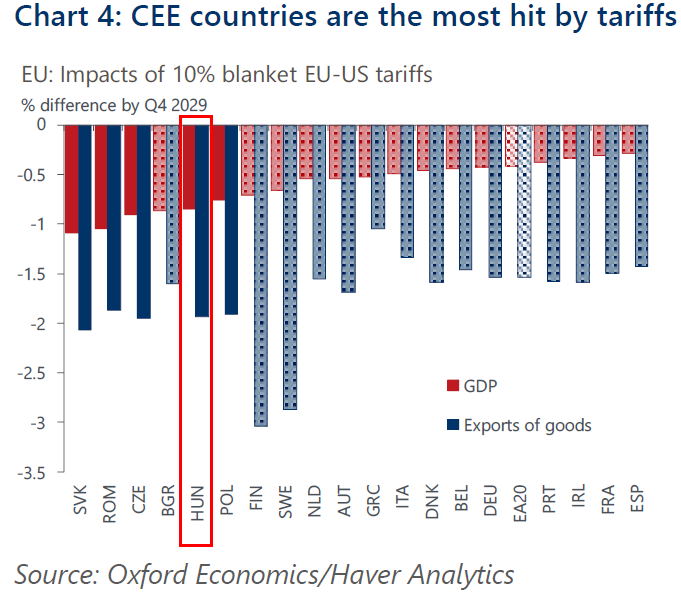
The 10% tariff is also projected to hit CEE countries particularly hard,
with GDP and exports in the region expected to fall by around twice the eurozone average.
The impact could also be significant for Hungary, which has an export-oriented economy and a high share of industry, the report says. Prior to Trump's election, Oxford Economics had forecast Hungarian growth of 3.2% by 2025, but this was cut to 1.5% due to the threat of tariffs.
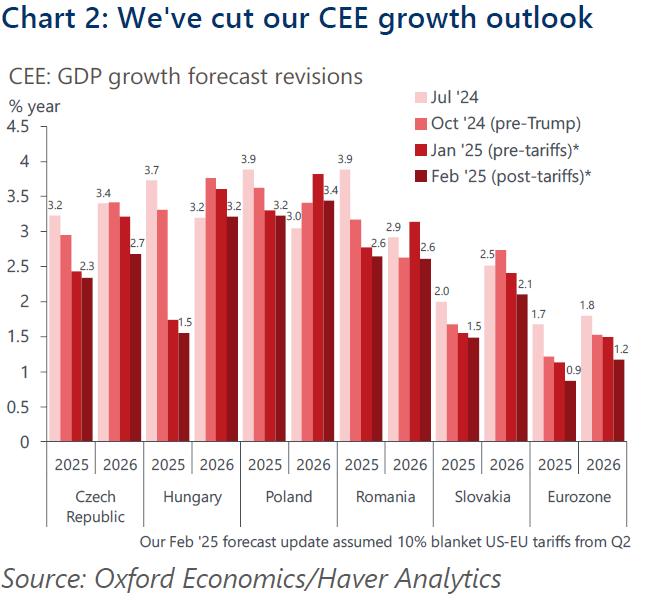
Poland is an exception: it has less trade exposure to the US, which mitigates the expected negative impact: the growth forecast has been lowered to 3.2% from 3.9%.
Central and Eastern Europe may also be concerned about the possibility of a slowdown in economic performance until the end of 2029, i.e. in the longer term.
Hungary would be one of the biggest losers, with exports falling by 2% and growth by almost 1%.
But even if the EU manages to cut a deal with the US to avoid or limit the imposition of tariffs, there will be an economic cost.
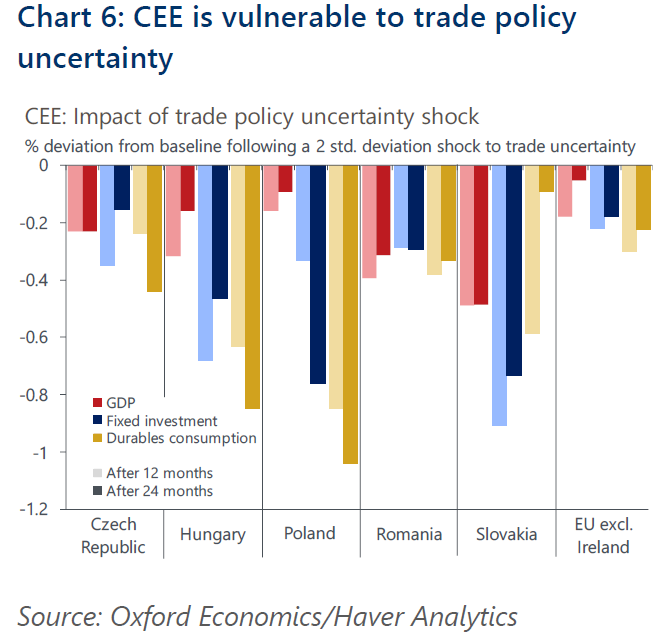
Oxford Economics estimates the increased trade policy uncertainty will have a negative impact on activity regardless of whether the tariffs are ultimately imposed or not. The current rise in uncertainty will lower GDP by around 0.4% in the next 12 months, twice the EU average. Primarily, lower investment and durables consumption will drive this.
They also warned that developments in China pose an indirect but potentially severe threat. China's manufacturing sector is producing at overcapacity (often subsidised) due to weak domestic demand. EU firms are already struggling to compete.
If the US-China trade war intensifies, China will look for new export markets, ramping up the competition for CEE manufacturers.
In some sectors, the authorities subsidise the overcapacity with the clear target of claiming larger market share – this is the case for the 'new three' industries in China (batteries, electric vehicles – EVs – and solar panels), as well as for steel and other metals. The combination of excess capacity and state subsidies means that Chinese firms can sell at prices European firms struggle to compete with.
Restrictions on access to the US market would only intensify this competition, likely leading to the EU imposing tariffs on Chinese imports, as we've seen in the past year with levies on Chinese EVs.
But even if the US doesn't ramp up protectionist measures against China to progress decoupling,
China is set to become an ever-more important factor for the CEE.
Chinese firms no longer confine themselves to cheap, simple products in a select set of segments such as apparel, furniture, and consumer electronics. They are increasingly able to compete with sophisticated products from EU firms, not just in export markets but also in Europe.
The number of categories in which China has a comparative advantage has risen over the past two decades.
In the EU, that number has mostly stagnated; however, crucially, the overlap of categories with China has increased, highlighting the stiffer competition.
The picture is slightly different for the CEE, but the established trends apply here as well. The Czech Republic's and Poland's overlap with China has increased modestly, but while Poland has been able to increase the number of products where it has a comparative advantage, this number has shrunk for the Czech Republic.
A solution many have proposed is for the CEE economies to shift up the value chain from intermediate inputs to higher value-added production. This would limit their reliance on the German economy and move production to areas where China is mostly not yet able to compete.
Moreover, although high value-added products aren't exempt from tariffs, a shift up the value chain would raise wages and thus help boost domestic demand, curbing dependence on exports. But such a shift is easier said than done.
In fact,
over the past five years, manufacturing volumes in the CEE economies have outperformed value added, meaning that the sector has actually moved down the value chain.
This is true both for Romania, where output volumes and gross value added (GVA) have fallen, and for Poland, where production volumes have soared but value added has grown at a much more modest pace. This highlights the difficulty of trying to move up the value chain.
This requires significant investment in education, R&D and infrastructure, and for the authorities to reduce regulatory burdens (such as planning-permission times) create incentives for private investment.
This, however, is not sufficiently supported by current public policies and institutional constraints.
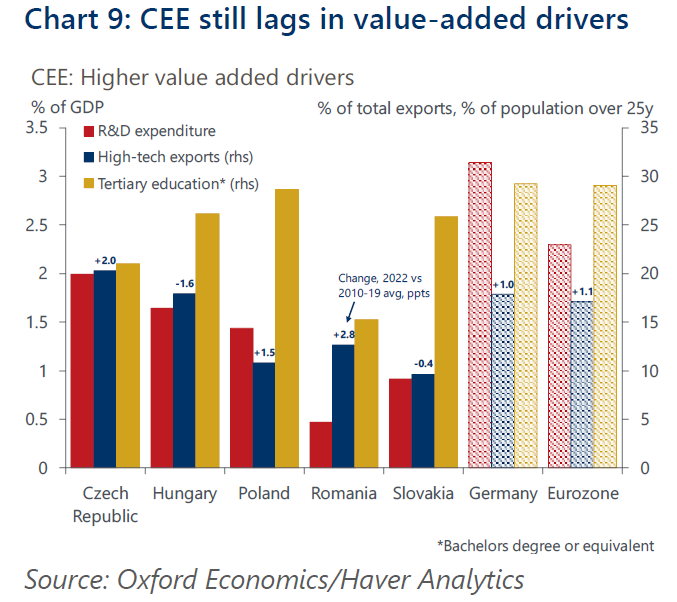
Oxford Economics pointed out that the CEE's record on all of this has been mixed in recent years. And there are other structural headwinds – for example, obsolete, carbon-intensive energy sectors will keep energy costs elevated and limit ESG compliance, stifling FDI inflows.
Moreover, growing pressure to increase defence spending in the current uncertain geopolitical environment will only add to the competing demands on already-strained public budgets. This ties into a fourth external threat – the outcome of the Russia-Ukraine conflict.
Overall, the CEE outlook has worsened in recent months, even relative to that of other EM regions.
- Within the region, they think Poland is best-placed given its growth momentum, lower exposure to the three external headwinds we have discussed in this report, and active fiscal policies.
- Hungary and Slovakia are held back primarily by their political fragility and eroding institutional quality, which translate into weak investment, harming future growth.
- The Czech Republic has perhaps the best potential to climb up the value chain, but far-reaching reforms to bolster higher value-added drivers – education, R&D spending and infrastructure – are needed to fulfil that.
- And, as Romania shows, wide deficits are not a panacea.
Cover image (for illustration purposes only): Getty Images





